The strength and intensity with which Aldo Franco speaks are overwhelming. This man, a Malvinas veteran, social responsibility activist, rugby player and father, is the benchmark for the new paradigm of the Argentine businessman. In 2018, he seems to be fulfilling his dream: the Mercedes Logistics System. In constant evolution, Aldo Franco, without artifice or posturing, is ready to have a sincere and natural talk with Aduana News about the logistics system that is betting on the future.
Question: What is the Mercedes Logistics System?
Answer: The Mercedes Logistics System is a concept that we want to use to boost sales for producers and to achieve economic development in the region. We have established a logistics zone on Route 5 that starts in Mercedes, in the province of Buenos Aires, and ends in Santa Rosa, La Pampa. It is an unprecedented project because it links two provinces. A truck can travel along this corridor 5 in one day, that is, it can go and come back, visiting several cities in the interior. The initiative is called “From Route 5 to the world” because in Mercedes we have a bonded warehouse from which everything produced in Corridor 5 can be exported and imported. It is an area that covers 500 km along the route. There are 12 cities, 500000 inhabitants, 64 towns in the area of influence. It also includes a provincial capital, Santa Rosa (La Pampa), and has two logistics nodes at both ends of the corridor.
Question: What is the vision of the Mercedes Logistics System?
Answer: The vision is to create a transformative system that allows the development of the Corridor 5 region and, based on this, to build both a logistics highway and a technological highway so that small producers can communicate. We detected that a producer of dulce de leche from Mercedes does not sell to Chivilcoy, which is 70 kilometers away. Why? He does not sell because of the high logistics costs. For this reason, in the first stage we tried to build a logistics corridor so that he can transport the merchandise at a low cost and thus produce and sell more inside and outside the region. If this happens, the producer will need more labor, there will be an economic spillover for the region. In a second stage, a technological platform will be built so that the producer can upload his products and others will find out that he is selling dulce de leche.
Today, from my home, I can buy in China and sell in Jujuy. I set up the logistics highway so that any product can be uploaded. Why? Because the quantities are changing. Before, there were five sellers and a truck that carried it. Now I have one seller with an app and five people who carry it. We have to lower transportation costs so that more can be sold and produced. It ends up being a concept of economic spillover. We businessmen have to provide the conditions so that the producer can do it. We are calculating to lower logistics costs by 25, 30 percent if we coordinate trips, in addition to concentrating the merchandise in one place so that it is distributed evenly. Our idea is that the benefits of this logistics system will become economic development for the region.
Question: What benefits does Mercedes offer to ensure the logistics system?
Answer: Mercedes has this logistics park, where we have been located for 6 years. It has 29 thousand square meters and a bonded warehouse, which is a work unit from where imports and exports can be made. Mercedes is a gateway to the world: the idea is for the region to grow. Regional products could also be exported or imported. We want there to be no intermediaries, for example, between a tomato producer from Cuyo and a grocer from Suipacha. Mercedes is a strategic distribution point and is equidistant from the three ports: Buenos Aires, La Plata and Zárate – Campana.
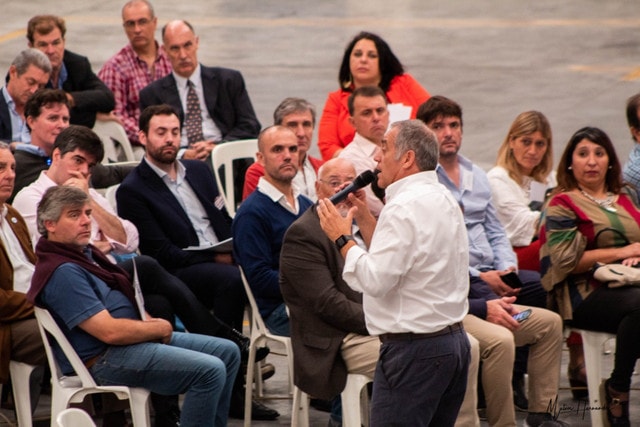
Question: An Entrepreneur with social responsibility, how did it come about?
Answer: This logistics company is 24 years old and has been working with supermarket chains for 14 years. We know the ins and outs of supermarkets and department stores. What do we believe? That logistics, to be efficient and cheap, must be regional. There is national logistics from Salta to Tierra del Fuego: it makes no sense.
Question: How many people do you employ?
Answer: At this moment, 1600 people. There are 150 in Mercedes and the rest in Greater Buenos Aires, Córdoba, Tucumán and Mendoza.
Question: How did the idea of reinventing yourself come about?
Answer: I want to clarify that there has never been a logistics concept in our country. When we talk about logistics, we talk about trucks; but logistics is the coordination of everything, the capacity to store and distribute. Logistics has been transformed in the last 20 years. Currently the center of gravity of the work is in the warehouse and not in the sale. Today a company has a website, so the volume of online sales forces us to double the distribution capacity. We must transform logistics to increase the sales of small producers. But it deserves to be done at a regional level.
Question: What prompted you to take this leap?
Answer: As a businessman, I have the responsibility to do something for my region and my country; this initiative ends up being a social economic development. We must promote work. A country as rich as ours needs systems like this to transform it. I am encouraged that the technology, the technological platform, is designed for my children. What models encourage me? In the 60s, companies like Rigolleau or Aceros Bragado developed neighborhoods, hospitals, schools for the region. These businessmen had the capacity to make a social impact from the company. We lock ourselves in selfishness, we want everything for the company and we do not realize that if the employees are well, that economic impact comes back.
Question: Who inspired him?
Answer: I am an entrepreneur. Naturally, I am an entrepreneur. I had the opportunity to give my life for the country at the age of 20, I took on what service is, I understood why people went to war. So, I cannot allow there to be hunger in my city. We entrepreneurs must provide work and not wait for the State to provide it. We must leave a mark.
Question: What would you do to make people better?
Answer: We have just hired forty young people between 18 and 25 years old for three months to do a private job. In addition, there are 5 people aged 58 who had just become unemployed. On the other hand, we are looking for clients who can give us work for these people. This was done through an agreement with the Ministry of Production of La Pampa. The idea is to train people: it is more interesting to teach them how to fish than to give them the fish… We have 6 interns from the industrial school of Mercedes every year. Today we have two students from the industrial school and two students of Foreign Trade from the University of Luján working. We also give courses in the logistics park.
Question: What initiatives does PLM have for sustainable development?
Answer: We comply with the regulations; we also recycle the pallets. We provide the waste pallets to the municipality so that they can recycle them in the social carpentry workshop, which produces tables, baskets, and boxes to sell.
Question: How is the link between PLM and Customs?
Answer: The PLM depends on the Campana Customs Office. The ease with which Customs works is impressive. We have a very good relationship, we really feel the support of Customs, which provides a permanent solution with the necessary controls so that exports can be made.
Question: What were the most relevant PLM exports in 2018?
Answer: This year we exported a lot of citrus. Now, we are working on honey. We also export fertilizer, the result of a transformation process of peat from Tierra del Fuego and Canada, to give a special blend to tobacco from the United States and Mexico. In addition, we sell wood from Misiones and Salta to China and Taiwan. Argentina is the second largest exporter of honey, the first exporter of candied sunflower, and the second largest exporter of popcorn. In terms of imports, the PLM is bringing in household appliances as well as gearboxes. The PLM's bonded warehouse, opened in March of this year, is based on the latest technology.
Question: How is the initiative and PLM funded?
Answer: The Ruta 5 Corridor and the PLM are financed with loans from Banco Provincia, Galicia and Banco La Pampa. The PLM is Argentine logistics that is financed with Argentine capital, uses Argentine labor, produces for Argentina, exports to Argentina and the economy remains in Argentina.
***
Aldo Franco's profile (60 years)
*Father of 5 children
*Malvinas Veteran
*Studies: Bachelor's degree in Systems with Postgraduate studies
*Hobby: family and sport
*Dream: “To give back to society in action what society gives to us.”

Aduana News foi o primeiro jornal aduaneiro da Argentina a lançar sua versão digital. Com mais de 20 anos de trajetória, suas publicações e iniciativas têm como objetivo oferecer o conhecimento mais relevante sobre temas aduaneiros, contribuindo para a promoção do comércio seguro e da facilitação do comércio na região.