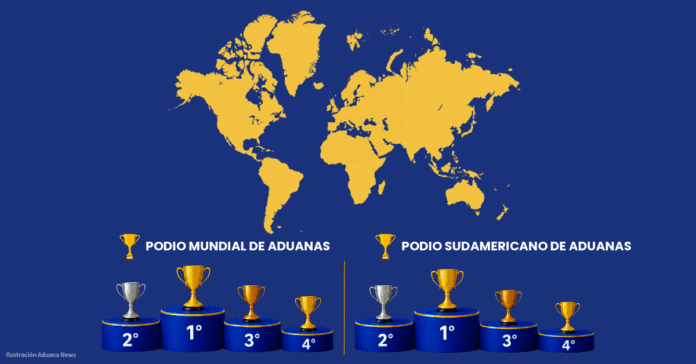
Every four years, the world stops to watch the World Cup. National teams compete to lift the trophy and prove who is the best on the pitch. But if, instead of footballers, the world's customs offices competed, who would be the champion? Which countries would reach the semifinals? And which South American customs office would be the highest-ranked?
Although it may seem like a curious question, there are international indicators that allow us to answer it with considerable accuracy. One of them is the Logistics Performance Index (LPI-IDL) Prepared by the World Bank, which analyzes different components of countries' logistics competitiveness, including the efficiency of customs and border processes.
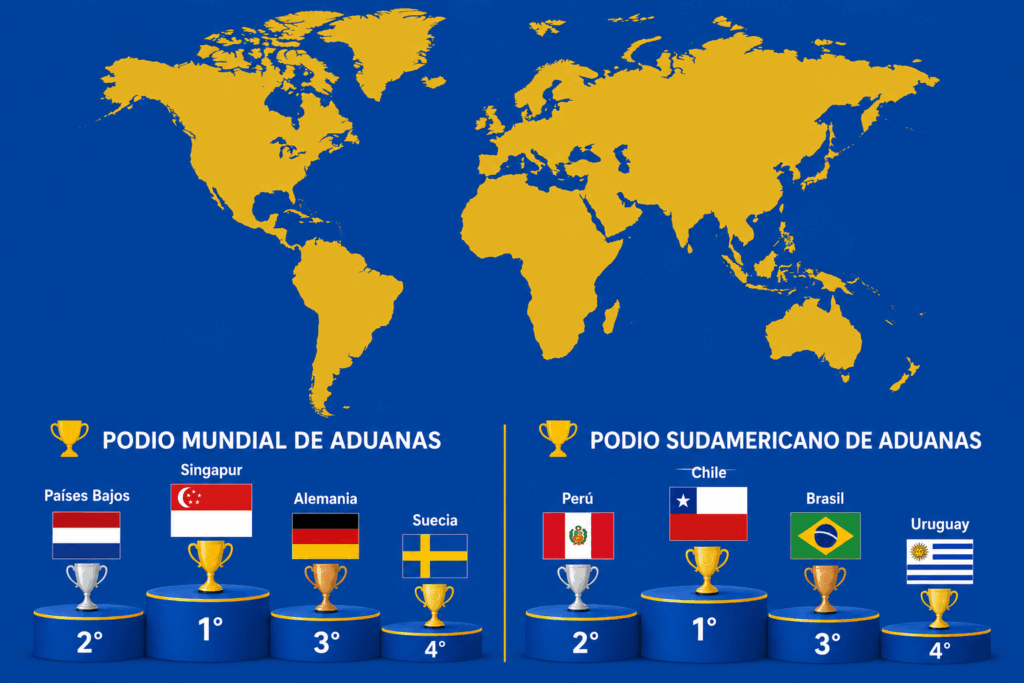
In this hypothetical World Customs Championship, the top contenders for the title would be Singapore, the Netherlands, Germany, Sweden, Denmark, and Finland. These customs administrations are characterized by strong digitalization, advanced risk management systems, intensive use of advance information, and efficient coordination with other agencies involved in foreign trade.
If I had to choose a champion, Singapore would probably lift the cup. Its customs system is considered one of the most efficient in the world. A large part of the operations are processed electronically, clearance times are minimal, and there is complete integration between government agencies and private operators. The prevailing concept is not to control more, but to control better. Singapore is small in size but is the 14th largest exporter globally.
The Netherlands would be a serious competitor. The Port of Rotterdam, Europe's largest gateway for goods, operates under facilitation standards that have made Dutch customs a global benchmark. Germany would also rank highly thanks to its combination of technology, predictability, and strong integration between logistics and the export industry. It is the world's fourth-largest exporter, behind only China, the US, and Germany.
The United States would likely reach the quarterfinals or semifinals. Its strength lies in its security programs, advance intelligence, and risk analysis. U.S. Customs possesses enormous technological and intelligence capabilities, although in some aspects related to trade facilitation it often lags behind European and Asian leaders.
And what about South America? In this hypothetical tournament, the best representative would be Chile. For years, the Andean nation has stood out for the modernization of its customs processes, the digitization of procedures, the use of one-stop shops, and a consistent policy of international integration. Its extensive network of trade agreements has also fostered a culture of trade facilitation, which is reflected in its border agencies.
Peru could compete for the championship, although logistically the IDL still penalizes for infrastructure or transport.
In the specific area of Customs, the evolution of Peruvian customs has been very important thanks to the modernization of SUNAT:
- Mass implementation of risk management.
- Advance dispatch.
- Authorized Economic Operator.
- Document digitization.
- Port-airport-border integration.
- Strong alignment with WCO standards.
- Customs digital transformation program.
Brazil and Uruguay could vie for third place. Brazil's economic size, the professionalization of its Federal Revenue Service (Receita Federal), and recent investments in digitalization would allow it to compete for top regional positions. However, the complexity of some procedures and the size of its administrative structure often create greater operational challenges. Uruguay, meanwhile, is also expected to perform well. Despite its smaller size, it has developed a highly efficient strategy in foreign trade, logistics, and its single window system, becoming a regional leader in various trade facilitation processes.
International experience shows that the best customs administrations are not those that carry out the most controls, but rather those that are best able to identify risks while facilitating legitimate trade. The challenge for modern administrations lies in finding that delicate balance between control and facilitation.
If customs officials played in a World Cup, Singapore would probably be the champion. In South America, Chile or Peru could lift the trophy and have a chance at winning the regional cup. But the real lesson is something else: in modern international trade, the winner isn't the one who seizes the most goods, but the one who ensures that legitimate transactions flow more quickly, safely, and efficiently.
A country's competitiveness is also measured at its borders.

The author is a Specialist in International Trade and holds a Master's degree in Tax Administration and Public Finance, with a solid academic background and extensive experience in foreign trade and customs policies. He teaches at the National University of Córdoba (UNC) and the Catholic University of Córdoba (UCC), where he lectures on courses related to international trade and trade facilitation. He is also an accredited expert of the World Customs Organization (WCO) and a specialist in trade facilitation.