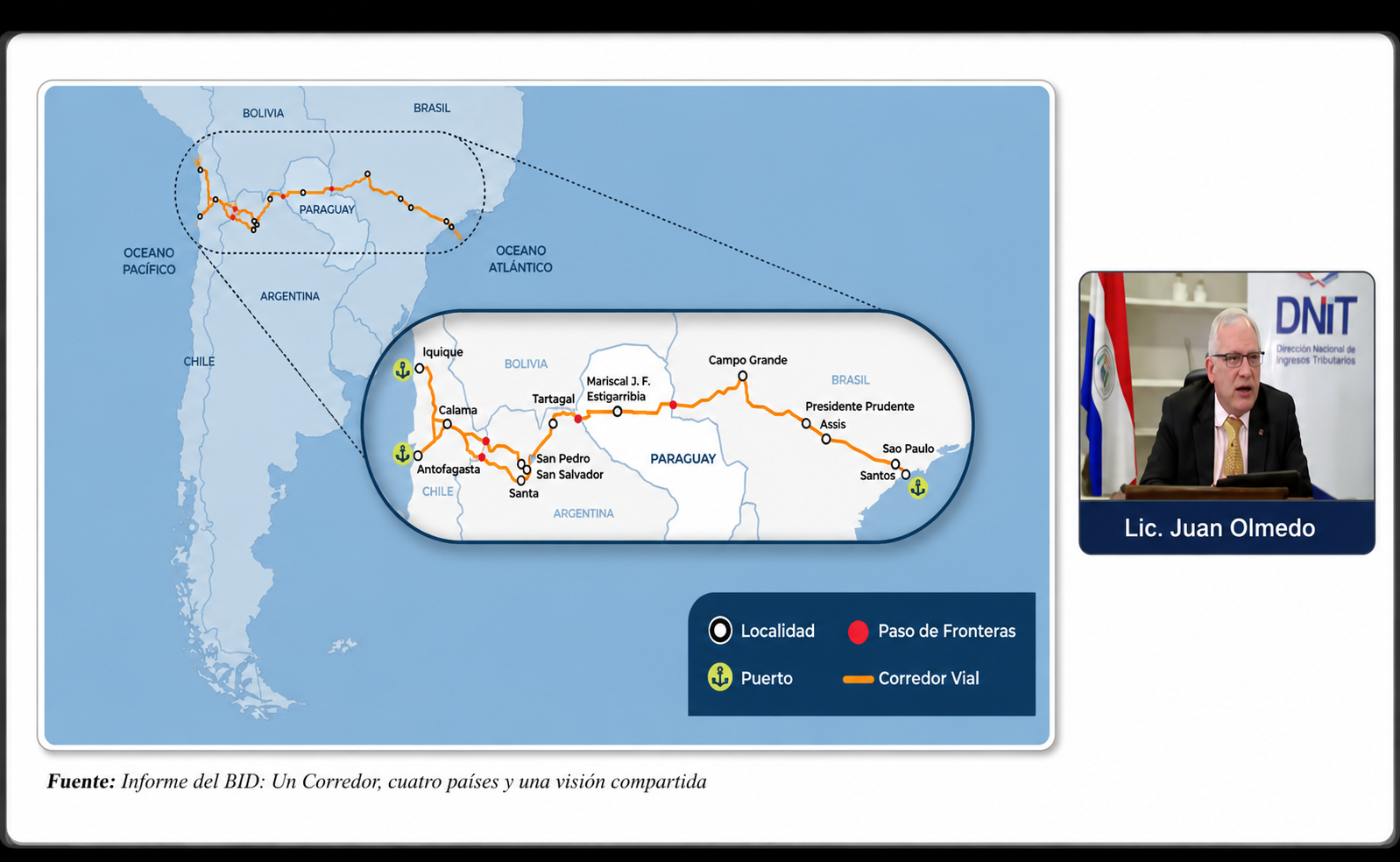

While the works that promise to transform the South American logistics map are progressing, Paraguay is working on another less visible, but equally crucial challenge: building the necessary institutional capacities so that this infrastructure translates into greater competitiveness.
The opening of new highways, bridges, and border crossings linked to the Capricorn Bi-Oceanic Corridor—as shown on the cover, which connects Brazil's Atlantic coast with the ports of northern Chile via Paraguay and northern Argentina—represents a strategic opportunity for the country. As a landlocked nation in South America, its competitiveness depends heavily on having efficient connections that facilitate access to international markets.
However, Paraguayan authorities maintain that physical infrastructure alone is not enough. Bridges and border crossings must be accompanied by new management models, greater inter-institutional coordination, and technological tools that allow these investments to be fully utilized.
This need had already been pointed out in Studies on trade facilitation and cross-border processes carried out within the framework of the Regional Master Plan for Integration and Development of the Capricorn Bioceanic Corridor, who identified opportunities for improvement in operational, regulatory, human resources and institutional matters.
It was precisely on this premise that the seminar organized by Procomex, in which Mikael Larsson, specialist from the Inter-American Development Bank (IDB), and Juan Olmedo, Customs Manager of the National Directorate of Tax Revenue (DNIT)They analyzed the Paraguayan experience in building management institutions in parallel with the development of border infrastructure.
Aduana NewsAs the media outlet that covered the event, we present below some of the main interventions from the meeting, selected for their relevance in terms of public policy.
More efficient borders
During his speech, Mikael Larsson pointed out that Latin American borders continue to operate, in many cases, under fragmented schemes, where different government agencies act independently, with poorly integrated procedures and systems.
This situation leads to duplicate controls, longer waiting times, and additional costs for trade. According to IDB estimates, inefficiencies at border crossings can represent between 4% and 12% of the value of the goodsThis significant impact translates directly into higher costs for the private sector. Furthermore, the average border crossing time in Latin America and the Caribbean reaches approximately [number of days]. 55 hours long.This figure is significantly higher than international standards. In comparison, Europe records average crossing times of between 10 and 12 hours, and in some countries, crossings can be resolved in less than an hour. This gap demonstrates a structural loss of competitiveness for the region.
Given this scenario, the IDB specialist highlighted the importance of moving towards coordinated border management models that allow for increased efficiency of controls and improved competitiveness of economies.
“Modernization is not just about building infrastructure. It also involves working on processes, technology, institutional capacity, and change management,” he explained.
Larsson identified five conditions necessary to advance this transformation: an adequate regulatory framework, strengthened institutions, functional infrastructure, technological solutions, and the capacity to manage organizational changes.
Regional experiences
The specialist reviewed experiences promoted by the IDB in Central Americawhere the modernization of border crossings significantly reduced dispatch times and increased operational capacity.
On case of ParaguayHe emphasized that the multilateral organization is supporting the organization. three lines of action complementary. The first is aimed at institutional strengthening, in particular at the creation of the National Directorate of Tax Revenue (DNIT)This integration, established by Law No. 7.143/2023, unified the Undersecretariat of State for Taxation (SET) and the National Customs Directorate. This integration has strengthened cross-border control, improved risk management, consolidated mandatory digital customs clearance, and optimized the efficiency and traceability of processes.
The second one seeks to promote the exports and attract investment, incorporating a specific component of coordinated border management. The third seeks to strengthen the international integration of Paraguayan companies.
One of the most important projects is the implementation of the management model for the Bridge of Integration, which connects Presidente Franco (Paraguay) with Foz do Iguaçu (Brazil). Projections indicate that the initiative could reduce export times by approximately half and decrease import times from about 60 hours to around 23 hours.
Change management
In turn, Juan Olmedo stated that Paraguay is developing various projects related to the Bioceanic Corridor and the upcoming opening of new border crossings, but stressed that the physical works constitute only one of the necessary components.
“Infrastructure is only one part. We also need technology, processes, and, above all, change management. There needs to be an institutional approach that allows us to transform those investments into concrete results,” he stated.
The Customs manager explained that DNIT works on four axes: specific diagnoses for each border, design of solutions adapted to each reality, strengthening of capacities and development of regulatory frameworks accompanied by implementation plans.
He pointed out that the immediate challenge is the commissioning of the Integration Bridge with Brazil, while the major strategic challenge is the Capricorn Bioceanic Corridor.
Smart control
To that end, Olmedo stated that Paraguayan Customs is seeking to evolve from a scheme based primarily on physical controls to a model based on intelligence and risk management.
“Control will remain important, but it must be more efficient and more effective. Our goal is to move towards smart control,” he explained.
In that regard, he emphasized that the exchange of information between the various agencies operating at the border will allow for the development of more accurate risk profiles and the reduction of unnecessary controls.
He also noted that non-intrusive inspection systems and scanners are fundamental tools, although he cautioned that it is not efficient to control 100% of operations.
"Scanners should be part of a comprehensive strategy based on risk management."
Interoperability with Brazil
Another aspect highlighted by Olmedo was the joint work with Brazil to advance the interoperability of computer systems and the exchange of information with Siscomex.
Furthermore, he emphasized the importance of the Authorized Economic Operator (AEO) program, conceived as a key tool for granting benefits to trusted operators and strengthening the security of the logistics chain, in line with the standards promoted by the World Customs Organization. He noted that there are regional agreements for mutual recognition of AEOs and trade facilitation with countries in Central America and the Pacific Alliance, although many of these agreements have not yet achieved full and effective implementation.
Along these lines, he emphasized that operational agreements—such as coordinated schedules, joint control mechanisms, and mutual recognition—need to move from formal regulations to real and sustained implementation. He also stressed the need to establish minimum verification standards, with non-intrusive scanning as the technological foundation at border crossings, to avoid bottlenecks and optimize international trade operations.
Institutionalize the transformations
In conclusion, the Customs Manager of the DNIT maintained that the real challenge lies not only in the execution of projects or in the incorporation of technology, but in ensuring that the new practices become established as permanent policies.
“All of this can remain in documents or presentations. Change happens when people take ownership of the processes and institutions manage to sustain them over time,” he noted.
In that regard, he emphasized that Paraguay's objective is to move towards a coordinated border management that transcends administrations and is consolidated as a State policy, within the framework of Mercosur and the Capricorn Bioceanic Corridor.
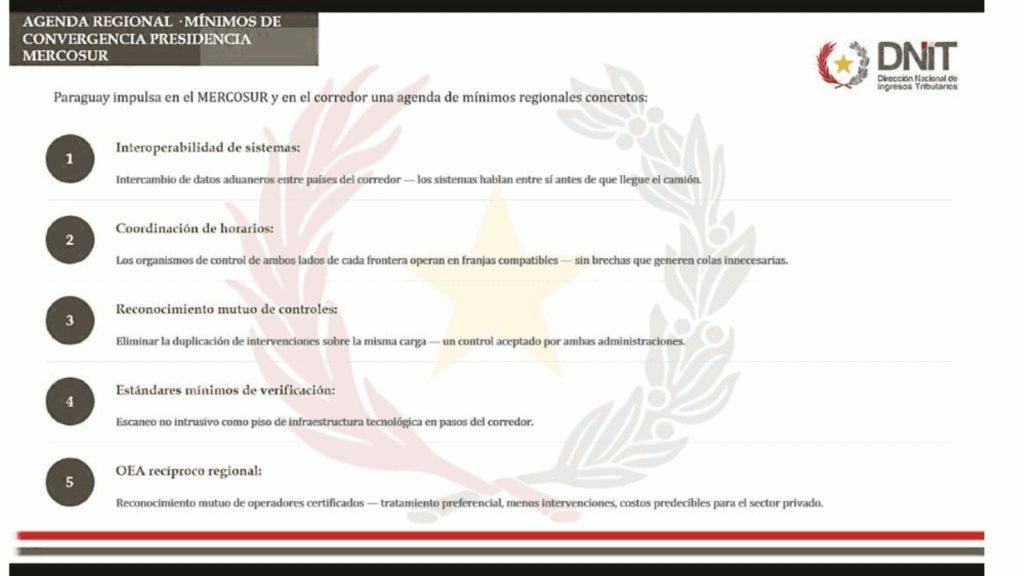
He also highlighted the need to establish regional convergence minimumsWithin the framework of Paraguay's pro tempore presidency of Mercosur during the first half of 2026, the goals are to transform integration into concrete results. Among these, he mentioned the interoperability of the customs systems—so that the exchange of data between countries in the corridor allows for information to be shared before the truck arrives—, the schedule coordination between the control agencies on both sides of the border and the remutual knowledge of controls to avoid duplications.
Added to this are minimum verification standards, such as the incorporation of non-intrusive scanning as a technological basis at border crossings along the corridor, and the promotion of schemes for Authorized Economic Operator (AEO) with reciprocal recognition at the regional level.
“Good practices must be institutionalized. That is the great challenge and, at the same time, the great opportunity offered by the Capricorn Bioceanic Corridor,” he concluded.

Aduana News foi o primeiro jornal aduaneiro da Argentina a lançar sua versão digital. Com mais de 20 anos de trajetória, suas publicações e iniciativas têm como objetivo oferecer o conhecimento mais relevante sobre temas aduaneiros, contribuindo para a promoção do comércio seguro e da facilitação do comércio na região.