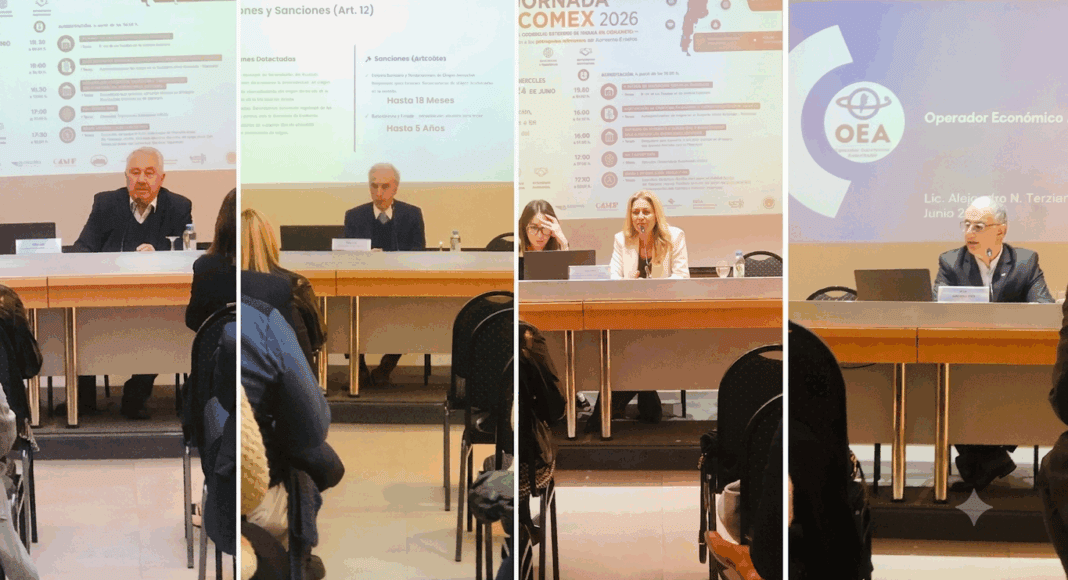

The second day of the Comex Conference (June 24, 2026) featured an agenda focused on three key areas: logistics, traceability, and trust, within a context of foreign trade transformation that combines operational facilitation with stricter compliance requirements. private sectorIn that context, the main actors in the debate were bonded warehouses, associations, business chambers, and banks.
Miguel Pascucci, representative of the Chamber of Private Fiscal Deposits (CADEFIP) highlighted the role of bonded warehouses as “a key tool for improving foreign trade operations and providing concrete solutions to importers and exporters.” Along these lines, it maintained that these facilities, authorized by Customs (ARCA) for the safekeeping of merchandise, have become a central player in logistics, working in conjunction with Customs and other agencies, by optimizing cargo management, improving predictability, and offering financial alternatives through partial withdrawals and extended storage periods.
However, he warned about “regulatory restrictions that hinder daily operations” and proposed making the staggered withdrawal of goods more flexible without affecting customs control. He also questioned the costs and delays associated with waiting in line at port terminals, noting that bonded warehouses act as a “logistical buffer” for the system.
Regarding exports, he called for simplifying procedures he considered excessively rigid and emphasized that “a bonded warehouse is now a highly controlled and secure facility.” In closing, he maintained that the challenge is to reconcile control and facilitation: “bonded warehouses want to be allies of customs brokers, importers, exporters, and freight forwarders.”
MERCOSUR and the European Union
Within the framework of the transformations of foreign trade, the Trade Agreement between MERCOSUR and the European Union —in provisional application since May 1, 2026— was another of the key topics of the day.
El Dr. Carlos Lacano, member of ADACEHe referred to one of his main innovations: the system of self-certification of origin by the exporter. He noted that the agreement is the result of more than two decades of negotiation and that its implementation introduces a structural change in operations.
“The certification of origin is no longer in the hands of authorized entities but is now transferred to the exporter himself,” he explained, noting that the declaration can be incorporated directly into the commercial invoice or other equivalent documents.
He cautioned, however, that this simplification implies greater corporate responsibility. In Argentina, the process will be channeled through the TAD system, with requirements for detailed information, digital signatures, and document retention for at least three years. He also emphasized the importance of traceability, as exporters must be able to demonstrate compliance with the rules of origin at all times. In the event of verification by European authorities, response times will be limited, and non-compliance could result in sanctions, including disqualifications of up to five years.
Lacano made it clear that, while the scheme simplifies processes, its success will depend on the level of professionalization of the companies and their capacity for document and information management.
The most complex part of implementing the Interim Trade Agreement between MERCOSUR and the European Union is related to compliance with the requirements for accessing the European market. At this point, the economist Ana Basco, representative of the Chamber of Commerce, Industry and Production of the Argentine Republic (CACIPRA)He analyzed, before customs brokers and operators, the main challenges that exporting companies will face.
With a long track record at the IDB, Basco highlighted that the agreement is part of a process of deep integration between two regions that represent more than 20% of global GDP, although with mainly sectoral rather than macroeconomic impacts.
In that regard, he warned that tariff reduction is only one part of the process, since the main barriers are concentrated in sanitary and phytosanitary requirements, technical standards, labeling, rules of origin, and environmental and labor requirements.
In particular, he mentioned the impact of the European Green Deal, carbon border adjustments, and anti-deforestation regulations, which will require full traceability of product origin. He emphasized that “companies will have to assess not only the tariff, but also the cost of complying with all these regulatory requirements,” and stressed the need for collaboration between the public and private sectors for companies to effectively benefit from the agreement.
The MERCOSUR-EU Agreement, in its chapter on trade facilitation, also recognizes the figure of the Authorized Economic Operator (OEA), a tool focused on the security of the logistics chain and the comprehensive management of goods, promoting greater coordination between customs and companies.
The Authorized Economic Operator (AEO) program in Argentina has a specific national program. Its implementation presents operational challenges, although it has been highlighted as a central tool for competitiveness within the framework of the agreement.
“We are in a VUCA environment, highly regulated and with a variety of stakeholders,” he noted at the beginning. Alejandro Tersian, from ICC Argentina, by contextualizing the scope of the scheme.
In her presentation, she outlined the background of the Authorized Economic Operator (AEO) program and its connection to international standards established after the September 11 attacks in the United States, which led to the CTPAT program and the World Customs Organization's SAFE Framework. She explained that the AEO program emerged as a response to the need to balance security and trade facilitation, and that its development is also aligned with the Trade Facilitation Agreement.
He also highlighted the use of WCO tools and noted that the national AEO program in Argentina is regulated by current regulations (RG 5107/2021), under a scheme of compliance, simplification and security, where the role of the customs broker is also integrated within a voluntary model based on trust that recognizes operators with high standards of customs, tax, financial and operational compliance.
Tersian emphasized that its core value lies in building trust between businesses and customs authorities, which allows for reduced controls, improved predictability, and optimized logistics costs. After detailing the qualitative and quantitative benefits and their application to SMEs, he concluded by noting that trust is becoming a true competitive advantage in global trade, especially in contexts of increased regulatory demands.
The second day of the Comex Conference thus highlighted the need to move towards greater logistical efficiency and trade openness, in a scenario of increasing demands in terms of traceability, control and compliance.

Aduana News foi o primeiro jornal aduaneiro da Argentina a lançar sua versão digital. Com mais de 20 anos de trajetória, suas publicações e iniciativas têm como objetivo oferecer o conhecimento mais relevante sobre temas aduaneiros, contribuindo para a promoção do comércio seguro e da facilitação do comércio na região.