Panama and Costa Rica held a series of bilateral meetings this week (February 7-10, 2022) to advance the modernization of their land border posts. This objective, consistent with the efforts made by Central American countries to deepen their regional integration process, will strengthen competitiveness according to the Panamanian customs administration's statement.
To this end, Costa Rica has the Border Integration Program (PIF), while Panama has the Customs Logistics Integration Program (PILA) led by the National Customs Authority.
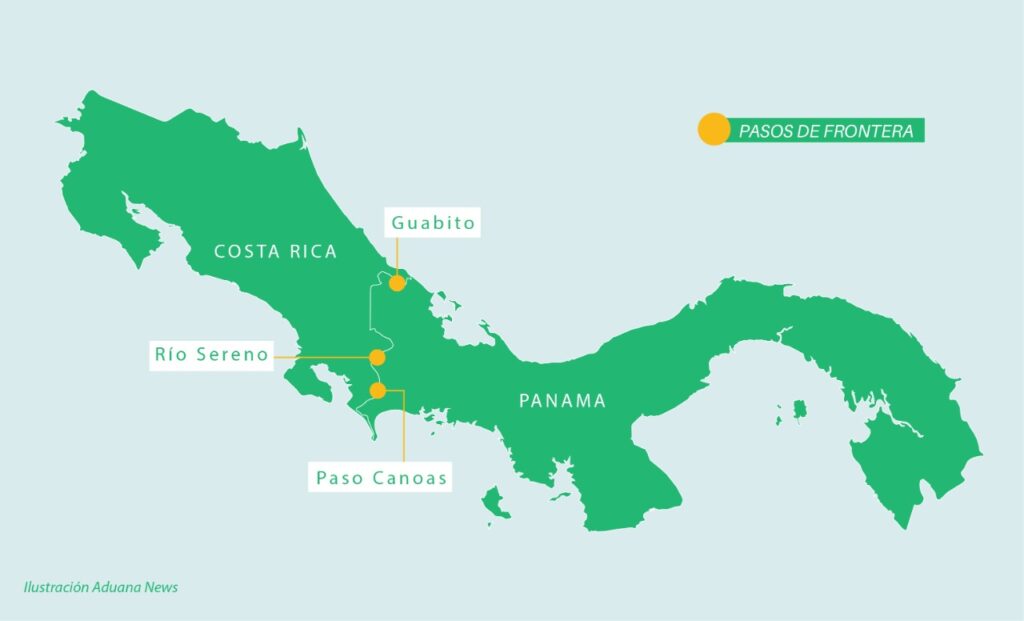
Both programs promote the integration of land border posts in these countries, supported by financing from the Inter-American Development Bank (IDB), based on the international concept of Coordinated Border Management and the concept of a “single stop” in the destination country, established in the Framework Agreement to implement binational integrated control systems at border crossings and approved by Costa Rica and Panama in 2019. In more detail:
- Paso Canoas (PANAMA)/ Paso Canoas (CR) under the double header scheme;
- Río Sereno (PANAMA)/ Sabalito (CR), under the single headwaters scheme, all with the presence of authorities from both countries.
- Guabito (PANAMA)/Sixaola (CR), also under the single-header scheme, all with the presence of authorities from both countries.
The National Customs Administration announced the most significant points of the day:
1. The border control processes of the Customs, Immigration, Agriculture, Food and Health authorities of each country were discussed. Progress was made on possible definitions regarding the integrated operation that will allow both countries to exercise the juxtaposed controls provided for in the approved Framework Agreement.
2. The need to expand workshops with the agricultural authorities of both countries was defined, in order to guarantee some improvements that the research has identified with respect to current processes, such as the need to promote the electronic phytosanitary certificate (e-phyto) of the Food and Agriculture Organization of the United Nations (FAO).
3. It was agreed to hold a workshop for exchanges between security authorities - mainly police - to examine how this matter will be handled, in a context of crime prevention, effectiveness, efficiency and respect for human rights.
4. It was agreed to promote, as soon as possible, the constitution of the Bilateral Coordination Committee provided for in the Framework Agreement between both nations, which corresponds to the main executive structure in its application. This Committee, as its name indicates, is binational in nature and its formation is the responsibility of the customs authorities of both countries.
Both programs have already contracted infrastructure works in Costa Rica and Panama on the Paso Canoas border, the statement said. It also referred to an upcoming announcement of the start of works for Sabalito/Río Sereno and Guabito/Sixaola.
It should be noted that the Costa Rican Border Integration Program also includes the process of modernizing the land border posts of Peñas Blancas and Las Tablillas on the northern border with Nicaragua.ANA Press Release)

Aduana News foi o primeiro jornal aduaneiro da Argentina a lançar sua versão digital. Com mais de 20 anos de trajetória, suas publicações e iniciativas têm como objetivo oferecer o conhecimento mais relevante sobre temas aduaneiros, contribuindo para a promoção do comércio seguro e da facilitação do comércio na região.