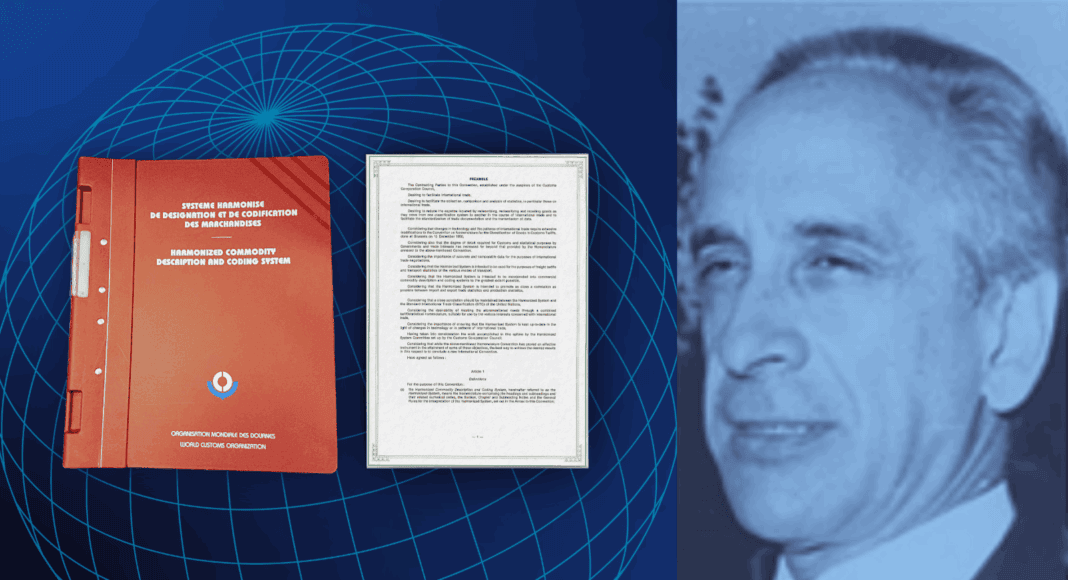
His legacy and career at the Customs Cooperation Council
Summary:
I. Introduction
II. The First Steps on the International Stage (1960-1968)
III. Argentina's Accession to the CCA (1968)
IV. Vice-President of the Council (1971-1973)
V. The Honorary Presidency in Buenos Aires (1975)
VI. Assistant Secretary General: A historic appointment
VII. Sortheix and the Development of the Harmonized System (1977-1986)
VIII. The Legacy: Recognition of the Harmonized System
IX. Post-CCA Activities and Continuing Influence (1987-2009)
X. Conclusions
🟦 I. Introduction
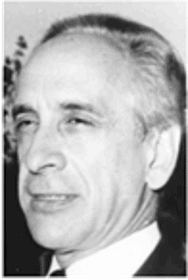
Juan José Alberto Sortheix, born in San Miguel de Tucumán on March 9, 1930, was a brilliant lawyer specializing in customs law, whose extraordinary contribution to the development and fluidity of international merchandise trade was outstanding. He is credited, among other contributions, with the Harmonized Commodity Description and Coding System, which is used today by almost all countries in the world.
A law graduate from the University of Buenos Aires, Sortheix quickly established his professional reputation both in Argentina and abroad.
His public career began at the General Directorate of Taxes in 1960, rising to hold important positions in the Argentine tax and customs administration, becoming National Director of Taxes from 1973 to 1977.
🟦II. The First Steps on the International Stage
In the late 1960s, Sortheix began his active international involvement, representing Argentina before the Customs Cooperation Council (the international organization known as the World Customs Organization). His fluency in English and French made him a notable figure among Latin American officials, allowing him to take a leading role in technical and legal debates.
This linguistic ability was a strategic tool in her professional development. In international organizations, the ability to communicate effectively across language barriers is essential for building consensus and influencing policy, and even more so in this case, where Sortheix was fluent in both official languages of the organization.
During this initial period, he participated initially as an observer, as Argentina was not a member of the Council. This special status allows representatives of non-member countries to participate in technical debates and discussions without voting rights. This initial role was key in laying the groundwork for his future leadership, allowing him to familiarize himself with the mechanisms of international cooperation in customs matters.
During that first stage, Sortheix served on the CCA's Customs Valuation Technical Committee from 1968 to 1972, actively participating in critical issues related to that subject.
In Argentina, he was responsible for writing - in his own hand - the original texts of the Executive Branch projects that the Honorable Congress of the Nation approved and transformed into the laws 16.686 (adoption of the Brussels Tariff Nomenclature -BNA-, with its legal notes, interpretative rules and explanatory notes prepared by the Customs Cooperation Council), 16.690 law (unification of import taxes), and the 19.640 law (regulation of special customs areas and free trade zones), into which he poured all his international experience. He also drafted the original texts of the legislation on customs valuation, based on the Brussels Definition of Value, which was later incorporated - practically unchanged - into the original version of the current Argentine Customs Code (1). He was also the Coordinator of the "Preliminary Draft of the General Customs Law» prepared in 1969, highlighting its contributions to the structural aspect and methodology for addressing the subject.
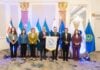
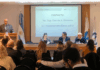
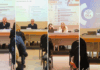
The testimony provided by his friend and then colleague at the Ministry of Economy, Mr. Dr. Horacio Vicente, who, in the framework of the Tribute to JA Sortheix held by the National University of Buenos Aires (UBA) in March 2025, told us that the honoree wrote the projects personally, with a fountain pen and paper, with a high linguistic quality because he mastered the Spanish language very well and took it to its maximum expression. He also commented -among many other things- that Sortheix had a deep knowledge of Tariff Classification, Valuation and Customs Technique (2).
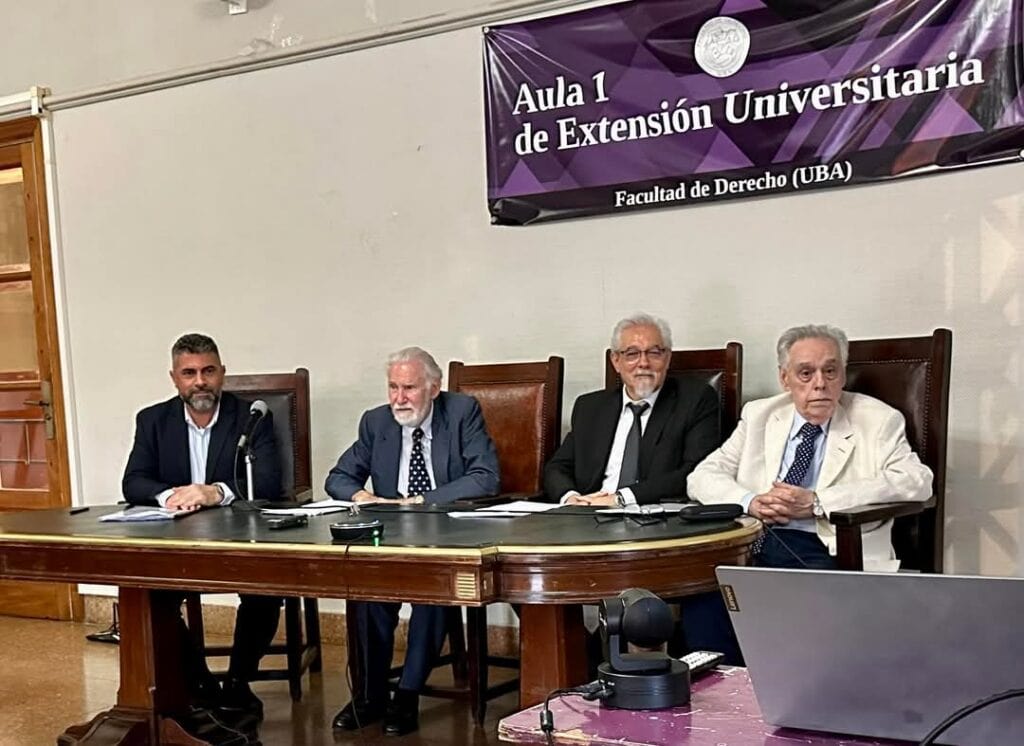
Also worth highlighting from this event was the testimony of the Customs Law specialist, Dr. Ricardo Xavier Basaldúa, of high prestige and international recognition, also a friend and colleague of Dr. Sortheix at the Ministry of Economy, who commented that he was lucky to be part of the drafting group for the Preliminary Draft of the General Customs Law that Sortheix created and directed, that he worked side by side with him every afternoon, learning, and having the opportunity to raise the most diverse issues involved in the preparation of a preliminary draft that addressed all customs issues and that, unfortunately, could not be approved because there was a change of government and it ended up "shelved", but it left planted that seed that over time would become the Argentine Customs Code. He recalled that when Sortheix was creating the group, the drafting committee of the Argentine Customs Code, the call appeared, an invitation from the CCA (WCO) to go to work in Brussels for the creation of the new tariff nomenclature. (3)
🟦 III. Argentina's Accession to the CCA
In 1967, by Law 17.587, the Argentine Republic decided to become an official member of the Council (4). On July 1, 1968, the Argentine Ambassador to the Kingdom of Belgium deposited the instrument of ratification with the Ministry of Foreign Affairs of the Belgian Government, which notified said deposit to all adhering governments and to the Secretary General of the CCA, thus fulfilling the formalities established in the Convention constituting the Organization.
This accession elevated the participation of the Argentine representative, Dr. Sortheix, to the status of "official delegate," which meant he could officially represent the country and vote in the decisions of the international organization.
In fact, Sortheix was part of the FIRST OFFICIAL DELEGATION of the Argentine Republic to the Customs Cooperation Council established by Decree No. 1849 of April 5, 1968.
It is necessary to pause in the recitals of this rule since the reasons that justified his designation and representation are set out there, namely: “That, given the importance of the technical issues to be addressed, the fact that our country is simultaneously joining the entity's work and that other member countries, due to the nature of the subject matter, usually assign specialized officials... evaluate the advisability of adhering to two other technical conventions, such as those of Nomenclature and Value... as well as gather background information for their correct application and updating... "
As an official delegate from 1969 to 1976, Sortheix participated in key CCA processes and decisions, contributing his technical and legal insight to solve complex challenges.
🟦 IV. Vice-President of the Council (1971-1973)
In recognition of his performance, Sortheix was elected Vice-President of the Council (a collegial body composed of representatives of all Member States and the highest authority of the Organization) in June 1971 during the sessions held in Vienna. This position entails important responsibilities such as assisting the President in conducting meetings, helping to achieve consensus among delegations, and maintaining a fluid working dynamic. His negotiating and diplomatic skills were recognized and valued by his international colleagues, who saw him as a natural leader capable of resolving technical and political tensions.
The importance of his role was further confirmed when he was re-elected as Vice President during the sessions held in Brussels in June 1972. This consecutive recognition was unusual and demonstrated the high regard the international community held for his skills and leadership.
During this period he participated in important decisions, perhaps the most important of which was at the time of the 41st/42nd Sessions of the Customs Cooperation Council held in Kyoto, Japan, between May 15 and 24, 1973, when one of the best instruments developed in the field of the CCA (WCO) was approved, the International Convention on the Simplification and Harmonization of Customs Procedures, a cornerstone of the modernization and harmonization of customs procedures globally. It represents the gold standard in trade facilitation, promoting efficient, transparent, and predictable customs practices that drive economic development and strengthen border security. He participated in these sessions in a dual role: as Delegate of the Argentine Republic and as Vice President of the CCA.
🟦 V. The Honorary Presidency in Buenos Aires (1975)
In May 1975, during the 45th/46th Session of the Council held in Buenos Aires, Mr. JASJIT SINGH (India), Chairman of the Council at that time, welcomed all delegates (the ACC then had 76 Member States) and observers (representatives of FAO, IATA, INTERPOL, GATT, ICC, and others) present, in particular those participating in the work of the Council for the first time, and then, at his proposal and with the vote of all present, elected Juan José Sortheix.Honorary president"of the Council, by general acclamation.
This honorary position was a distinction in recognition of his exceptional contributions to the organization. The honorary presidency entailed symbolically presiding over Council sessions, representing the organization before national authorities, and facilitating diplomatic relations during the event. It was an explicit recognition of his international prestige and the respect he had earned over years of work.
Mr. Ricardo Lumi, Secretary of Finance of the Argentine Republic, was present on that occasion. He noted that this was the first time that the Council had met in a country that had not yet reached its full development and that it was also the first time that the Council's sessions had been held on the American continent, emphasizing its importance and significance.
Hosting the sessions of an international organization is a significant undertaking, and granting the Honorary Presidency to a prominent national figure like Sortheix underscores its importance to both the Organization and Argentina. This event likely strengthened the relationship between Argentina and the CEC, further cementing Sortheix's position as a key liaison. By recognizing Sortheix in this way, the CEC acknowledged Argentina's commitment to customs cooperation and likely fostered closer ties between the organization and the host nation.
Please note that, at the end of the successful official meeting, all visitors were invited to explore the natural beauty of Bariloche and stay at the exquisite Hotel Llao Llao, next to Lake Nahuel Huapi, where they shared unforgettable experiences, which surely strengthened the bonds of friendship and camaraderie among the members.
🟦 VI. Assistant Secretary General: A historic appointment
In June 1976, the Customs Cooperation Council (CCC) made an extraordinary decision in its organizational structure by creating, for the first time in its history, two dedicated Assistant Secretary General positions. This decision was taken in direct response to the growing technical and operational demands facing the institution, particularly due to the complex project of creating and implementing the Harmonized System, which required specialized leadership.
The creation of this position was truly exceptional in the history of the Council, as prior to this resolution, the structure of the ACC General Secretariat consisted solely of the Secretary General and technical directors. The Council understood that the magnitude and technical complexity of the Harmonized System required specialized leadership to facilitate the management, coordination, and international communication of the project.
Sortheix's specific appointment as one of the first two Assistant Secretaries-General, effective January 1, 1977, was a clear recognition of his extensive technical experience, solid diplomatic skills, and outstanding leadership demonstrated in previous Council sessions. Sortheix had already demonstrated exceptional ability to achieve consensus on complex technical issues, crucial to the successful implementation of the Harmonized System project, considered a priority task for world trade.
The Council also decided to establish a small Committee to examine the powers and responsibilities of these two positions in relation to those of the Secretary General and the Directors, establishing the following for Sortheix: “It will assume leadership of the work related to the Harmonized System, taking into account the Council's desire to complete it as quickly as possible. To this end, it will chair the discussions of the Committee responsible for this work and establish the necessary contacts with the authorities and organizations concerned."(6)
This position, created exclusively for Sortheix, allowed him to play a fundamental role in the technical and strategic direction of the Harmonized System, ensuring its successful development and coordinating the complex international negotiations necessary for its final approval in 1983. The exceptional nature of the position is further evidenced by the fact that once Sortheix's term of office concluded in 1986, the post of Assistant Secretary-General ceased to exist, and the Secretariat's structure returned to its traditional composition.
In short, Sortheix's position as Assistant Secretary General was unique and unrepeatable in the entire history of the Customs Cooperation Council (remember that the official name of the World Customs Organization remains the Customs Cooperation Council). This exceptional position recognized not only Sortheix's outstanding technical and diplomatic talent, but also the critical importance of the Harmonized System project for international trade, consolidating it as one of the Council's main institutional legacies in its more than 70-year history.
🟦 VII. Sortheix and the Development of the Harmonized System (1977-1986)
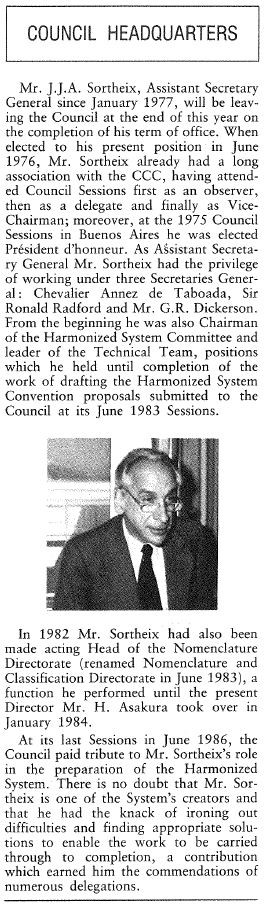
For more than six years, between 1977 and 1983 (7), Juan José Alberto Sortheix chaired the Harmonized System Committee of the Customs Cooperation Council. His leadership was instrumental in establishing a coherent and uniform international tariff classification system that continues to facilitate international trade today.
The initial challenges were formidable. The main task was to harmonize a multitude of existing nomenclatures, such as the then-current Customs Cooperation Council Nomenclature (CCCN) and the Standard International Trade Classification (SITC), which until then had featured significant differences and frequently generated disagreements and trade disputes. This context required strong leadership, advanced technical skills, and outstanding negotiating ability.
Sortheix led an international team composed of customs experts, technicians, and legal experts from more than 60 countries and various international organizations such as the UN, the WTO, and the International Chamber of Commerce. The work dynamic included ongoing plenary meetings and technical subcommittees tasked with analyzing each group of goods in detail, from agricultural products to industrial technology. The Committee also benefited from ongoing input from specialized agencies, ensuring a thorough and rigorous analysis.
One of the main strengths of Sortheix's leadership was her diplomatic ability to resolve technical and political disagreements between countries with diverging economic interests. She established a working methodology centered on ongoing dialogue, technical precision, and the constant search for consensus, avoiding confrontations that could have jeopardized the project. Sortheix's dedication and patience were crucial in maintaining the Committee's cohesion and motivation during years of hard work.
Finally, under his leadership, the Committee successfully concluded the International Convention on the Harmonized System of Standards in June 1983. This treaty was considered a historic achievement, as it provided a uniform legal and technical framework that was quickly adopted by nearly all countries in the world, facilitating the simplification of international trade, significantly reducing costs and trade conflicts, and allowing for greater precision in the collection and analysis of trade statistics worldwide.
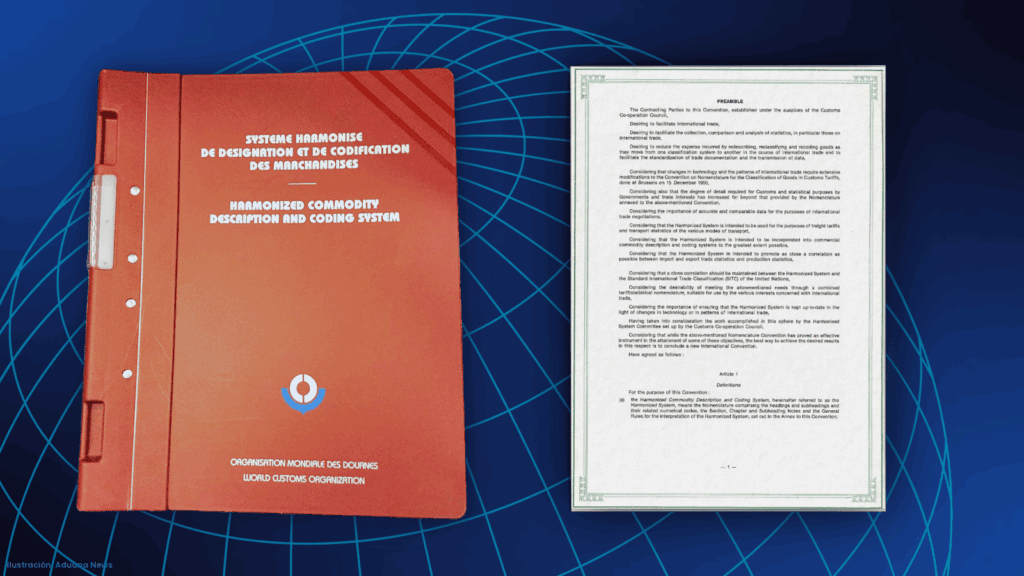
In May 1984, during its 63rd and 64th sessions, the Council decided to grant Dr. Sortheix the last legally possible extension of two years to his term as Assistant Secretary-General until 31 December 1986, in order to disseminate the work he had accomplished throughout the world and to encourage its membership.
As a senior international official, Sortheix frequently served on official missions representing the Customs Cooperation Council at international conferences and technical meetings around the world. His role was key in ensuring the effective implementation of the Harmonized System in various regions, particularly in Latin America, Asia, and Africa.
He organized and led seminars in locations as diverse as Canada, India, Thailand, Burkina Faso, Zambia, Brazil, and Uruguay, actively promoting technical cooperation and facilitating the international adoption of the new system.
🟦 VIII. The Legacy: Recognition of the Harmonized System
The result was a revolutionary advance for world trade, significantly contributing to the reduction of non-tariff trade barriers and generating a positive impact on the global economy. Dr. Sortheix's legacy, internationally recognized—not sufficiently so in the undersigned's opinion—left an indelible mark on the history of international customs cooperation and established the Harmonized System as one of the fundamental instruments for modern international trade.
More than three decades after its implementation, the Harmonized System remains in force, confirming the strategic and technical vision that Sortheix brought to this international project. His contribution remains an example of effective leadership, commitment to global cooperation, and technical excellence.
In recognition of his outstanding work, when the Harmonized System officially entered into force in 1988, the Council specially invited him to deliver the inaugural address, thus recognizing his decisive contribution to global trade.
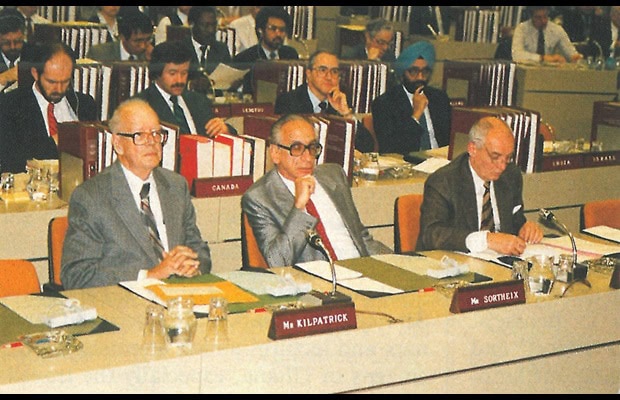
🟦 IX. Post-CCA Activities and Continuing Influence (1987-2009)
After completing his international assignment in 1986, Sortheix returned to Argentina, where he continued his work as a prestigious international consultant. In particular, he collaborated closely with ALADI (Latin American Association of Associations) in the adaptation of the Harmonized System in Latin America.
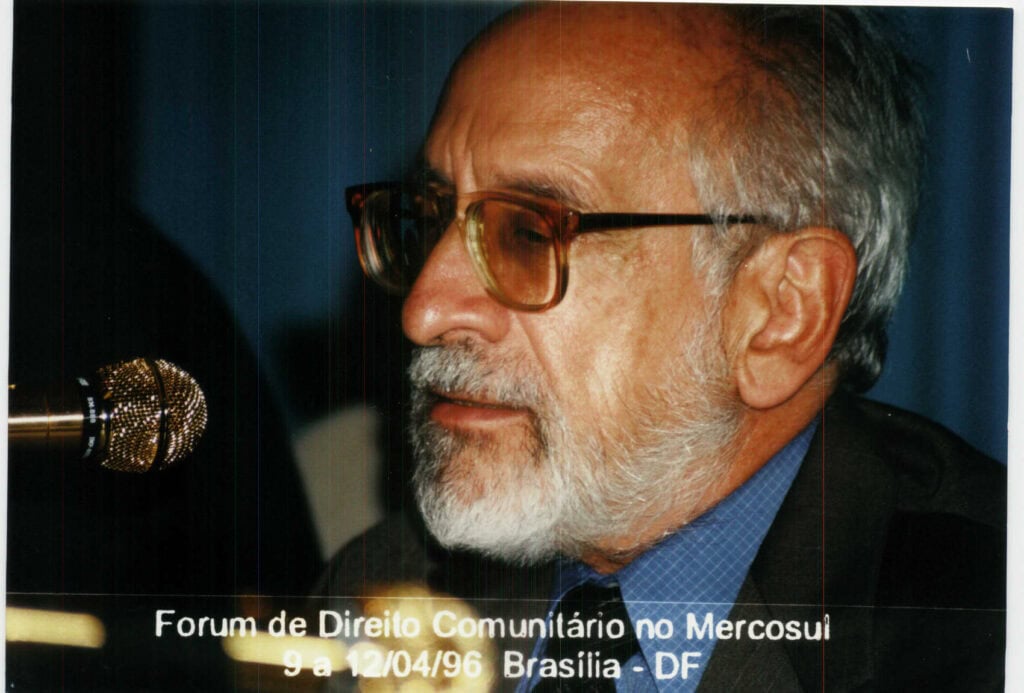
His teaching and consulting work continued to be distinguished, giving courses and lectures at various Argentine academic and professional institutions, such as the Institute for the Development of Entrepreneurs in Argentina (IDEA) and the Argentine Export School of the Bank of Boston Foundation.
Juan José Alberto Sortheix passed away in June 2009. His passing represented a great loss for the international customs world. The technical and legal soundness of his contributions, particularly in the creation of the Harmonized System, consolidated his position as one of the most influential jurists in customs matters.
🟦 X. Conclusions
Juan José Alberto Sortheix stands out as a model technical official, specialized in customs law and committed to the development of international trade.
In the academic field, his articles on Origin of the Merchandise (Extensive study whose reading is suggested due to its relevance and impact on Argentine legislation; available at: https://aduananews.com/wp-content/uploads/2025/06/Sortheix-El-Problema-del-Origen-de-las-Mercadrias-y-Nuestra-Legislacion-Aduanera.pdf, and the nature of the taxable event in the matter of import (required reading for customs law enthusiasts; available at: https://aduananews.com/wp-content/uploads/2025/06/Sortheix-La-Estructura-del-Hecho-Gravado-por-los-Derechos-de-Importacion.pdf, dumping and many other customs matters in which he excelled. His systemic and global vision left his mark.
His career at the Customs Cooperation Council, from his initial role as an observer to his exceptional appointment as Assistant Secretary General, demonstrates an unwavering dedication and strategic vision for facilitating global trade. His ability to navigate complex technical and political negotiations, his fluency in languages, and his ability to build consensus were crucial to the success of the Harmonized System, an achievement that continues to positively impact global trade more than three decades after its implementation.
Sortheix's legacy goes beyond the creation of a classification system; it represents a commitment to global customs cooperation and technical excellence that served as an example for future generations of foreign trade specialists who had the honor of knowing him. His influence endured even after his retirement from the CCC, through his work as a consultant, educator, and promoter of the Harmonized System in various regions of the world.
In March 2025, the University of Buenos Aires honored his memory and legacy, recognizing the historical dimension of his contribution to international trade and highlighting him as an example to follow for future generations of foreign trade specialists. The posthumous recognition by his “alma mater", the UBA (University of Buenos Aires) highlights the historical importance of his contributions and their lasting impact on the field of international trade.
1. In 1969, Sortheix joined and coordinated a working group –together with renowned experts such as Ricardo Xavier Basaldúa, Juan P. Cotter Moine and Julio T. Rubens y Rojo– to draft a Preliminary Draft of the General Customs Law. Although that draft was not approved due to changes in government, its structure, methodology and 602 articles served as the basis for drafting the Customs Code approved in 1981.
2. We suggest watching and listening to Dr. Horacio Vicente's full presentation, in which he highlights Dr. Sortheix's personal and professional qualities. The video is available at: https://youtu.be/LoiODUbfbuE?si=ioFCAHUKBsFuXc4v
3. We suggest watching and listening to Dr. Ricardo Xavier Basaldúa's full presentation, in which he provides a personal, professional, and academic profile of Dr. Sortheix. The video is available at: https://youtu.be/LoiODUbfbuE?si=ioFCAHUKBsFuXc4v
4. Dr. Ricardo Xavier Basaldúa, in his presentation at the Tribute at the UBA (available at: https://youtu.be/LoiODUbfbuE?si=ioFCAHUKBsFuXc4v) tells us that Sortheix was one of the driving forces behind Argentina's accession to the CCA.
5. In June 1976, during its 47th and 48th sessions, the Council decided that two posts of Assistant Secretary-General should be created, effective 1 January 1977. For this purpose, it appointed Mr. James B. Clawson and Mr. Juan José Alberto Sortheix for a five-year term.
6. OMA Document No. 22.686 f, dated September 20, 1976, "Powers and Status of the Assistant Secretaries General."
Sources:
Customs News. «UBA: Tribute to «Father of the Harmonized System, Dr. Juan José Alberto Sortheix, and his contribution to National and International Customs Law« https://aduananews.com/con-un-acto-en-la-uba-recuerdan-el-legado-aduanero-del-dr-juan-alberto-sortheix-y-su-contribucion-a-la-cooperacion-internacional/
Article published in CCC news, No. 8, Winter 1986, 3rd page.
Basaldúa, Ricardo Xavier (2009). Profile of Juan José Sortheix. Practical Guide to Foreign Trade, No. 150, September 30, 2009.
CV of Juan José Alberto Sortheix.
Historical documents of the Customs Cooperation Council: https://wcoomd.org
Juárez Allende, Héctor Hugo. (2021). The World Customs Organization. Past, present, and future. Valencia: Editorial Tirant Lo Blanch.
Manzano,Felipe J. Article titled: “The 41st/42nd Sessions of the Customs Cooperation Council”, Customs Law, Volume V, pp. 769/786.
WCO (World Customs Organization). (2018). Harmonized System Compendium. Recovered from: https://www.wcoomd.org/-/media/wco/public/global/pdf/topics/nomenclature/activities-and-programmes/30-years-hs/hs-compendium.pdf
WCO News, No. 86. Harmonized System Update. Available in: https://mag.wcoomd.org

The author is a Member (Judge) of the National Tax Court. University Professor. Specialized in Higher Education Teaching (UCC). Professor at the National University of Córdoba (UNC), Blas Pascal University (UBP), Austral University and Universidad del Rosario (Colombia). Professor and member of the Academic Committee of the Specialization in Customs Law at the National University of La Plata (UNLP). Member of the Drafting Group of the MERCOSUR Customs Code. Author of the book: "The World Customs Organization. Past, present and future.". Tirant Lo Blanch Publishing House, Valencia City, Spain. Year 2021 - Email: [email protected]