






SUMMARY
I. Introduction
II. International Agreements
III. Recommendations
IV. Declarations
V. Resolutions
VI. Technical Opinions
VII. Memoranda of Understanding
VIII. Other agreements administered or managed
IX. Conclusion
Introduction
The World Customs Organization (WCO) is the principal intergovernmental body for customs matters. With 187 members, whose customs administrations manage more than 98% of world trade, it is the natural technical forum for developing common standards, instruments, and criteria applicable to international customs activity.
Contemporary customs operations no longer operate within the closed framework of each national legal system, but within an international network of agreements, regulations, technical models and cooperation mechanisms that directly affect the international flow of goods.
Within this framework, the WCO does not rely on a single instrument or a single legal category. Alongside international conventions—its most formal normative expression—it uses recommendations, declarations, resolutions, technical opinions, and memoranda of understanding, instruments of a heterogeneous nature but converging in their purpose: to harmonize customs regimes, facilitate legitimate trade, and strengthen international control and cooperation.
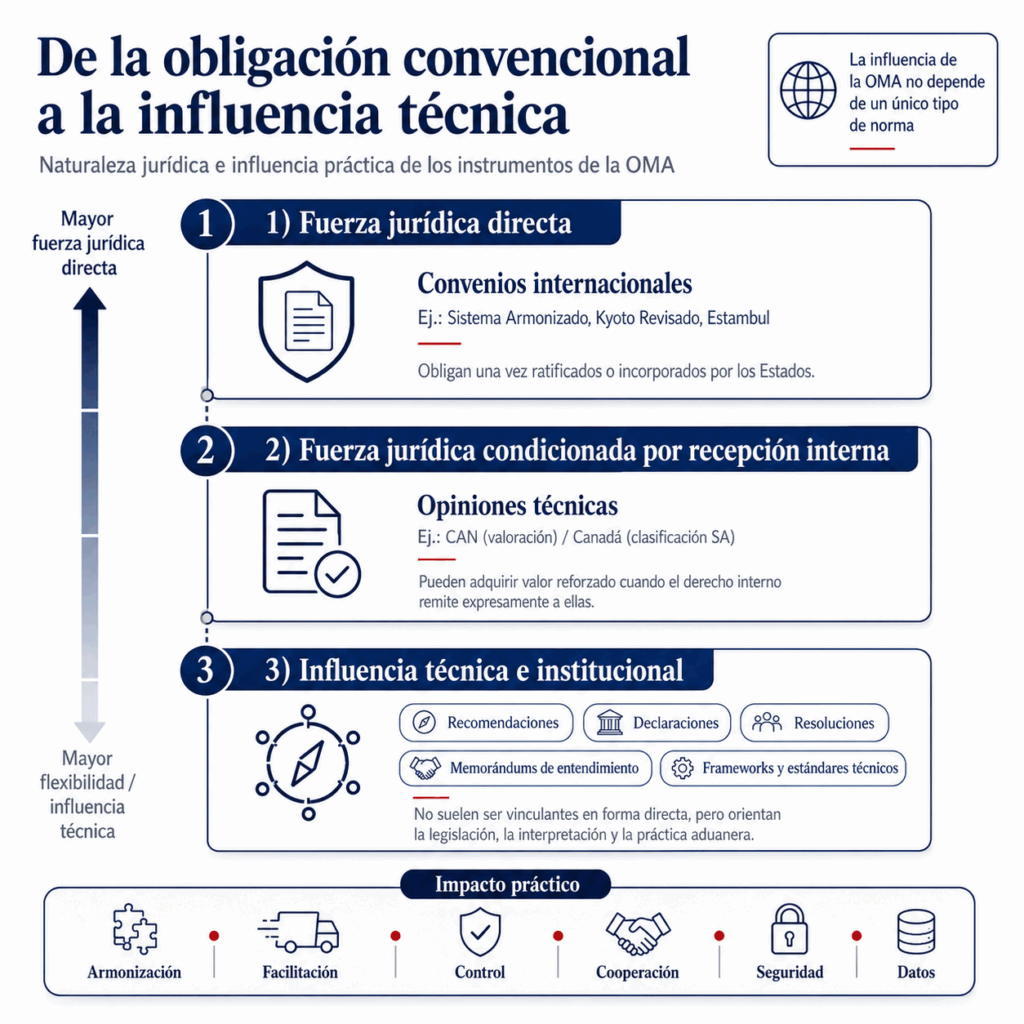
This heterogeneity is also reflected in their legal force. Some of these instruments become binding once ratified or incorporated in accordance with the constitutional procedures of each State; others lack direct binding effect, but guide legislation, condition administrative interpretation, and shape customs operational practices.
This influence is also evident in regional integration processes and contemporary trade agreements. Many WCO instruments serve as technical guidelines for the development of common standards: the Revised Kyoto Convention, for example, was considered among the relevant international precedents for the MERCOSUR Customs Code. In turn, new-generation agreements often incorporate specific chapters on customs and trade facilitation—as is the case in the MERCOSUR-European Union Agreement—where WCO principles reappear: simplification, transparency, risk management, customs cooperation, information exchange, and mutual administrative assistance.
The purpose of this work is to examine, in a synthetic way, the main legal instruments used by the WCO and their impact on the construction of global customs rules.
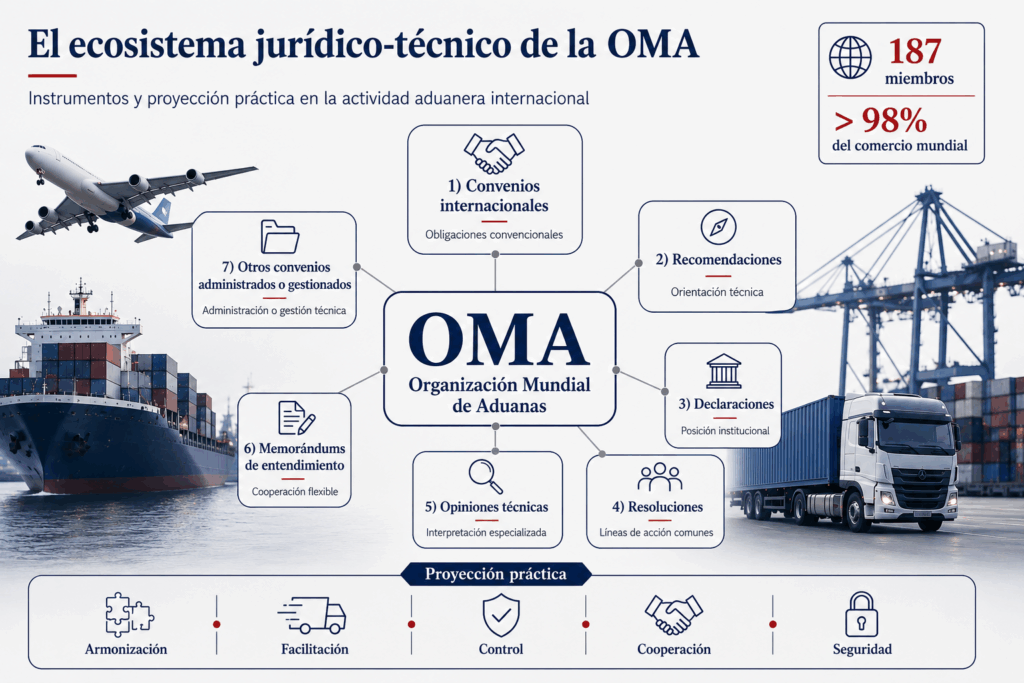
II.- International agreements
International conventions constitute the most formal and important legal instrument within the normative activity of the World Customs Organization. These are multilateral treaties adopted within the framework of the Organization that become binding on the States that ratify, approve, or incorporate them in accordance with their respective constitutional procedures.
Their internal effectiveness will naturally depend on how each legal system regulates the reception of international law. However, even before or outside of their formal incorporation by certain States, these conventions often exert a significant indirect influence, as they serve as a technical model for the development of national laws, procedural reforms, and administrative practices.
Among the most important agreements developed or administered within the WCO, the International Convention on the Harmonized Commodity Description and Coding System deserves special mention. Its importance extends beyond mere tariff nomenclature: it constitutes the common language of international trade in goods and serves as the basis for tariffs, statistics, rules of origin, non-economic controls, and numerous public policies related to foreign trade.
Also of central importance is the International Convention on the Simplification and Harmonization of Customs Procedures, known as the Revised Kyoto Convention. This instrument embodies one of the WCO's long-standing objectives: to simplify, harmonize, and modernize customs procedures without weakening its control powers. Its influence is evident in areas such as risk management, audit-based control, information technology, transparency, predictability, and cooperation with other border agencies.
Regarding temporary admission, the Convention on Temporary Admission – the Istanbul Convention – should be highlighted. This instrument aims to facilitate the temporary entry of goods intended, among other things, for exhibitions, fairs, congresses, trade shows, and professional, scientific, educational, or sporting equipment, avoiding unnecessary burdens when there is no definitive import for consumption.
Likewise, agreements on mutual administrative assistance, including the Nairobi Convention and the Johannesburg Convention—the latter not yet in force—reflect the cooperative dimension of contemporary customs law. Faced with customs offenses such as smuggling, under-invoicing, document triangulation, or other infractions, the isolated actions of a customs administration are insufficient. Hence the importance of international mechanisms for information exchange, mutual assistance, and operational cooperation.
The WCO conventions thus serve a dual purpose. On the one hand, they establish legal obligations for the States that formally accept them. On the other hand, even if they are not incorporated into all legal systems, they operate as technical standards of reference for the progressive harmonization of national customs systems.
Much of their importance lies in this dual dimension—normative and inspirational. The agreements not only create obligations; they also provide guidance, systematize procedures, and offer technical solutions developed from the comparative experience of customs administrations.
III.- Recommendations
The WCO recommendations are non-binding instruments, generally adopted by the Council based on the work of its technical bodies. They do not impose direct legal obligations on member states unless they choose to incorporate them into their respective legal systems or administrative practices.
Their importance lies precisely in their guiding function. Through them, the WCO proposes technical criteria, guidelines for action, and uniform solutions aimed at facilitating the progressive harmonization of customs systems. In many cases, the recommendations anticipate regulatory reforms, consolidate best practices, or serve as a basis for the modernization of internal procedures.
Historically, the recommendations have covered a wide range of subjects: franchises, refunds, re-imported goods, samples without commercial value, commercial invoices, certificates of origin, right of appeal, transit, baggage, customs seals, control, combating fraud and use of computer systems.
Currently, its function remains fully relevant in the face of new challenges related to the digitization of procedures, the advance exchange of information, risk management, the use of data, the security of the logistics chain and the coordination between agencies involved at the border.
As an example, one can mention the recommendation regarding the use of the WCO Data Model, approved on June 27, 2009, which demonstrates the role of these instruments in the standardization of customs information and in the progressive interoperability of the administrations' computer systems.
Thus, although they lack direct binding force, recommendations fulfill an indirect normative function. They do not replace law or treaties, but they guide the actions of customs administrations and contribute to the development of common technical criteria. Their value lies not so much in legal coercion, but in the technical authority of the issuing body and in their gradual adoption by member states.
IV.- Declarations
WCO declarations are institutional positions on issues considered relevant to the international customs community. They do not, in themselves, create direct legal obligations for member states. Their function is to establish principles, priorities, or general criteria for action in response to specific phenomena or challenges.
Through these resolutions, the WCO expresses a political, technical, or institutional orientation that can then be projected onto other instruments, work programs, regulatory reforms, or administrative practices. Their value, therefore, lies in the authority of the consensus reached within the Organization and in their capacity to shape a common agenda.
Among the most relevant declarations are the Revised Arusha Declaration, concerning good governance and integrity in customs; the Luxor Declaration, concerning the role of customs in combating terrorism and strengthening security; and the Beijing Declaration, related to cross-border electronic commerce.
These instruments demonstrate that the WCO does not merely develop conventional standards or technical recommendations. It also establishes institutional positions on issues that affect customs administrations across the board, such as public safety, supply chain security, e-commerce, international cooperation, and the adaptation of controls to new operational practices.
V.- Resolutions
Resolutions are institutional acts adopted by the WCO in response to specific situations or to establish common courses of action on matters considered priorities. They do not, in principle, have the legal nature of an international treaty nor do they, in themselves, create direct contractual obligations. However, they can acquire significant practical impact when they express relevant technical consensus and are subsequently incorporated into internal policies, regulations, or procedures.
Among the most relevant resolutions are those related to the security of the logistics chain, the role of customs in the face of natural disasters, trade facilitation and the institutional response to new risks in international trade.
The most relevant example is the Council Resolution of June 2005, by which the SAFE Regulatory Framework to Secure and Facilitate Global TradeThis is one of the most important instruments developed by the WCO regarding supply chain security and trade facilitation.
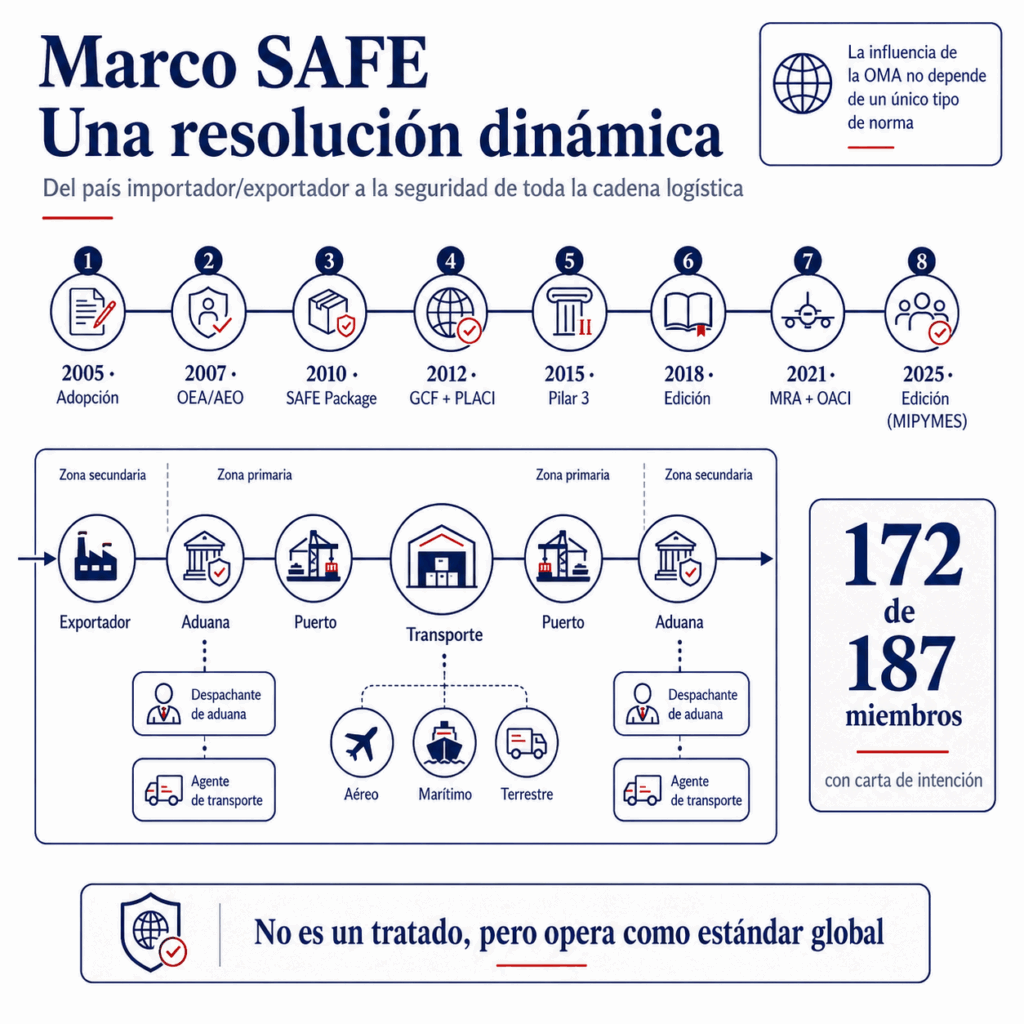
The SAFE framework also demonstrates the dynamic nature of certain instruments of the Organization. It was adopted in 2005 and subsequently revised in 2007, 2010, 2012, 2015, 2018, 2021, and 2025, always in accordance with the principles of the Revised Kyoto Convention. This evolution confirms that it is not a closed document, but rather a technical and regulatory framework subject to periodic adaptation in response to changes in international trade.
To date, 172 of the 187 WCO members have signed a letter of intent to implement the SAFE Framework. This demonstrates its high level of international acceptance, despite not being a traditional international convention.
Its conceptual importance lies in the paradigm shift it brought about. It no longer starts from a compartmentalized and isolated view—exporting country/importing country—but rather from a comprehensive understanding of the international logistics chain. The objective is to ensure the complete flow of goods, from the exporter's factory to the importer's warehouse.
In that respect, the SAFE Framework clearly shows the role that WCO resolutions can play: although they are not international treaties, they can become global reference standards and have a direct impact on risk management, advance information, Authorised Economic Operator programs, mutual recognition, customs-customs cooperation and the customs-business relationship.
VI.- Opinions
Opinions are non-binding technical instruments that, as a rule, provide guidance on specific issues of interpretation or application. Within the WCO, advisory opinions related to customs valuation and tariff classification are of particular importance.
In matters of valuation, the advisory opinions of the Technical Valuation Committee do not, in themselves, constitute binding international standards nor do they establish a valuation automatically applicable to all cases. However, they provide highly useful technical criteria for interpreting the Valuation Agreement and resolving situations involving similar problems.
This general rule admits relevant nuances. Its internal legal force will depend on how each State incorporates it into its own legal system. Thus, for example, in the Andean Community, Decision 571/03 stipulates that, for the interpretation and application of valuation rules, the decisions of the WTO Committee on Customs Valuation and the advisory opinions, comments, explanatory notes, case studies, and studies of the WCO Technical Committee on Valuation must be taken into account.
In matters of classification, the WCO issues classification opinions based on cases submitted to the Harmonized System Committee by the customs administrations of the Contracting Parties. These opinions are incorporated into the Compendium of Classification Opinions and reflect decisions made regarding goods whose tariff classification is complex or debatable.
Its practical importance is evident. Tariff classification determines the tax, statistical, prohibitive, sanitary, technical, or commercial treatment of goods. Therefore, although classification opinions are not directly binding in all legal systems, they constitute a highly qualified technical criterion for ensuring the uniform application of the Harmonized System.
As an example of explicit normative reception, we can mention Canadian legislation, which stipulates that the classification of imported goods must be carried out in accordance with the General Rules for the Interpretation of the Harmonized System and establishes that, to interpret its headings and subheadings, the Compendium of Classification Opinions and the Explanatory Notes to the Harmonized System published by the WCO, as amended, must be taken into account. This demonstrates that, in certain legal systems, these technical instruments acquire legal relevance reinforced by express reference in domestic law.
The opinions thus reveal a particularly practical dimension to WCO instruments. They do not create general rules like conventions, nor do they establish institutional policies like declarations or resolutions, but they do help resolve specific problems of technical interpretation. In matters such as classification and valuation, this function is crucial for reducing discrepancies, preventing disparate treatment, and strengthening the predictability of international trade.
VII.- Memoranda of Understanding
The WCO routinely uses memoranda of understanding to implement cooperation agreements with other international organizations, customs administrations, academic entities, private sector organizations and other actors involved in international trade.
One of the WCO's most important functions—and probably one of the least known—is its role as the technical representative of customs administrations before other international organizations and private entities. In this capacity, it has signed more than 150 memoranda of understanding, which have led to the development of products, standards, and cooperation mechanisms that directly impact daily customs practice.
Consider, among other examples, the CN22 and CN23 forms - postal customs declarations - linked to the Universal Postal Union; the institutional relationship with the International Chamber of Commerce regarding Incoterms; the standards on advance passenger information developed with IATA and ICAO; the work on chemical precursors with the International Narcotics Control Board; or the global cooperation procedures against customs offenses coordinated with INTERPOL.
Unlike international agreements, these instruments do not typically create strictly enforceable legal obligations. Generally, they express a convergence of wills and establish a flexible framework for collaboration in areas such as information exchange, technical assistance, training, capacity building, research, integrity, supply chain security, and trade facilitation.
Their usefulness lies precisely in this flexibility. They allow for the documentation of cooperation channels without resorting to more rigid, conventional structures. For this reason, although they do not normally have the legal force of a treaty, they form part of the set of instruments through which the WCO projects its institutional and technical influence on the international customs community.
VIII.- Other agreements administered or managed
In addition to the instruments developed within its own institutional framework, the WCO is involved in the administration or technical management of other international agreements directly linked to customs activity.
This intervention is not uniform. In some cases, the Organization performs technical administrative functions for the instrument. This is the case with the 1972 Customs Convention on Containers, for which the WCO established a Management Committee responsible for its review, updating, promotion, and technical monitoring.
In other cases, their participation is channeled through specialized technical bodies. This is the case with the WTO Agreement on Customs Valuation and the WTO Agreement on Rules of Origin, whose application requires technical customs criteria in matters that are particularly sensitive for international trade.
This distinction allows for a more precise understanding of the WCO's role within the international system. The Organization not only develops its own legal instruments but also provides technical administration for certain conventions and, through its committees, manages the interpretation and uniform application of other international regimes that directly impact daily customs operations.
IX.- Conclusion
The World Customs Organization does not operate through a single type of legal instrument. Its influence derives from a broader system, comprised of international conventions, recommendations, declarations, resolutions, technical opinions, memoranda of understanding, and other instruments of cooperation.
Some of these agreements are conventional in nature and become binding on the States that ratify or incorporate them into their respective domestic legal systems. Others lack direct binding effect but guide legislative reforms, administrative criteria, operational practices, and mechanisms for international cooperation.
In this context, the classic distinction between mandatory and non-mandatory law is insufficient to explain the WCO's real influence. Many of its instruments do not have direct binding force, but they serve as technical guidelines, inspire internal reforms, inform administrative decisions, and contribute to the international uniformity of customs practice.
This diversity is not a weakness, but rather a defining characteristic of contemporary international customs law. In the face of dynamic, technologically advanced, and increasingly interconnected global trade, harmonization is not achieved solely through treaties. It is also built upon standards, recommendations, resolutions, technical opinions, cooperation models, and common practices.
In this context, the WCO fulfills an essential function: it offers customs administrations an institutional space for technical consensus and a set of instruments designed to strengthen control, facilitate legitimate trade, promote international cooperation and ensure a more uniform application of customs rules.
The WCO does not replace the regulatory power of States, but it contributes to organizing the legal and technical environment in which that power is exercised. Much of its importance lies in the progressive construction of a common customs language for increasingly integrated international trade.
Highlighted
1 World Customs Organization, “Membership”. The WCO reports that it has 187 members, whose administrations manage more than 98% of world trade. Access: https://www.wcoomd.org/en/about-us/wco-members/membership.aspx
2 World Customs Organization, “Legal Instruments”. General page on WCO legal instruments: conventions and agreements, recommendations, declarations, policies and resolutions. Access: https://www.wcoomd.org/en/about-us/legal-instruments.aspx
3 European Commission, “EU-Mercosur: Text of the agreement”. Official page containing the texts of the MERCOSUR-European Union Agreement, including the chapter on customs and trade facilitation and the annex on mutual administrative assistance in customs matters.
Access: https://policy.trade.ec.europa.eu/eu-trade-relationships-country-and-region/countries-and-regions/mercosur/eu-mercosur-agreement/text-agreement_en
4 World Customs Organization, “International Convention on the Harmonized Commodity Description and Coding System (HS Convention)”. Official source on the Harmonized System Convention. Access: https://www.wcoomd.org/en/topics/nomenclature/instrument-and-tools/hs_convention.aspx
5 World Customs Organization, “The Revised Kyoto Convention”. Official source on the Revised Kyoto Convention. Access: https://www.wcoomd.org/en/topics/facilitation/instrument-and-tools/conventions/pf_revised_kyoto_conv.aspx
6 World Customs Organization, “Recommendations Related to Information Technologies”. This includes the recommendation regarding the use of the WCO Data Model, dated June 27, 2009. Access: https://www.wcoomd.org/en/about-us/legal instruments/recommendations/it_recommendations.aspx
7 World Customs Organization, “Members who have expressed their intention to implement the WCO Framework of Standards to Secure and Facilitate Global Trade.” Official document reporting, as of March 31, 2022, a total of 172 countries that had expressed their intention to implement the SAFE Framework. Access: https://www.wcoomd.org/-/media/wco/public/global/pdf/topics/facilitation/instruments-and-
tools/tools/safe-package/wco-table-intention-to-implement-the-fos.pdf?la=en
8 Andean Community, Decision 571, “Customs Value of Imported Goods”. Article 22 provides that, for the interpretation and application of the valuation rules, the decisions of the WTO Customs Valuation Committee, as well as advisory opinions, shall be taken into account.
Comments, explanatory notes, case studies, and studies from the WCO Technical Assessment Committee. Access: https://www.comunidadandina.org/StaticFiles/DocOf/DEC571.pdf
9 Canada, Customs Tariff, arts. 10 and 11. The rule provides that the classification of imported goods must be carried out in accordance with the General Rules for the Interpretation of the Harmonized System and that, to interpret headings and subheadings, the Compendium of
Classification Opinions and Explanatory Notes to the Harmonized System published by the WCO. Access: https://laws-lois.justice.gc.ca/eng/acts/C-54.011/page-2.html
10. Canada, Customs Tariff, art. 14. This rule authorizes modifications to the tariff schedule to give effect to an amendment to the Harmonized System or to any interpretative criteria approved by the Customs Cooperation Council, now the WCO. Access: https://laws-lois.justice.gc.ca/eng/acts/C-54.011/page-2.html
11 Juárez Allende, Héctor H., The World Customs Organization. Past, present and future, Tirant lo Blanch, 2021, chapter 3, section 3.6, “Memorandums of Understanding”.

The author is a Member (Judge) of the National Tax Court. University Professor. Specialized in Higher Education Teaching (UCC). Professor at the National University of Córdoba (UNC), Blas Pascal University (UBP), Austral University and Universidad del Rosario (Colombia). Professor and member of the Academic Committee of the Specialization in Customs Law at the National University of La Plata (UNLP). Member of the Drafting Group of the MERCOSUR Customs Code. Author of the book: "The World Customs Organization. Past, present and future.". Tirant Lo Blanch Publishing House, Valencia City, Spain. Year 2021 - Email: [email protected]