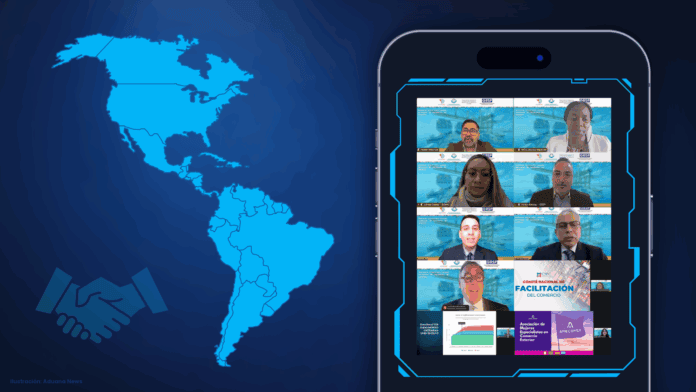
With the focus on strengthening institutional spaces for public-private cooperation in the region, the World Customs Organization (WCO) held this Wednesday (11.06.2025) the Virtual Seminar on National Trade Facilitation Committees (NTFC)This mechanism, central to the implementation of the Trade Facilitation Agreement, facilitates internal coordination and promotes the effective application of the provisions set forth in Article 23.2.
Organized by the WCO Regional Vice-Presidency for the Americas and the Caribbean—led by Peruvian Customs—and the Regional Private Sector Group (RPG), the seminar was part of the actions planned in the Regional Strategic Plan 2024–2026.
Peru: Openness with an integrative vision
In line with the objective of the seminar, at the beginning of the event, the Deputy National Superintendent of Customs of SUNAT Peru and Regional Vice President of the WCO, Manuel Emilio Sánchez PeraltaHe emphasized that the NCTFs are "fundamental multisectoral forums for implementing the WTO Trade Facilitation Agreement." He added: "This mandate reflects a modern vision of international trade that recognizes the need for structured and ongoing collaboration between the public and private sectors."
Progress and challenges in the region according to the WTO
One of the main exhibitors was Jesse Nicol, Secretary of the World Trade Organization (WTO) Trade Facilitation Committee, who reported that 80% of the commitments made by developing and least developed countries have already been implemented. In Latin America and the Caribbean, that level rises to 82,5%. Nicol emphasized that "80% of members have already created these committees," although He acknowledged that the greatest challenge lies in its effective operation (*)He also emphasized that the most complex commitments continue to be those classified in Category C, such as single windows, border cooperation, risk management, and Authorized Economic Operator (AEO) programs, which require technical assistance and institutional strengthening.
The GRSP warns about the weak participation of the private sector
The technical panel continued with Fabián Villarroel Ríos, GRSP Trade Facilitation Coordinator for the Americas and the Caribbean, an expert accredited to the WCO and a member of the WTO dispute settlement system. With nearly 20 years of experience in Chilean Customs, Villarroel noted that while many countries "already have established National Trade Facilitation Committees in accordance with the WTO Facilitation Agreement, private sector participation is limited and mostly occasional." He noted that "the private sector typically only has the right to speak, not vote, and it would be ideal if it could present initiatives to contribute more actively."
He also mentioned that challenges such as "digitalization, OAS programs, advance rulings, and sanctions" persist, and that "the lack of transparency and regularity in the meetings of these committees" must be urgently addressed. Finally, he announced that the GRSP is developing a survey to "evaluate the performance of these committees" in order to "improve inclusiveness and transparency."
Shared good practices
Dominican Republic: institutional framework and vision of a logistics hub.
Rosario del Castillo Báez, official of the General Directorate of Customs of the Dominican Republic, presented his country's CNFC as a "key entity for the implementation of the Trade Facilitation Agreement." He emphasized that the committee has a budget, an institutional structure, and active participation from the private sector. "Our committee has a clear purpose: to turn the Dominican Republic into a regional logistics hub," he said, emphasizing his commitment to "the continuous improvement of compliance with the agreement and the maintenance of a permanent and constructive dialogue between the public and private sectors."
Brazil: transparency, participation and inclusion.
From Brazil, Susana Rosadio, President of AMECOMEX He highlighted his entity's formal incorporation into the Brazilian National Commission for the Promotion of Finance (CNFC) in 2024 as one of the 11 designated organizations. Among the achievements, he highlighted the "effective coordination between the Ministry of Development, Industry, and Commerce and the Federal Revenue Service," the "publication of meeting minutes and recordings on YouTube," and the opening of technical spaces where "the private sector not only reacts, but also makes proposals."
However, she warned that the Federal Revenue Service strike at the end of 2024 highlighted "the need for stronger institutions" and to promote "greater inclusion and diversity of voices, especially women with technical training and young professionals."
Dialogue table: tools to strengthen the CNFC
During the panel moderated by Villarroel, Mónica Parwi, Technical Officer of the OMA, He emphasized that NCFCs "must have structured action plans, the participation of high-level authorities, and continuously trained members," since "the competence of committee members is essential for their proper functioning." He recalled that the WCO conducted a survey in 2020 that identified good practices and is currently providing countries with "model action plans, operational templates, and training designed to strengthen institutional management and retain knowledge in the face of member turnover." He also noted that "making the economic impacts of reforms visible" is key to sustaining political will.
From Ecuadorian Customs, Yulisa Godoy, Head of Customs Policy and Regulations at SENAE, stated that the committees should be "spaces for constructive dialogue" that allow "the private sector to be heard and joint initiatives to address technological, commercial, and geopolitical challenges to be generated." He commented on the creation of an "early warning system" driven by the private sector and stated that, for his country, "the committee is a key and strategic factor for the continuity of foreign trade."
For its part, Victor Almiray, Global Customs Affairs Advisor at Huawei, He argued that the committees must move beyond a reactive approach and toward a proactive approach: "They must analyze trends, monitor regulatory changes, develop contingency plans, and promote inter-institutional cooperation." In this regard, he concluded with a statement that resonated with the audience: "Trade facilitation begins with facilitating dialogue."
Closing: A call to institutionalize dialogue
Alfonso Rojas, President of the Regional Private Sector Group (GRSP) for the Americas and the Caribbean, was in charge of closing the seminar. He praised "the productive two hours of the seminar. The presenters were extraordinary and the examples inspiring." He emphasized the importance of strengthening structured dialogue between the public and private sectors, following up on commitments made, and positioning the NCFCs as relevant forums for more effective, efficient, and sustainable trade integration in the region.
In keeping with the spirit of the meeting, he concluded with a message that summarized the general consensus: “Trade facilitation begins with facilitating dialogueThe outstanding attendance—more than 200 people connected—confirms the interest aroused by this central axis, not only in the technical field, but also as a driving force for the progress of the countries in the region.
(*) On this point, it should be remembered that the National Committee for Trade Facilitation of Argentina It was created by Decree 535/2019, published in the Official Gazette on August 2, 2019. However, to date it does not have internal regulations nor has it held operational meetings.

Aduana News foi o primeiro jornal aduaneiro da Argentina a lançar sua versão digital. Com mais de 20 anos de trajetória, suas publicações e iniciativas têm como objetivo oferecer o conhecimento mais relevante sobre temas aduaneiros, contribuindo para a promoção do comércio seguro e da facilitação do comércio na região.