Summary: 1.- Introduction. 2.- The Exchange of Customs Information at a Global Level. 3.- The Exchange of Customs Information at a Regional Level. 4.- The Exchange of Customs Information in MERCOSUR: 4.1.- Regulatory framework. 4.2.- The INDIRA System: Origin and Evolution. 4.3.- Its operation. 4.4.- INDIRA and customs valuation. 4.5.- INDIRA and International Standards. 5.- Final words.
1.- Introduction
The Customs Records Information Exchange System (INDIRA) It is a computer mechanism implemented between the States Parties of MERCOSUR so that their Customs Administrations share information automatically, accessing their databases online and in real time.
Its implementation began in August 2004 within the scope of MERCOSUR, legally framed within the provisions of CMC Decision No. 54/04, which instructed the Member States to establish an online interconnection of existing customs management computer systems and to agree on a set of common data for export and import customs operations.
Each State Party makes available to the other members a carefully selected menu of data on intra- and extra-zone imports and exports.
Customs administrations are responsible for the control of their own users. The web application connects to the web service of the required country via the Internet using HTTPS with WSSA (Web Service Authentication and Authorization); the response is received on the screen of the customs agent himself, in real time and the data is encrypted in XML format.
In this article we will make a brief analysis of this simple but powerful computer tool that was opportunely classified by the Secretary General of the World Customs Organization (WCO) as a pilot test at a global level. To do so, we will begin by analyzing the importance of the Exchange of Customs Information at a global and regional level, and then we will delve into the details of the INDIRA System, its origin, its legal framework, its evolution, its usefulness and its future prospects.
2.- The Exchange of Customs Information at a Global Level
Since its inception, the WCO has sought means of international cooperation to assist its members in the fight against customs offences. Thus, on 5 December 1953, the WCO adopted the Recommendation on mutual administrative assistance This allowed the administrations that accepted it to establish very close cooperation, based mainly on “direct personal contact” between the customs services involved, without the need to go through a central or diplomatic agency.[1]
Subsequently, numerous similar and supplementary Recommendations were issued, reflecting the fact that the WCO has always attached paramount importance to international cooperation in combating increasingly complex and global customs fraud. However, some countries experienced difficulties in providing administrative assistance on the basis of recommendations alone and considered that bilateral Conventions on mutual administrative assistance would provide a more effective means of action against customs offences.
To facilitate and promote such agreements, the Customs Cooperation Council proposed a model bilateral Convention for consideration by interested countries.
In June 1967, the Council approved the “Model bilateral agreement on mutual administrative assistance for the prevention, investigation and repression of customs violations.”
This model was given the form and content of a complete Convention, without prejudice to which, Members were free to eliminate or modify provisions at their discretion, or to insert additional ones according to their needs.
This allowed Members interested in entering into a bilateral agreement to choose the provisions that best suited their requirements.
In 1974, the WCO Council instructed the Permanent Technical Committee to draft a Multilateral Convention on Mutual Administrative Assistance, with the understanding that the resulting instrument should be sufficiently effective, binding and, at the same time, acceptable to the greatest possible number of countries.
This work culminated in the adoption, on 9 June 1977, at the Council meeting in Nairobi (Kenya), of a International Convention on Mutual Administrative Assistance for the Prevention, Investigation and Punishment of Customs Offences, known as the Nairobi Convention, which came into force on May 21, 1980 and to date has 52 countries signed up.
Subsequently, on June 27, 2003, in the city of Johannesburg, the new International Convention on Mutual Administrative Assistance in Customs Matters, not limited to customs offences, which has not yet entered into force (it has 3 ratifications), and which seeks to modernize and expand the Convention referred to in the preceding paragraph.
The Global Customs Network
In 2008, the WCO Council approved the document called “21st Century Customs”, based on the strategic vision of the nascent century, with the aim of ensuring that its members are well positioned to respond to the new challenges and opportunities of global trade. This document comprises ten thematic blocks, of which the Global Customs Network (GNC) is the first. And to ensure the success of the GNC, an ad hoc Special Working Group was created by the WCO to carry out an exhaustive analysis of the possibilities of rationalizing, harmonizing and standardizing the secure and efficient exchange of information between WCO members.
Between 2009 and 2012, the work of the Group has been strengthened by technological advances in line with increasing “connectivity”. It has also been confirmed that the maximum benefits of Customs-Customs cooperation can be achieved more effectively by streamlining the exchange of information, processes that can also benefit other stakeholders.
The standard method consists of using generic templates that facilitate and improve these processes by accelerating the development and implementation of information exchange agreements.
This possibility of technological interaction must be accompanied by a regulatory framework that provides support, for which the signing of bilateral and multilateral agreements is encouraged.
The “connectivity” between individual WCO members through these automated systems at the technical level, at the international level, can be significantly improved through this global framework.
The use of GNC is voluntary. WCO members can continue to negotiate, develop and generate other agreements. This also applies even if partner countries are using GNC for another information exchange procedure.
An administration must have national laws that allow for the exchange of information and that protect the information that is shared with others. It must also be prepared to share information electronically using GNC standards.
Obstacles to implementing the solution are typically related to legal, security and data protection issues, lack of trust, the need for an organisation responsible for the system, the complexity of creating and financing such a system, and the lack of initial investment funds.
The WTO and Trade Facilitation
Article 12 of the WTO Agreement on Trade Facilitation (TFA), adopted in December 2013, includes provisions on customs cooperation related to the exchange of information between Members. The aim is to verify the declarations of the subjects involved in an operation in the exporting country and those involved in the importing country, thus providing Customs with data that can be audited and verified.[2]
3. The Exchange of Customs Information at Regional Level
The COMALEP
The Multilateral Customs Agreement of Latin America, Spain and Portugal (COMALEP) was signed in Mexico on September 11, 1981 (later revised and modified in 1999) and is made up of: Bolivia, Argentina, Brazil, Paraguay, Uruguay, Peru, Colombia, Ecuador, Chile, Costa Rica, Cuba, El Salvador, Honduras, Nicaragua, Panama, Mexico, Dominican Republic, Venezuela, Spain and Portugal.[3]
COMALEP aims to provide cooperation and technical assistance between Customs to ensure the correct application of customs laws, institutionalize cooperation between countries and combat fraud and customs offenses.
To this end, it has a Permanent Secretariat that is in charge of organizing the annual meeting between the National Directors of Customs, where the progress of Customs in matters of customs procedures, valuation, nomenclature, trade facilitation, among others, and which are related to the guidelines of the World Customs Organization are evaluated; the private sector linked to foreign trade and invited international organizations also participate in the meetings.
It is the major regulatory framework through which information exchanges between the countries of Latin America are channeled.
At the meeting held in the Republic of Peru in 2014, the Customs Directors agreed to adopt and promote the INDIRA System as a “best practice” in the exchange of customs information.
4.- The Exchange of Customs Information in MERCOSUR
4.1.- Regulatory Framework
Since the birth of the Southern Common Market (MERCOSUR), an ORIGINARY or PRIMARY right has been consolidated, which is the one formed by the founding Treaty of Asunción dated March 26, 1991 (with its protocols and Annexes), the Brasilia Protocol and the Ouro Preto Protocol (with its Annex), and a DERIVED or SECONDARY right, which is the one issued by the Bodies with legislative powers (decision-making powers): The Common Market Council -CMC- (which issues "Decisions"), the Common Market Group -GMC- (which issues "Resolutions") and the Trade Commission -CCM- (which issues "Directives").
The classification into ORIGINARY and DERIVED norms is of a doctrinal nature and has a “functional” foundation: the former (original) are those that create or institute International Organizations, establish their structure, and their decision-making mechanisms, while the latter (derived) are those norms generated by the Organizations created by the original norms.
The decisions of the Mercosur bodies are taken by consensus and with the presence of all the Member States, which undertake to adopt the necessary measures to ensure compliance with the rules in their respective territories.
Decisions of the Common Market Council, Resolutions of the Common Market Group and Directives of the Trade Commission must be published in the Official Gazette of Mercosur, as well as Arbitration Awards for dispute resolution.
The Ouro Preto Protocol establishes a procedure to ensure the simultaneous validity of the following standards:
1. Once the standard has been approved, the States must incorporate it into National Law and communicate this to the Mercosur Secretariat.
2. When all States have communicated their incorporation, the Secretariat shall inform the States Parties of this.
3. The regulations will enter into force simultaneously 30 days after the communication made by the Secretariat. Each State must publicize this communication in its respective Official Gazette.
4.2.- The INDIRA System: Origin and Evolution.
At the XXVI Ordinary Meeting of the Common Market Council of Mercosur, Decision No. 13/04 (CMC) was approved, referring to the "Exchange of Information through Computer Systems".
This Community standard is complementary to its similar Decision No. 1/97 (CMC) by which the "Agreement on Cooperation and Reciprocal Assistance between the customs administrations of MERCOSUR, regarding the Prevention and Fight against Customs Offenses" was established.
Article 1 of this regulation established that Customs Administrations must organize, maintain and share the information contained in their computerized databases, including that relating to natural and legal persons involved in foreign trade operations of the respective Member States, subsequently clarifying that the exchange of information will be used for the purposes of preventing, investigating and prosecuting customs offences, and its use for other purposes or its disclosure being prohibited, in accordance with the provisions of section 3 of article 7 of CMC Decision No. 1/97.
Subsequently, through Decision CMC 54/04, entitled “Elimination of double charging of the AEC and distribution of customs revenue”, in its article 4th, it was established to approve and put into effect the online interconnection of the customs management computer systems existing in the States Parties of MERCOSUR, for which purpose a set of common data on the customs export and import operations of the States Parties should be agreed upon.
This mandate must be analyzed jointly with its complementary rule (regulation), Decision CMC 37/05, which in its articles established:
Art. 21 – The Customs Administrations of the States Parties shall establish the necessary mechanisms to allow the exchange of information contained in Annex IV of this Decision in their respective computer systems through the INDIRA System, relating to:
a) imports of goods from third countries made by a State Party
b) imports by a State Party of goods from any of the other States Parties; and
c) exports by a State Party of goods destined for any of the other States Parties
Art. 22 – Information will be exchanged online and in real time and will be available to officials authorized by the Customs Administrations of the Member States through the INDIRA system.
The exchange of information through computer systems will not require a request, response or confirmation.
Art. 23 – Information obtained through computer systems shall enjoy, in the country that receives it, the same protection measures as confidential information and professional secrecy in force in the country of origin.
Through Decision (CMC) No. 26/06, the currently valid "Membership Agreement" was put into effect within the scope of MERCOSUR.Cooperation Agreement, Exchange of Information, Data Consultation and Mutual Assistance between Mercosur Customs Administrations"which repealed the previous CMC Decisions No. 01/97, 13/04 and 19/05.
Decision CMC 01/08 established the Technical Characteristics Specifications of the IT Infrastructure for the Electronic Exchange of Customs Operations Information through the INDIRA System.[4]
In its Article 2, this regulation makes it perfectly clear that the information transmitted on this computer platform will be for the exclusive use of specially designated government officials whose identity is duly authenticated by the security systems of each Customs Office.
Technical Committee No. 2
At this point, we cannot fail to mention Technical Committee No. 2 on Customs Affairs and Trade Facilitation (CT2), which is structurally dependent on the Mercosur Trade Commission (CCM), since the regulatory projects mentioned above were drawn up within it and it is the area that was in charge of the titanic task of harmonizing and developing the INDIRA system.
CT2 is coordinated by the heads of the customs services of the Member States and has, in turn, Technical Subcommittees made up of customs officials specialized in the areas of information technology, valuation, procedures and legal matters.
It is a true customs integration plant. In addition to the INDIRA System, the Integrated International Customs Transit System (SINTIA), the Baggage Regime, the Cultural Goods Circulation Regime, the Promotional Material Circulation Regime, Standards for the circulation of private and rental tourist vehicles, the Regime for Transporting Packages in passenger buses, the Valuation Manual and the Risk Control and Management regulations were developed within the system, to name just a few.
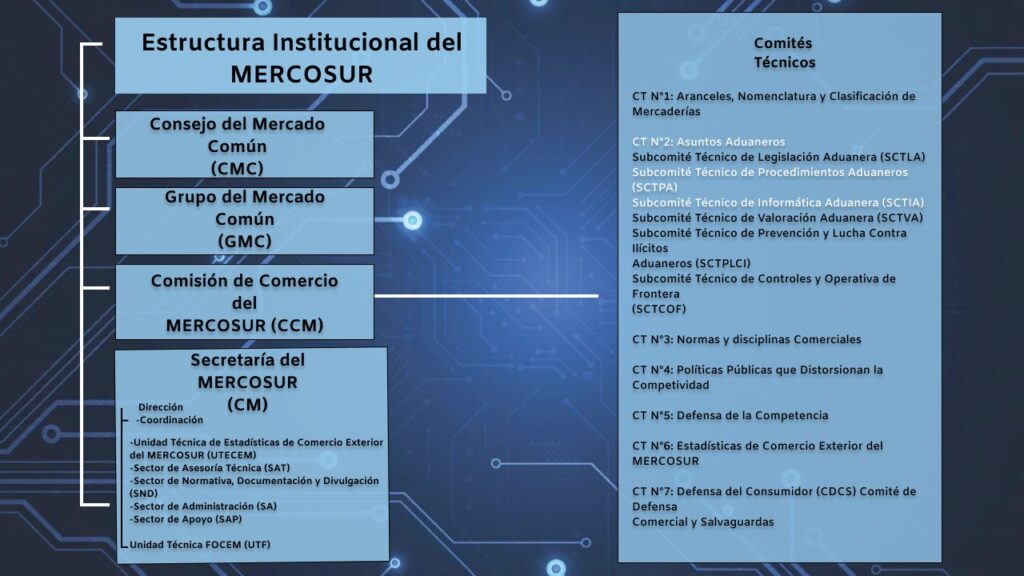
Its working methodology is very simple and effective. With each Pro-Tempore Presidency (semiannual and rotating), an analysis is carried out of: a) the issues in process and, b) the pending issues in the customs integration process. With regard to the issues in process (a), a schedule of implementation is established, and with regard to the new issues pending development (b), priorities are selected, tasks are distributed among the subgroups, an agenda is established and work begins until the conclusion of the work. Then, the project is submitted to the CCM, which, if approved, is sent to the Decision-Making Body empowered to issue the rule or implement the developed process.
In the case of the INDIRA System, two of the Technical Sub-Committees that make up CT2 have played a fundamental role: the Technical Sub-Committee on Information Technology and the Technical Sub-Committee on Customs Procedures. We owe this important development to them in particular.
4.3.- Its operation
The MERCOSUR Member States use four different and independent computer systems to register their customs operations: the Malvina System in Argentina, the SISCOMEX System in Brazil, the Sofía System in Paraguay and the Lucía System in Uruguay.
When a query is made through the INDIRA System, the Web application connects to the web service of the required country via the Internet using HTTPS with WSSA (Web Authentication and Authorization Service); the response is received on the screen of the same customs agent, in real time and the data is encrypted in XML format.[5]
Customs Services are responsible for determining which officials are authorized to make inquiries in the system and the required level of security, so that in the event of a leak or sale of information, the persons who have accessed it are identifiable.
All queries made with the INDIRA system will be executed on the server of the country of registration of the destinations to be consulted. Therefore, first of all, when making a query, the official must select the country on which it will be applied.
Once the country has been entered, the official will be able to select one of the five queries currently available:
– Consultation of a Detailed Declaration
– Destination Consultation
– Intra-zone Import Destination Consultation
– Consult Destinations that invoke CCPAC (Certificate of Compliance with the Common Tariff Policy) / CCROM (Certificate of Compliance with the MERCOSUR Origin Regime).
– Consultation CCPAC/CCROM Certificate
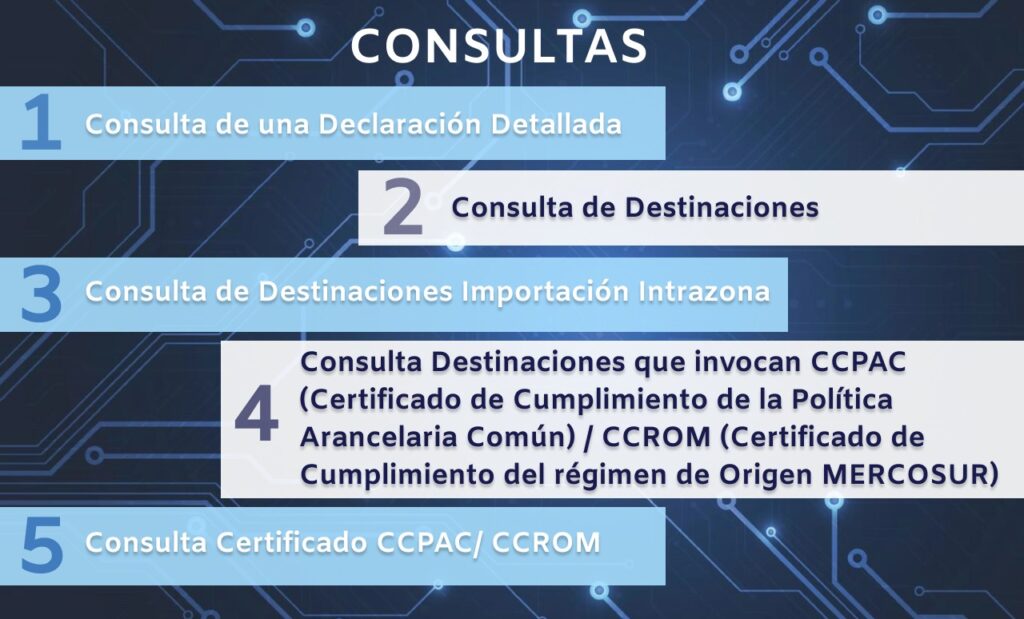
In addition to queries on specific Declarations or Destinations, the System also makes it possible to make other generic queries and for periods of time (up to 30 days), for example: to know the universe of exports from Uruguay to Argentina in a given period of time, and then, once the operation on which you wish to investigate further has been detected, access it and each of its items if you consider it necessary.
Once the query data has been obtained, the System offers the official a button to Save Consulted Declaration, which when pressed allows the generation of a file in CSV (Comma Separated Values) format with the information displayed on the screen. In other words, the System extracts and saves the information in the registry system of the consulted country for the consulting official.
As mentioned in the previous regulatory framework, the system provides information on all import destinations from any country to the MERCOSUR Member States and on exports from them. In addition to these countries, in Argentina it is possible to access the declarations of the following MERCOSUR member countries: Chile, Ecuador and Bolivia, due to the existence of specific agreements in this regard.
The INDIRA System and customs valuation
By means of CMC Decision No. 13/07, the Agreement on the Implementation of Article VII of the General Agreement on Tariffs and Trade of 1994 (GATT) was adopted within the scope of MERCOSUR, and the Implementation Standard on the Customs Valuation of Goods was approved.
For this reason, and in order for the Member States to carry out the control of the customs value of imported goods in a uniform manner, the Common Market Council proceeded to approve, through Decision 16/2010, the “MERCOSUR Procedures Manual for Customs Value Control”.
In section 4.1 of the said regulation, entitled “Preparation of the inspection”, it is established that the start of any inspection includes an initial phase of recognition. Once the subject to be inspected and, eventually, the object of the inspection itself have been defined, the internal preparation phase consists of the set of procedures carried out before the direct visit to the operator, with a view to collecting and selecting information on the case, ranging from its registration data to market information on the goods whose value will be analysed.
The preparation of a file is an essential procedure in the preparation stage of the audit and consists of the compilation and classification of all the information available on the company and the merchandise. Some of this information may be collected internally, such as:… consults INDIRA on similar operations carried out between the importing country and the other States Parties of MERCOSUR, as well as operations of the other States Parties in extra-zone trade. "
As can be seen, the MERCOSUR Valuation Manual itself indicates the convenience of proceeding to consult the INDIRA system in order to, based on the information obtained there, proceed to the inspection of the operations.[6]
4.4.- INDIRA and International Standards.
The INDIRA System and the OMA
At the 119th/120th Sessions of the Council of the World Customs Organization, held from June 28 to 30, 2012, the Argentine Republic, representing the Customs of MERCOSUR, expressed its intention to participate in the demonstration phase of the viability of the Globally Connected Customs Initiative using the INDIRA System.
Subsequently, during the 74th Session of the General Policy Commission, held from 7 to 9 December 2015, the Argentine Republic insisted on its proposal for an Information Exchange Agreement, highlighting that it has been tested by the MERCOSUR countries for eleven years with positive results.
The Commission thanked Argentina (supported by the other MERCOSUR members and Chile) for presenting such an interesting regional approach to the exchange of information and instructed the Anti-Fraud Committee (AFC) to carry out a detailed evaluation of the proposal, comparing the text with the Nairobi and Johannesburg Conventions and the elements of the Utility Blocks of the AMR. The Committee issued a statement suggesting the convenience of adapting it to the international standards on which the WCO was working.
The INDIRA-MODDA System and the WCO
In order to enable the expansion of the model worldwide and to enable interoperability of systems, the project called INDIRA-MODDA was launched in 2019, which adopts the format of the World Customs Organization Data Model and begins to discuss the technological framework for data exchange, within which the format of the messages (XML or JSON) and the definition of the architecture, infrastructure and transmission (Blockchain, WS, etc.) must be defined.
Looking back a bit, we must remember that by CMC Decision No. 17/10 the "Single Customs Document of MERCOSUR" (DUAM) was established as the common data model to integrate declarations of customs destinations and operations in MERCOSUR as an indispensable step for the harmonization of customs management procedures.
Subsequently, awareness was raised of the need to take into account the provisions of the Recommendation of the Customs Cooperation Council on the use of the WCO Data Model, so work was undertaken to align its data with those of the WCO Data Model, in terms of names, definitions and identifications.
In 2015, the Customs Directors of the MERCOSUR Member States approved the launch of the project "Harmonization of the MERCOSUR Customs Declaration Data Model (MODDA)" and, working together with WCO Experts, achieved the objective of a univocal interpretation of the MERCOSUR data model with respect to the WCO Data Model.
Accordingly, on August 26, 2021, the Common Market Group, through Resolution GMC 9/2021, approved the MODDA and instructed the States Parties to incorporate it in all projects that involve the exchange of information and implementation of systems linked to the data of the customs declarations of the States Parties, and of these with third countries or groups of countries.
Adaptation to the WCO Data Model renews the hope of positioning INDIRA as a Model Customs Information Exchange System, replicable as a best practice at the international level.
5.- Final words
In June 2005, the WCO Council approved the Resolution that launched the so-called Framework of Standards to Secure and Facilitate Trade, known as "SAFE Regulatory Framework” (SAFE Framework, as it is known in English).
This international instrument marked the beginning of modern supply chain security standards and announced the start of a new approach to the control of goods, of a comprehensive, holistic nature, which ensures the security of the entire logistics chain, from the exporter who sends the goods to the importer who receives them, ensuring the reliability of all the sectors involved, while recognizing the importance of a closer partnership between customs and the private sector and between customs themselves.
In fact, one of its fundamental pillars is called “Customs – Customs”, whose central principle is the use of advance electronic information to identify high-risk cargo and means of transport, through the use of automatic guidance tools, which make it possible to identify high-risk shipments as early as possible in the supply chain.
In this way, a real “paradigm shift”: There is no longer a tiered vision (importing country / exporting country), but rather an attempt is made to ensure the entire process, from the exporter's factory to the importer's warehouse.
In this context, the implementation of the INDIRA System has brought with it a series of benefits, including greater facilitation and security of regional trade, since this tool has made it possible to prevent, deter, as well as investigate and suppress customs offences, which previously went unnoticed due to the lack of information to cross-check and compare.
The INDIRA System is a dynamic and expansive tool, as it is constantly being reviewed and updated within the MERCOSUR, incorporating new data and consultations at the request of the Member States and with their consensus.
Its adaptation to the WCO Data Model will allow it to return to the “big leagues” and present itself as a viable and effective model for automatic exchange of information.
[1] The Argentine Republic formally joined through Law No. 19.044 of 1971.
[2] In 2018, the Argentine Republic ratified the Trade Facilitation Agreement (TFA) of the World Trade Organization (WTO), in force since February 22, 2017 (Law 27.373).
[3] The Argentine Republic formally adhered to its main body through Law No. 22.663 and to its annexes through Law No. 24.208. Subsequently, its Modification Protocol was approved on October 10, 2010 through Law No. 26.642.
[4] This rule was internalized in Argentina through AFIP General Resolution No. 2495, dated September 22, 2008; in Brazil, through Decree 6870/09 of June 4, 2009; in the Republic of Paraguay through DNA Resolution No. 99/12 of February 22, 2012 and in Uruguay, through Decree No. 282/12 of August 27, 2012.
[5] It should be noted that currently, consultations between the founding States Parties of MERCOSUR are carried out in the manner originally implemented, through a Virtual Private Network.
[6] As a mere example of the effective use of this valuable tool for the detection of inaccurate value declarations in the Argentine Republic, we can mention the following case law precedents: (i) Ruling of the FEDERAL ADMINISTRATIVE LITIGATION CHAMBER – CHAMBER III 44028/2019 MALTERIA PAMPA SA TF 35123-A v. DGA s/DIRECT APPEAL BY AN EXTERNAL ORGANIZATION confirming the fine imposed by the Argentine Customs on the company for inaccurate declaration of the value of its export prices to Brazil (art. 954, ap.1, inc. c of the Customs Code), available at http://scw.pjn.gov.ar/scw/home.seam ; (ii) Ruling of the TAX COURT OF THE NATION - Chamber E - "PIONEER ARGENTINA SRL v. DGA s/ appeal" EX-2021-91985106-APN-SGASAD#TFN, which confirms the fine imposed by the Argentine Customs for the inaccurate declaration of the import price of the merchandise (parental seeds) from Brazil (art. 954, ap.1, inc. c of the Customs Code), available (soon) at https://jurisprudenciatfn.mecon.gob.ar/ ; and (iii) Ruling of the FEDERAL ADMINISTRATIVE LITIGATION CHAMBER - CHAMBER III 44028/2019 MALTERIA PAMPA SA TF 35123-A v. DGA s/DIRECT APPEAL BY EXTERNAL ORGANIZATION confirming the fine imposed by the Argentine Customs on the company for inaccurate declaration of the value of the prices of its exports to Brazil (art. 954, ap.1, inc. c of the Customs Code), available at http://scw.pjn.gov.ar/scw/home.seam.

The author is a Member (Judge) of the National Tax Court. University Professor. Specialized in Higher Education Teaching (UCC). Professor at the National University of Córdoba (UNC), Blas Pascal University (UBP), Austral University and Universidad del Rosario (Colombia). Professor and member of the Academic Committee of the Specialization in Customs Law at the National University of La Plata (UNLP). Member of the Drafting Group of the MERCOSUR Customs Code. Author of the book: "The World Customs Organization. Past, present and future.". Tirant Lo Blanch Publishing House, Valencia City, Spain. Year 2021 - Email: [email protected]