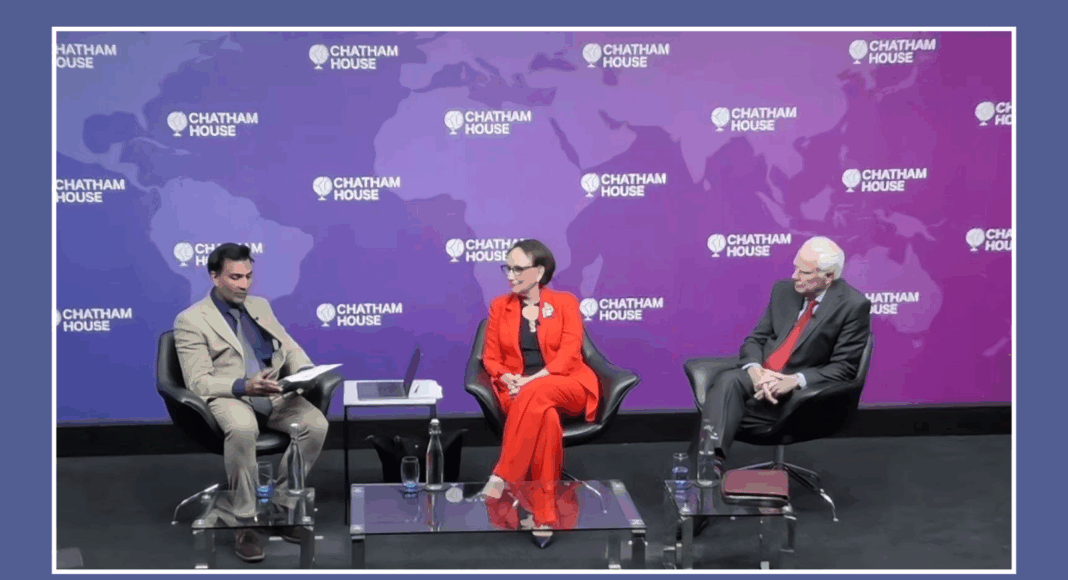

The Secretary-General of the United Nations Conference on Trade and Development (UNCTAD), Rebecca Greenspan, participated today (26.11.2025) in a panel at Chatham House where she offered a profound reflection on the current state of multilateralism, the structural changes in world trade and the challenges facing international cooperation.
During her speech —broadcast live by The Royal Institute of International Affairs, better known as Chatham House, a prestigious think tanks The Secretary-General of UNCTAD, a British organization based in London whose mission is to “help governments and societies build a sustainable, secure, prosperous and fair world”—emphasized that, despite the widespread discourse on the “crisis of multilateralism”, the facts show a more complex reality.
“On the one hand, there is talk of a crisis, but on the other, we see that the world wants to continue coming to multilateral spaces,” he stated, recalling that the UN General Assembly returned to pre-pandemic participation levels in 2024, and that the recent 16th United Nations Conference on Trade and Development gathered 170 delegations, the highest figure in its history.
Multilateralism: Between Tensions and Opportunities
Ms. Greenspan noted that while the agreements reached in forums such as COP or the G20 fall short of addressing the magnitude of global challenges, the persistence of international dialogue is a sign of commitment. “Perhaps the agreements are not ambitious enough, but they still show that it is possible to build shared minimum standards in a difficult context,” she stated.
In his analysis, he emphasized that the challenge is not only to defend the existing system, but to transform it. “The world today is very different from that of 1945. To be multilateralist means to be reformist. We must preserve the multilateral space, but adapt it to a different century,” he argued.
Global trade shows resilience
Regarding the report Trade and Development ReportGreenspan, speaking about the report that UNCTAD will publish next week, said that the organization identifies a surprising resilience of international trade despite geopolitical tensions and the rise of protectionism.
As he anticipated:
- Global trade will grow by around 4% in 2025, outperforming global GDP growth.
- The worst-case scenario predicted at the beginning of the year —a sharp contraction in trade— did not materialize.
- Part of the growth is due to the acceleration of imports in the face of uncertainty about tariffs, but also to profound structural changes.
One of these changes is the expansion of South-South trade, which today represents a percentage equivalent to trade between advanced economies: “For the first time in three centuries, South-South trade is as important as North-North trade: 30% and 30%, respectively. And South-South trade is growing at 8% annually,” he emphasized.
Even excluding China, trade among developing countries remains dynamic. Greenspan added that 70% of global economic growth over the next five years will come from the Global South, reflecting a more diversified, multipolar, and decentralized economy.
Services, digitization and AI
The head of UNCTAD stressed that Services are currently the most dynamic segment of world trade (something that was also highlighted by ECLAC in its report from November 19th), driven by investments associated with digital technologies and artificial intelligence. “AI is transforming the structure of trade. Investments in this area have also driven the expansion of trade in services,” he explained.
In that regard, Grynspan emphasized a main pointToday we live in a world where seemingly contradictory forces coexist—protectionism and openness, nationalism and cooperation, uncertainty and resilience. “Not everything moves in the same direction. We need evidence "To understand that complexity," he noted at the beginning of a presentation that lasted for an hour.
The event —broadcast live, with audience and online participation— addressed geopolitical tensions, the resurgence of economic nationalism, the limitations of multilateralism, and the role of evidence in policymaking.

Aduana News foi o primeiro jornal aduaneiro da Argentina a lançar sua versão digital. Com mais de 20 anos de trajetória, suas publicações e iniciativas têm como objetivo oferecer o conhecimento mais relevante sobre temas aduaneiros, contribuindo para a promoção do comércio seguro e da facilitação do comércio na região.