With the year entering its final stretch, the Economic Commission for Latin America and the Caribbean (ECLAC) presented its annual report this Wednesday (19.11.2025), from Santiago, Chile.International Trade in the New Era of Instrumentalized InterdependenceIn a virtual press conference, the organization analyzed how the new US tariff policy is reshaping global and regional trade flows.
The Executive Secretary, Jose Manuel Salazar-Xirinachs, warned that “Trade and geopolitics are more intertwined than ever, creating an uncertain global scenario.”Given this context, characteristic of 2025, the organization stated that the region must diversify its trading partners, strengthen alliances both within and outside of Latin America, and move towards more effective regional integration, including regulatory convergence, infrastructure and logistics.
Economists Sebastián Herreros, José Durán and Nanno Mulder —members of the team that prepared the report— participated in the event where the main results were presented, showing the accelerated transformation of world trade.
A world with more tariffs and fewer rules
One of the key findings released by ECLAC is the sharp increase in US tariffs: the average effective tariff went from 2,4% in 2024 to 17,4% in September 2025The highest level in nine decades. ECLAC noted that this policy breaks with the norms of the multilateral system and pushes toward a framework of bilateral negotiations that demands greater coordination and strategy for the region. The profound shift in US trade policy during 2025 substantially alters the terms under which trade relations between the region and that country were traditionally conducted, which, in several cases, included tariff-free trade based on legally binding commitments. While, in general, the region's exports face lower tariffs in the United States than those of most of its main competitors, this situation could change depending on the evolution of trade balances or even non-economic factors.
Global dynamics also show that trade is still expanding —5% growth between January and July 2025 and a projection of 2,4% for the whole year— although with a projected decline by 2026, when an increase of just 0,5 %.
Services on the rise and intraregional trade recovering
The report highlights that exports of goods from Latin America and the Caribbean grew 4%and those of services 7% during the first half of 2025. modern servicesSectors linked to technology, knowledge, and digitization were the most dynamic, with an increase of 13 %while mining continued to decline.
Trade within the region—key to productive integration—also showed signs of recovery, with growth of 1%After the previous year's decline, Argentina and Brazil drove the rebound thanks to the dynamism of the agro-industrial sector, with increases in beef, soybeans, oil, and other agricultural products.
Trade relations with the U.S.
ECLAC stressed that the trade relationship with the United States is strongly dominated by Mexicowhich accounts for 63% of exports and 75% of thes imports regional toward that market. Without Mexico, the region maintains a trade deficit with Washington.
Still, Latin America receives a lower average tariff (7,4%) than that applied to the rest of the world, which opens up opportunities in sectors such as clothing, medical devices and agribusiness.
Technology, talent and innovation
The report dedicates an entire chapter to exports of high technology and modern services. Technological manufactures already represent 30% of global manufactured exportsand the most modern services 50 % of global service exports.
In the region, Mexico is by far the leader in high-tech manufacturing, while Brazil, Mexico, Argentina, and Costa Rica lead in knowledge-based services. Salazar-Xirinachs highlighted that “Countries that converge in income with advanced economies are those that manage to increase their share of more technologically intensive goods and modern services.”.
Argentina: What role should Customs play?
During the conference, Aduana News ECLAC was consulted on how Argentine Customs can contribute to improving export competitiveness in a context where the United States has signed new framework agreements with countries in the region, including Argentina.
The specialists responded that The continuity of trade facilitation is essential. They pointed out that the agreement with the United States includes concrete measures, such as pre-arrival processing of goods, facilities for express delivery operators, and the possibility of certifying Specialized Economic Operators, which streamlines and professionalizes the export chain.
Furthermore, they insisted that Argentina must strengthen infrastructure, logistics and supply chainsfundamental elements in a country with large internal distances. Physical integration with Brazil, Chile and Paraguay, in line with the commitments of Brasilia ConsensusIt was presented as an indispensable condition to boost productive territorial development and expand intraregional trade.
Conclusion: alliances, integration and technology
The report concludes with a powerful call to action. In the words of the Executive Secretary of ECLAC:In this new era of interdependence, geographically diversifying trade—deepening ties with established partners like the European Union and China, and expanding into emerging markets such as India, ASEAN, and the Gulf countries plus Africa—as well as consolidating regional alliances and increasing the technological sophistication of our exports, is crucial. Without skilled human talent and strong institutions, it is impossible to manage the challenges posed by digital transformation and the technological revolution, or to overcome the limited growth capacity that persists in our region..
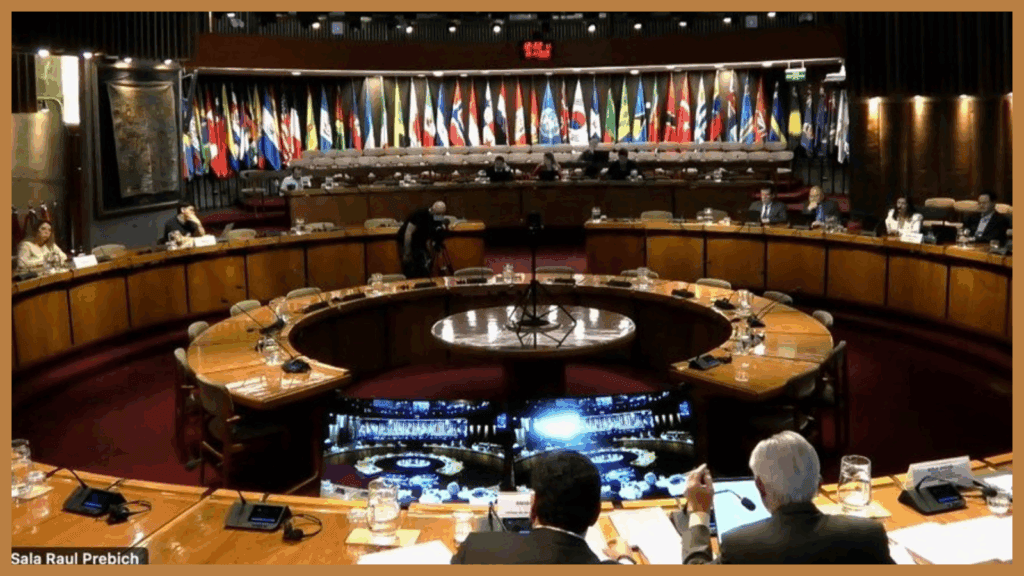
Finally, ECLAC invites you to consult the report International Trade Outlook for Latin America and the Caribbean, 2025, presented during the press conference and available below.
◼ https://repositorio.cepal.org/server/api/core/bitstreams/7375883b-5e0a-4203-b2fa-dab429cbba4e/content

Aduana News foi o primeiro jornal aduaneiro da Argentina a lançar sua versão digital. Com mais de 20 anos de trajetória, suas publicações e iniciativas têm como objetivo oferecer o conhecimento mais relevante sobre temas aduaneiros, contribuindo para a promoção do comércio seguro e da facilitação do comércio na região.