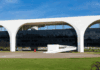
The corner of Arenales and Uruguay streets was the stop, where the New headquarters of the Embassy of Uruguay in Argentina, an aristocratic residence inspired by French neoclassicism. In this hierarchical space that maintains the atmosphere and style worthy of the importance of the relationship between both countries, he received the Ambassador, Dr. Hector Lescano Fraschini to Aduana News. There, this veterinarian, professor and politician analyzed the state of the bilateral relationship, the coordinated activities and the challenge posed by the growing international uncertainty.
Question. How did you end up at the Uruguayan Embassy in Argentina?
Reply. When el Uruguay recovers democracy, andIn 1985, I had to choose between two strong vocations: a Doctorate in Veterinary Medicine or Politics. Although I was elected national deputy, I have the honor of being part of the National Academy of Veterinary Sciences for contributing to the dissemination of a noble profession linked to health, which transversally cuts across almost all areas of human activity. Specifically, in politics, the ambassadors in Argentina, due to the strong ties that unite us, have been political ambassadors, that is, appointed by the President of the Republic. So it was an appointment by President Tabaré Vázquez and Foreign Minister Rodolfo Novoa with the approval of the Senate and the support of all political parties. For me it is undoubtedly an honor to represent Uruguay in this great country. This is the largest embassy in the world due to the number of Uruguayans living in Argentina and the most important due to the ties to which I referred.
P: How is the political relationship between Uruguay and Argentina?
R: Bilateral relations are going through a very good moment. Since January 2016, when the first summit meeting between the two presidents was held in Anchorena, Colonia department, Uruguay, there has been great progress, with a positive agenda that until now remains without points of controversy that cannot be resolved within the framework of an excellent climate. The good relationship is not only between the leaders but also between the ministers and the binational commissions, many of which have to do with the Río de la Plata, the Antarctic Treaty, the Maritime Front and the Joint Technical Commission in Salto Grande, among other issues. There is a very fluid relationship to improve aspects of Mercosur and open ourselves to the world as a more consistent platform than it has been until now. So bilateral relations are very good. Symbolically, this is transmitted in the inauguration of this Embassy, property of the Uruguayan State in Argentina, on the corner of Arenales and Uruguay. The new headquarters was inaugurated with the presence and speeches of the two presidents accompanied by their foreign ministers. This image reflects our relationship and the Embassy with the Consulate is working in this direction to deepen it.
P. What projects are being implemented on the border to deepen the relationship?
R. This aspect is very important. After many years, the Border Committee (CODEFRO) and the Border Commissions that link two cities on the coast of Entre Ríos, such as Colón with Paysandú (Uruguay) and Gualeguaychú with Fray Bentos (Uruguay), began to function. We are not a federal country, but we share, in the territories, decentralized activities linked to common objectives such as facilitating border crossings and the necessary controls. Together we fight drug trafficking and human trafficking. In addition, there are productive projects, since they are very rich areas on both sides. Also, educational projects. For example, there are binational courses such as the Bachelor's Degree in Tourism that is offered in the Salto Oriental North Region. There is the largest infrastructure of the University of the Republic, which is the largest in Uruguay; there are agreements with universities in Entre Ríos and the Montevideo Group that does a great job with other educational centers in the region. So there is an important dynamism in these commissions, and the participation of civil society.
Then, There is joint work with customs, which are important border points where control is not easy to carry out. In this regard, the National Director of Customs of Uruguay, Dr. Enrique Canon, has made public statements regarding the need to incorporate technology and trained personnel, fundamentally. For example, last week, Customs detected a container of 417 kilos of cocaine thanks to the collaboration of Argentine Customs. And next November, there will be a meeting of directors of customs of America in Sao Paulo, Brazil, to identify issues such as the Authorized Economic Operator, coordination motivated by the political will to combat evils and opacity.
I have been asked about money laundering. Uruguay has a firm position on This does not mean that the situation is perfect. In some cases, self-criticism is necessary and perhaps sometimes control was not exercised with the appropriate firmness and depth. But the prosecutor's offices for organized crime, money laundering, and new issues between interjurisdictional Uruguayan organizations work very well. The Prosecutor of the Court has instructed the prosecutors to work firmly on these issues and the President of the Republic himself has recommended to one of his closest ministers the monitoring of port movements. So Uruguay is working on the issue responsibly because it is its obligation, to which is added the interest in coordinate action with Argentina.
On the other hand, on the river border that we share, nature brought Timoteo Domínguez Island closer to Martín García Island and there is a project aimed at inaugurating the first dry border in history between Uruguay and Argentina.
Q. What binational projects exist to boost the regional economy across the river border?
R. There is great coordination at the Ministry of Tourism level, and also on a personal level with Gustavo Santos. For example, there is a river project in Pájaros Pintados that consists of a tour of the area with an agenda based on natural and cultural resources.
Another example is the Jesuit Route, similar to the Camino de Santiago (Spain). The Jesuit footprint was important in Paraguay, Argentina, Bolivia, and also in the Jesuit estancias in Uruguay.
There are also tourism promotion projects in distant places. Japan is the only Mercosur tourism project with an office in Tokyo, a destination with an interesting demand.
All these Projects are generators of labor for men and women in the region, which will not be replaced by the robot, because there is no technology that can replace human warmth.
Q. Is there a binational cruise project?
R. Cruise activity is important in Uruguay. Our country is receiving between 300 and 400 cruise ships in the ports of Montevideo and Punta del Este. This requires a lot of manpower. For example, a Uruguayan piano tuner was able to provide his service to these floating cities. And with Rosario we have raised the possibility of a river tourism for the external, internal and social sectors. Of course, this initiative is linked to the navigability of rivers, which is why work is being done on dredging and improving ports to promote cruise tourism.
P. What measures will Uruguay take for the summer season?
R. Uruguay has announced at the FIT a series of measures related to the exemption of VAT on car rentals, housing rentals… In short, it is a stimulus from the public and private sectors to help an activity that is so important for the country. Tourism is a two-way street. Last year, Uruguay had a record of almost two million Argentines. Given the exchange rate situation, Uruguayans and other tourists from around the world will come to Argentina. As has been studied, people like to have one more stamp in their passport; therefore, regional complementarity will help the Dutch or German who come here also be interested in crossing the river to add one more stamp to their cultural baggage.
P. Is there enough connectivity?
R. Yes, there is, although it deserves to be strengthened. Uruguay is interested in developing the greatest possible connectivity at the border crossings, which are three bridges, although there could be talk of a future fourth bridge for the one that is still on the agenda. Also, river and air connectivity between Montevideo and Buenos Aires and other cities such as Rosario, Córdoba, etc. We are a little low on frequencies.Q. What is the cultural frequency?
R. It is the busiest bridge. During this century and the last, Buenos Aires has been a great magnet but there are complementary projects. Colon and Solis theaters are two icons whencultural events, the oldest and most recognized for their quality and history. Here, within the framework of the open embassy, we try to have the greatest amount of cultural activity possible. In this venue we will have mixed exhibitions between Argentine and Uruguayan visual artists who are interconnected. China Zorrilla, who left an important mark on the culture of the River Plate, will be honored at the Teatro Colón. A few days ago Hermenegildo Sabat died, a great journalist, visual artist, very recognized by Uruguayans and Argentines, an icon. When I talk about culture, I also refer to Páez Vilaró, Berugo Carámbula and Juan Manuel Tenuta. The Argentine people love Alfredo Zitarrosa, one of the strongest oriental voices in popular singing. I also refer to the sporting aspect, youth participation in nautical activities, the Argentine soccer market, so important, horse riding and Uruguayan murgas like Agarrate Catalina, a strong cultural expression in every sense, voices, costumes and content.
P. How should Uruguay think about the international framework and the Brazilian elections? Eastern culture says that "if a man lives in the past, he despises the present; if a man ignores the present, he may despise the future."
R. I appreciate that you mentioned the past, because we easterners have the deepest inspiration in Artigas, protector of free peoples and integration. Uruguay gives enormous weight to international politics. The chancellor has mentioned that “Uruguay's politics will one day be international politics or it will not be.” We are a small country geographically, located between two large countries and We would like to improve Mercosur. The bloc has large debts after twenty-five years of its foundation. As a parliamentarian, I voted for the Treaty of Asunción and I remember having done so with political conviction, because the integrationist ideal is that of Artigas and San Martín, the Founding Fathers and of the great popular currents. Hopefully Mercosur can improve so that agreements can be made with other important blocs, such as the European Union, to contribute to multipolarity. Regarding Brazil, there is great expectation with the presidential election. I think the word is “uncertainty”, because some expressions have been made by the one who has the greatest chances of being elected. Of course, we are concerned about homophobia, the treatment of minorities and women, the intention to get closer to Trump, but we hope that his trade policy does not affect the relationship with Argentina so that we can integrate as well as possible. We are there, faithful to the main lines of international politics such as non-intervention and the peaceful solution of controversies.
Quoting Miguel de Unamuno, who spoke of the numbersIn terms of numbers, we are a small country in terms of geography and population, but the letters have to do with values such as the challenge of caring for the environment. This is a big issue that is worrying in the face of the fatal political will of countries to consider what Pope Francis mentions in "Laudato Si". The letters also refer to democracy and peace that must be based on justice. Below these lines is Uruguay.
****
Profile
*Hector Carlos Lescano Fraschini (Uruguay, February 13, 1948)
*Ambassador of Uruguay in Argentina since 2015
*Veterinarian, professor and politician
*Married and father of three boys
*Decorations: Bernardo O'Higgins Order for his constant parliamentary struggle for democracy in Chile and Order of Merit of the Italian Republic in the rank of Commendatore.

Aduana News foi o primeiro jornal aduaneiro da Argentina a lançar sua versão digital. Com mais de 20 anos de trajetória, suas publicações e iniciativas têm como objetivo oferecer o conhecimento mais relevante sobre temas aduaneiros, contribuindo para a promoção do comércio seguro e da facilitação do comércio na região.