
Below is a brief summary of the most significant developments in the foreign exchange market since December 13, 2023. For context, it should be noted that during the last two years of the previous administration—between 2022 and December 10, 2023—there was a virtual cessation of payments for goods and services, resulting from the dramatic shortage of foreign currency at the Central Bank.
Almost all payments for imported goods and services were subject to authorization from the former AFIP (National Tax Administration Agency), through the submission of SIRE (for goods) and SIRASE (for services) forms.
These documents authorized importers to access the foreign exchange market on a specific date. However, when the foreign currency purchase was finalized, the authorization platform—known as the Single Current Account for Foreign Trade (CCUCE)—was either not functioning or had been out of service for several days.
Only transfers abroad were allowed for tourism services, health expenses, loans from international financial organizations, and payments for purchases in foreign currency using credit and debit cards.
New measures for access to the foreign exchange market from December 2023
Upon the new administration's assumption of office, a new exchange rate regime was established through BCRA Communication A 7917. Over the following months, foreign payments for goods and services began to be gradually regularized.
Starting December 13, 2025, a new system for access to the foreign exchange market will be established. From that date, all new payment flows for imported goods and services will be able to be made with direct access to the foreign exchange market, without the need for a prior SIRA or SIRASE.
Regarding commercial debts for imports of goods and services prior to December 12, 2025, these can be settled by subscribing to Bopreales, according to the various series available.
For new imports of goods made on or after December 13, 2025, payments may generally be made in four installments of 25% each, at 30, 60, 90, and 120 days from the date of nationalization of the goods.
Some exceptions are established:
- For automobiles, payments can be made 180 days after delivery to the dealership.
- For certain goods linked to the fuel and energy sector, payment is enabled within zero days of delivery to the warehouse.
- Medicines and fertilizers may be paid for 30 days after nationalization.
- Services may be paid within 30 days of their provision or accrual.
- Likewise, payment for services to related companies is again enabled, and may be made 180 days after the service is rendered or accrued.
On the other hand, three series of Bopreal bonds were issued in December 2023, intended for the payment of goods, services, profits, and dividends accrued through December 12, 12.
These three series reached a total value of USD 10.000 billion, were fully subscribed, and have a maximum maturity of October 2027.
The issuance partially decompressed the significant commercial debt accumulated from 2020 to December 2023. According to the former AFIP registry, importers of goods and services declared liabilities of USD 24 billion as of January 01, 2024, although only USD 50.000 billion of the Bopreal bonds issued were subscribed.
Both the Ministry of Economy and the Central Bank of Argentina (BCRA) provided extensive facilities for the subscription of Bopreal bonds to pay off debts from the previous government's stock, as well as tax breaks, since the first series of Bopreal bonds, worth USD 5.000 billion, was exempt from the country's tax.
On the other hand, imports of goods were regularized month by month, and payment terms gradually decreased throughout the year. We reached the end of 2024 with a unified payment term of 30 days for all goods, except for fuels and lubricants, which remained at zero days from the date of shipment to the market.
Also in the services sector, foreign currency transfers were regularized, and intercompany services began to be paid for starting in July 2024.
Exchange rate stability, liberalization and complementary measures in 2024-2025
Throughout the year 2024, a notable exchange rate stability was maintained, supported by a monthly devaluation scheme of 2%, known as crawling pegs.
It is worth highlighting the success of money laundering, which allowed for the externalization of more than USD 30.000 billion and contributed significantly to exchange rate stability.
Furthermore, the gap between the official dollar and financial dollars—MEP and cash with settlement (CCL)—did not exceed 15% throughout the year, with some months in which it fell to less than 5%. This situation contrasts sharply with previous years, when the gap exceeded 200%.
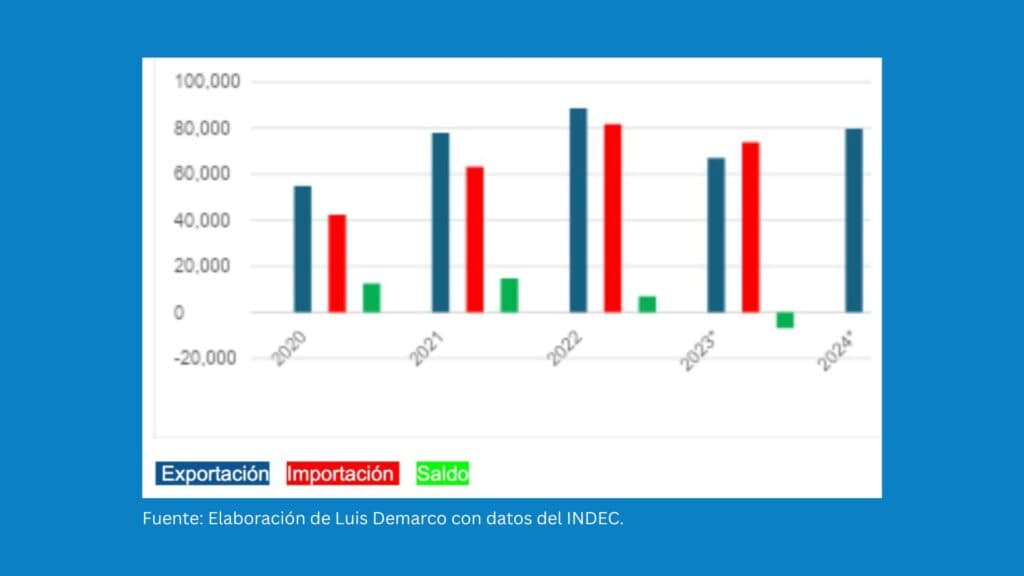
Exports registered a considerable increase compared to 2023, while imports of goods decreased compared to the previous year. As a result, the trade balance showed a surplus of USD 18.929 billion.
In April 2025, the government launched an economic stability plan that included liberalizing access to the foreign exchange market for individuals residing in the country. Since then, they have been able to freely purchase dollar bills on the local market or transfer them to their own accounts abroad through banking institutions.
It's worth remembering that legal entities and other entities are not authorized to purchase foreign currency or make transfers abroad with access to the foreign exchange market.
In addition, the period of car park 90 days to operate in both the foreign exchange market and the securities market, allowing individuals to intervene simultaneously in the MEP and CCL dollar markets and in the official foreign exchange market (MULC).
Finally, the payment of dividends to companies with access to the MULC, starting with the fiscal years commencing on or after January 1, 2025.
The 90-day stay outside the MULC for companies operating in the MEP or CCL dollar is being waived for a one-time period. Thus, they will be able to regain access to the official foreign exchange market starting April 14, 04. This waiver is exceptional and is granted only once. If a company returns to operating simultaneously in both markets (official and financial), it will again lose access to the MULC for a period of 2025 days.
All goods and services will have reduced payment terms starting April 14, 04, and can be paid within zero days from the date the goods are dispatched to the warehouse or from the date the service is rendered or accrued. This means that payment terms are reduced from 2025 days to zero days.
Intercompany services are reduced from 180 days to 90 days for paying the MULC at the official dollar rate.
Companies with MSME certification can pay on demand for shipments after 14/04/2025
Advance payment for capital goods is also permitted up to 30% of the FOB value.
The Ministry of Economy, for its part, will issue a new series of Bopreal 4 bonds, which will allow for the settlement of obligations not only for goods, services, profits, and dividends, but also the principal and interest on intercompany loans that do not have access to the foreign exchange market.
Currently, individuals residing in the country are purchasing between USD 60 and 70 million daily, representing monthly sales of nearly USD 1.300 billion.
It's worth noting that the general public has not withdrawn the dollars purchased on the single free exchange market (MULC) from banks: almost 95% remain deposited in current accounts.
This, in turn, allows local financial institutions to use these funds to provide loans to exporters or producers that generate foreign currency.
This entire stability plan will be complemented by the current Administration with a set of measures to be approved by the National Congress to allow the use of dollars deposited in banks, stored in safe deposit boxes, or in household mattresses to purchase goods registered in dollars with financing and tax facilities. This will ensure that the dollars in circulation produce a multiplier effect and thus contribute to the stability and growth of our country's economy.
It is worth noting that the PAIS tax on imported goods and services has been eliminated, a measure that contributed to a higher real exchange rate. In the case of exports, a temporary reduction in withholding taxes was implemented until June 30, 2025. Furthermore, the foreign exchange market was unified, establishing the obligation to enter and settle foreign currency for goods and services through a single channel, which implies the elimination of the so-called dollar blend scheme (80% MULC and 20% MEP/CCL).
Below, and by way of closing, a table is presented showing the evolution of exports and imports of goods since 2020, which allows a graphic visualization of the improvement recorded in the last year, evidenced by a notable increase in the trade surplus.
Picture: comparison of exports, imports and trade balance

He is a certified public accountant from the University of Buenos Aires (UBA). He has a postgraduate degree in Finance from the Universidad Argentina de Empresas (UADE). Currently, he is Head of the Comex Technical Area at Banco Santander Argentina, since 1987. He also serves as Secretary of the Comex Commission at the Association of Argentine Banks (ABA), since 2011. He has been married for 34 years to Adriana Barsanti, and has three children aged 33, 31 and 26, all professionals.