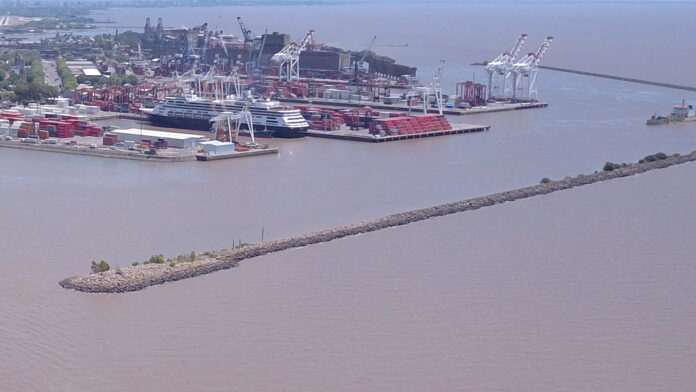
The National Government made official this Monday (06.01.2025) the dissolution of the General Port Administration (AGP), a state-owned company that since its creation was in charge of the administration of the Port of Buenos Aires and, more recently, the management of the Paraná-Paraguay Waterway.
The measure, made official through the Decree 3 / 2025, establishes the liquidation of the AGP Sociedad Anónima Unipersonal (AGP SAU) and the Undersecretariat of Ports and Navigable Waterways, marking a change in the structure of the national port system.
Instead, the National Ports and Navigation Agency (ANPYN), an autonomous entity dependent on the Ministry of Economy. This new body will be the only one with national port authority, and its function will be to implement laws and regulations in the areas of ports and navigation (including Law No. 24.093/1992, Law No. 27.419/2017 and other relevant regulations), consolidating its position as a key player in foreign trade management.
Structure and leadership of the ANPYN
The ANPYN will be managed by a Executive Director with the rank and hierarchy of Secretary of State, assisted by a Deputy Executive Director with the rank of Undersecretary. Both authorities will be appointed and removed by the National Executive Branch, and their terms will last four years.
Through the Decree 5 / 2025, also published this Monday, was designated Iñaki Miguel Arreseygor, Master in Business Administration, as Executive Director of Anpyn for a period of four years, as of January 3, 2025.
A new model of port management
In short, with the creation of ANPYN, the National Government seeks to centralize and modernize port management, granting the new organization the financial autonomy necessary to operate independently and efficiently. In this sense, ANPYN has the powers to guarantee the safety of navigation, strengthen port infrastructure and optimize the transport of goods, essential aspects for the development of Argentine foreign trade.
The measure, effective immediately, The decree aims to reduce the oversizing of the state apparatus by dissolving the two aforementioned entities and restructuring their respective operational areas. According to the decree, this restructuring will allow for “greater specialization and efficiency in the execution of state functions, eliminating the fragmentation of tasks and strengthening the strategic and commercial development of the country.” In addition, it seeks to “simplify procedures, promote de-bureaucratization and foster the growth of Argentina’s commercial and industrial sector.”
The law states that the adoption of this measure "is essential for the proper management of the current government plan, the urgency of which, as justified in the above, makes it impossible to follow the ordinary procedures provided for by the National Constitution for the approval of laws." According to Law No. 26.122, the National Congress has the authority to evaluate the validity of decrees of necessity and urgency, and various government entities, such as the Ministry of Deregulation and Transformation of the State, the Undersecretariat of Ports and Navigable Waterways, and the National Budget Office, support the adoption of this measure.

Aduana News foi o primeiro jornal aduaneiro da Argentina a lançar sua versão digital. Com mais de 20 anos de trajetória, suas publicações e iniciativas têm como objetivo oferecer o conhecimento mais relevante sobre temas aduaneiros, contribuindo para a promoção do comércio seguro e da facilitação do comércio na região.