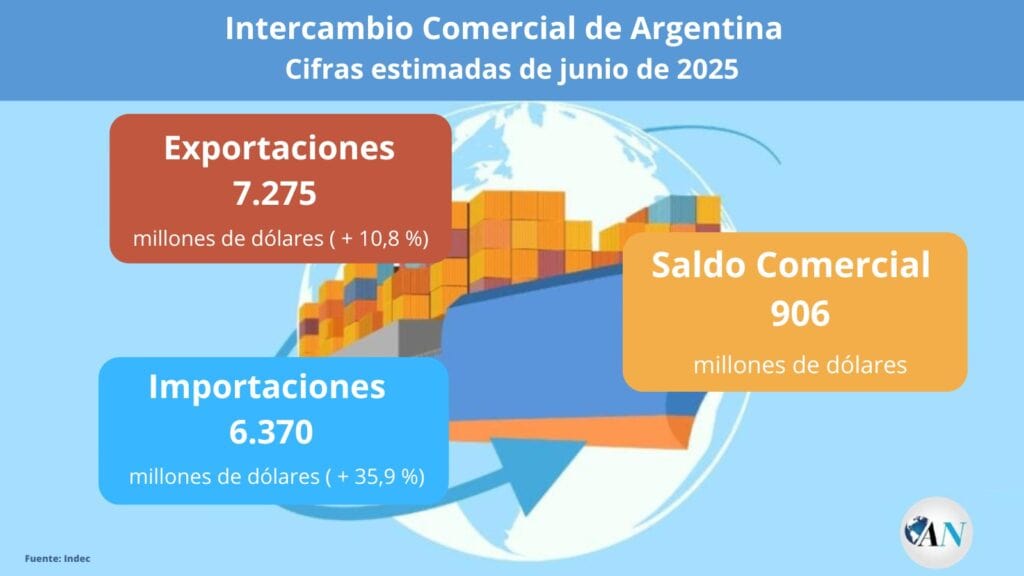
Argentina recorded a trade surplus of USD 2025 million in June 906, a 52% drop compared to the same month in 2024, amid a sharp increase in imports, according to data from the National Institute of Statistics and Census (INDEC).
Even so, the positive balance showed a 49% improvement compared to last May's surplus of USD 607 million. Despite the year-on-year decline, The country has accumulated 19 consecutive months with a surplus in its trade balance.
Exports
Exports totaled USD 7.275 billion, representing a year-over-year increase of 10,8%, driven by an 11,2% increase in exported quantities, which offset a slight 0,4% drop in prices.
By category, export values of Primary Products (PP), Industrial Manufactures (MOI), and Fuels and Energy (CyE) increased. In contrast, Agricultural Manufactures (MOA) registered a slight decline, due to a drop in prices that outweighed the increase in export quantities.
The sharp increase in the exported quantities of Fuels and Energy (+110,5%) was notable. In the case of Industrial Manufactures, the growth was due to both an increase in prices (+8,5%) and quantities (+4,0%).
In terms of destinations, Brazil remained Argentina's main trading partner, accounting for 14,8% of Argentina's exports. Significant increases were also observed in shipments to the United States (+46,3%) and Chile (+36,1%). Conversely, declines were recorded in shipments to the European Union (-21,5%), China (-17,8%), and India (-15,0%).
Imports
In June 2025, imports totaled USD 6.370 billion, representing a year-over-year increase of 35,9% compared to the same month in 2024 (USD 4.688 billion). This growth was explained by a 53,2% increase in imported quantities, which offset an 11,0% drop in prices.
Imported values for all economic uses increased, except for fuels and lubricants, which fell by 57,9% due to a sharp drop in quantities (-58,8%), despite a 4,0% increase in prices.
The largest import volumes were passenger motor vehicles (269,9%), capital goods (98,3%), consumer goods (85,8%), and parts and accessories for capital goods (48,2%). In the case of intermediate goods, quantities increased by 27,3%, while prices decreased by 6,0%.
By origin, imports grew from China (92,2%), Chile (88,3%), Brazil (68,7%), and the European Union (5,4%). In contrast, purchases from the United States fell by 13,5%, making it the only significant source with a year-over-year decline.
First semester
In the first six months of the year, Argentina accumulated a trade surplus of USD 2.788 billion, with exports totaling USD 39.742 billion and imports totaling USD 36.954 billion.
In summary, the half-year result shows a sustained recovery compared to the deficit recorded in 2023. The balance remained positive even in a context of reactivation of imports. However, challenges persist. Sustaining this rebound requires balancing trade flows, diversifying destinations, and strengthening competitiveness. In an adverse global context, such as warns the WTO, strengthening the commercial strategy is central to reducing risks and taking advantage of opportunities. (Argentine Trade. Goods. June 2025)

Aduana News foi o primeiro jornal aduaneiro da Argentina a lançar sua versão digital. Com mais de 20 anos de trajetória, suas publicações e iniciativas têm como objetivo oferecer o conhecimento mais relevante sobre temas aduaneiros, contribuindo para a promoção do comércio seguro e da facilitação do comércio na região.