
The electronic issuance of the Preferential Certificate of Origin is a key tool for moving toward paperless foreign trade. This document provides access to tariff benefits under trade agreements and is supported by the WTO's Trade Facilitation Agreement (TFA). Unlike the non-preferential certificate of origin, which only indicates the country of manufacture, the preferential certificate of origin is linked to bilateral or multilateral commitments that grant specific tariff reductions or exemptions.
The implementation of electronic certificates (e-CO) promotes interoperability between customs offices, streamlines procedures, reduces costs and time, and improves the transparency and traceability of international trade.
It is worth noting that while the AFC promotes the adoption of such digitalization measures as part of “paperless trade,” it does not mandate them. As a result, implementation rates vary widely: according to the latest United Nations survey, range from 43% to 90%, depending on the country and region.
Meeting on “paperless trade”
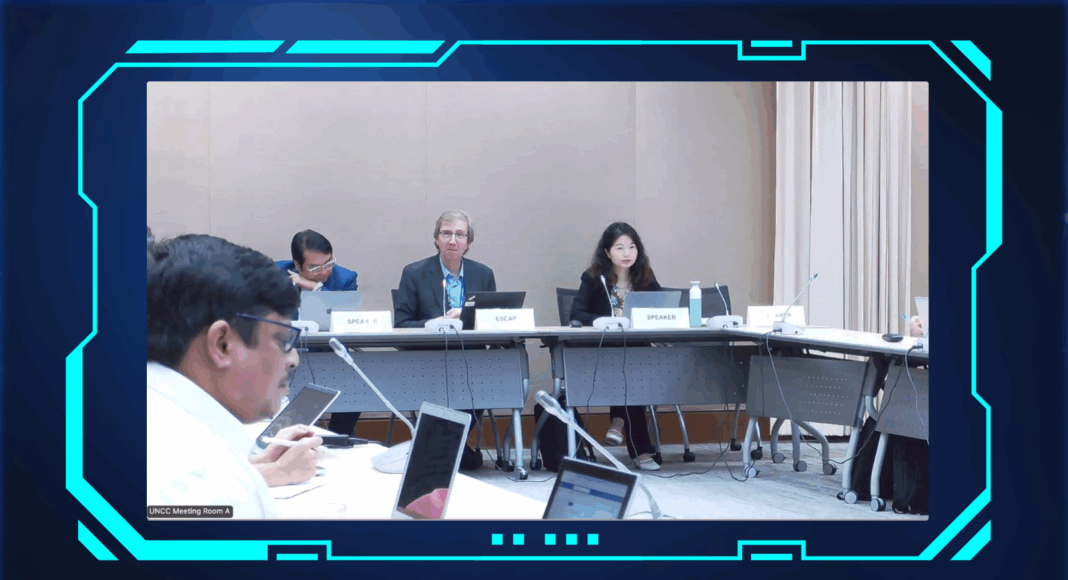
In this context, this Monday, June 9, 2025, at 12:30 am (Buenos Aires time), the session was held in Bangkok “Adopting Electronic Certificate of Origin: Global and Regional Trends”, within the framework of Paperless Trade Week organized by the United Nations Economic and Social Commission for Asia and the Pacific (UNESCAP), at the United Nations Conference Centre (UNCC).
The event, broadcast in a hybrid format, brought together representatives of international organizations, governments, and regional blocs to discuss this facilitating measure for progress toward "paperless trade." The opening session was led by Yan Duval, Head of the Trade Facilitation Section at UNESCAP, who proposed expanding these technical spaces through one- or two-day training workshops, given the high demand for both in-person and virtual participation.
One of the central exhibitions was in charge of Chunxiao Xu, Technical Attaché of the Subdirectorate of Origin of the World Customs Organization (WCO), who presented the findings of a global study conducted by the institution. According to the report, 22 member states have already implemented electronic data exchange systems for certificates of origin, while another nine are developing pilot projects.
Ms. Xu emphasized “the need for a common language for electronic certificates of origin”, referring to the model of WCO data, which has been widely adopted as the technical basis for message formats. He also highlighted the benefits observed in countries and blocs where electronic exchange is already in use: real-time verification during customs clearance, elimination of scanned copies, streamlined certification, improved data quality, strengthened risk management, and a clear push toward digitalization through reduced paper use.
In his historical review, he highlighted that the first experience of electronic exchange dates back to 2004, when China implemented this system with Hong Kong and Macao within the framework of the Closer Economic Partnership Arrangement (CEPA). Colombia and Mexico followed in 2009, and, starting in 2016, new initiatives were added in countries such as New Zealand, South Korea, ASEAN members, and various Latin American economies, including Argentina, Uruguay, Chile, and Peru, demonstrating a growing convergence toward the digitalization of customs procedures.
The ALADI model and the promotion of MERCOSUR
Along these lines, it's worth remembering that the Latin American Integration Association (ALADI) has been a pioneer in the region in developing and implementing the Digital Certificate of Origin (COD), a tool that enables the secure and verifiable electronic transmission of certificates between member countries. This system not only reduces time and costs but also strengthens traceability and document security.
MERCOSUR has strengthened this system by implementing interoperable mechanisms for preferential origin certification, aligned with the ALADI (Latin American and Caribbean Development Association) Code of Conduct. This coordination strengthens the facilitation of intraregional trade and promotes greater efficiency in its trade flows.
This is what the Dr. Hector Juarez in a article It highlights the importance of the initiatives promoted by ALADI to modernize trade in Latin America, particularly with regard to streamlining customs processes and certification of origin. Its analysis also reviews the status of implementation of the Digital Certificate of Origin (COD) in member countries, reflecting the regional commitment to digitalization, integration, and legal security.

For its part, the Lic. Andrea Russo underlines in Another item As the latest update to the Mercosur base standard -DEC. CMC No. 05/23 “MERCOSUR Origin Regime” (ROM)-, the adaptation to the VII Amendment of the Harmonized System of Origin Requirements, that is, to the 2022 version of the MERCOSUR Common Nomenclature (NCM) through CCM Directive No. 130/24, of December 2, 2024.
Furthermore, in line with the evolution of international trade and regional initiatives in facilitation, Russo highlighted Aduana News that in the current agenda of MERCOSUR, one of the topics that is being carried out in various technical forums, is the analysis and the necessary adaptations to the new model of Digital Certificate of Origin (COD) by each State Party of MERCOSUR, given that the next July 18, 2025 The transitional validity period for the certificate of origin model of the previous regulations -DEC. CMC No. 01/09- will end, and it is expected that all Member States will have implemented version 4.1.0 of the COD.These measures reaffirm MERCOSUR's commitment to regulatory modernization, trade facilitation and the continuous improvement of its procedures.", Russo said.
Current projects in interconnectivity
Returning to the WCO's intervention in the session, Ms. Xu also mentioned current projects relevant to interconnectivity, including:
- The development of a system under the African Continental Free Trade Area (AfCFTA), which involves 55 countries and constitutes the world's most comprehensive trade agreement.
- The Pan-Euro-Mediterranean Convention, which includes the European Union, AFTA, and countries such as Norway and Denmark.
Additionally, he presented the WCO interconnectivity framework for certificates of origin, developed between 2023 and 2025, based on four pillars: a trade process model, an e-CO dataset, a legal framework, and technological specifications. This document, approved by the Standing Technical Committee and undergoing final validation by the WCO Council, will be published shortly as a guide for Customs administrations and their trading partners.
At the end of her speech, Ms. Xu stressed that “To achieve effective interconnection, it is essential to advance bilateral agreements, regulatory harmonization and shared technological standards.”. He also noted that legislation—both national and international—can act as a facilitator or a barrier to the implementation of these systems. In that sense, “The Interconnectivity System for Certificates of Origin (CIS), proposed by the WCO, is designed to accompany these processes from a comprehensive perspective.".
Finally, he announced that the full report with these announced progress will be published on the WCO's official website once it is approved by its Council, during the meeting scheduled for late June 2025.

Aduana News foi o primeiro jornal aduaneiro da Argentina a lançar sua versão digital. Com mais de 20 anos de trajetória, suas publicações e iniciativas têm como objetivo oferecer o conhecimento mais relevante sobre temas aduaneiros, contribuindo para a promoção do comércio seguro e da facilitação do comércio na região.