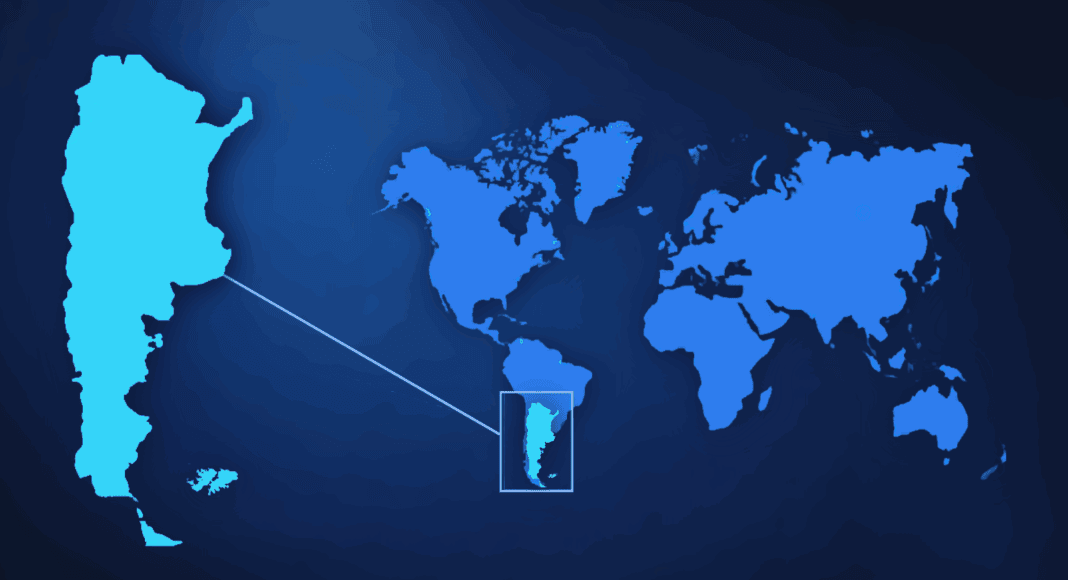

The year 2025 ended with Argentine foreign trade undergoing a regulatory reconfiguration aimed at streamlining operations, simplifying procedures, and strengthening transparency. This process was based on the foundations established by the Decree 70/2023, which promoted a structural reform of the Customs Code and redefined the general framework of customs operations.
Beyond the number of regulations—published in the Official Gazette and disseminated through official channels, such as the Single Window for Foreign Trade (VUCE), and the main private information spaces in the sector—the last twelve months consolidated a consistent trend.
This evolution allows us to identify key areas that will shape the course in 2026:
- Export Duties: One of the most significant features of the past year was the reconfiguration of the Export Duty scheme, with reduced rates and, in many cases, 0%. This measure affected broad sectors of the agricultural export complex, regional economies, and certain industrial products considered strategic, such as mining, sending a signal of encouragement to export supply.
- Less paperwork, more trade. The year also saw concrete progress in operational facilitation. The expansion of the Exporta Simple regime, the elimination of the CIBU (Unique Customs Declaration), the creation of simplified regimes for small shipments, and the digitization of declarations and manifests reflect a shift in approach: more streamlined procedures, a reduced administrative burden, and greater accessibility for new operators.
- New structure of the ARK. At the institutional level, 2025 was the year of restructuring of the Customs Collection and Control Agency (ARCA) and the General Directorate of Customs
- Digitization and intelligent control. The implementation of remotely monitored exports, the expansion of the Authorized Economic Operator (AEO) program, and the extension of the Argentine Single Window for Foreign Trade (VUCEA) until December 31, 2026, demonstrate a shift towards non-intrusive controls, risk management, and digital traceability, in line with international standards promoted by the World Customs Organization (WCO).
- Fewer technical and financial barriers.The year-end regulations included a simplified system for accrediting technical requirements and a more flexible customs guarantee regime. In addition, certain foreign trade-related balances can now be expressed in US dollars.
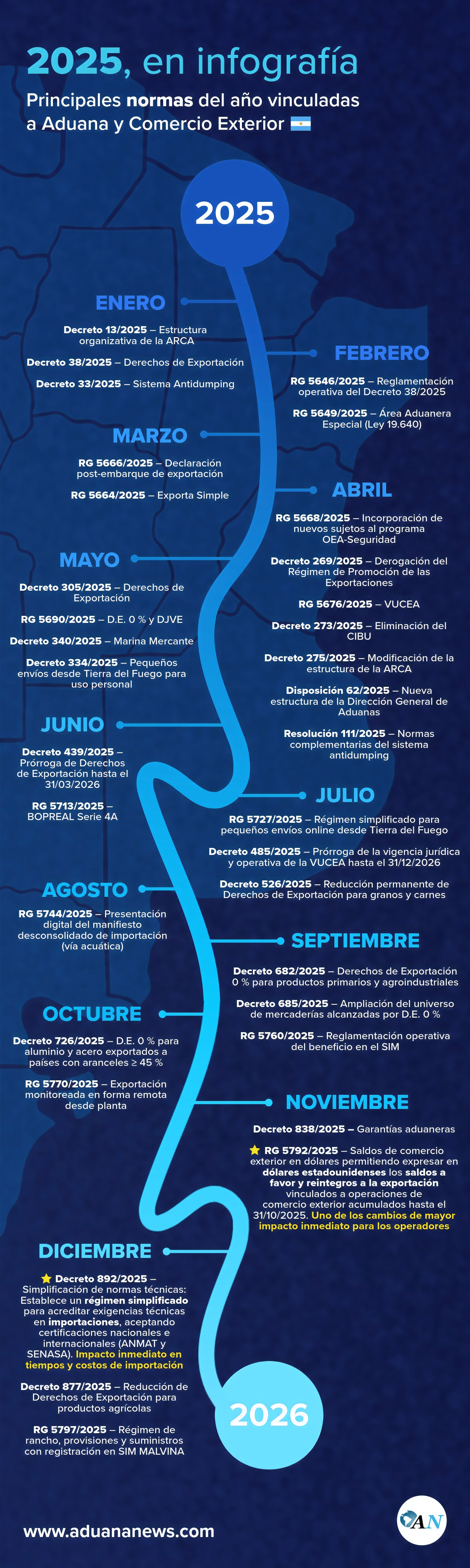
In detail
January 2025 – Most important rules of the month
*Decree 38/2025 – Export Duties (27/01/2025)Sets a 0% rate for certain tariff positions and establishes transitional rates until June 30, 2025.
*Decree 13/2025 – Organizational structure of ARCA (07/01/2025). Institutionally consolidates the Customs Collection and Control Agency (ARCA).
*Decree 33/2025 – Antidumping System. This decree modifies the antidumping system to align it with the general foreign trade policy. The National Foreign Trade Commission will be the body responsible for processing trade defense investigations. Unifying the system—previously divided between two departments within the Ministry of Industry and Commerce—will allow for simplification and reduced bureaucracy, greater technical coordination, improved quality of investigations, and more consistent findings, aligning with the practices of most WTO member countries.
February 2025 – Most important rules of the month
*General Resolution 5646/2025 – Export Duties (DJVE). Regulates Decree 38/2025, giving it effective operation. It directly affects goods covered by DJVE, especially those from the agricultural export sector.
* General Resolution 5649/2025 – Special Customs Area (Law 19.640) Reorganizes and unifies the customs procedures applicable to the traffic of goods, with a direct impact on Tierra del Fuego, the inindustry, logistics and foreign trade.
March 2025 – Most important rules of the month
*General Resolution 5666/2025 (21/03/2025) – Post-shipment export declaration. Regulates the post-shipment declaration, improving the control and traceability of export operations.
* General Resolution 5664/2025 (March 14, 2025) – Exporta Simple. Expands the use of bonded warehouses with non-intrusive control, allows exporting through all channels, and strengthens the simplified export regime.
April 2025. Most important rules of the month
*General Resolution 5668/2025 – Incorporation of subjects into the AEO program. It establishes the terms and conditions that permit holders of bonded warehouses and maritime cargo terminals must meet when requesting to join the Authorized Economic Operator (AEO) program, and they can only be categorized at the AEO-SECURITY level.
* Decree 269/2025 (14/04/2025) – Repeal of the Export Promotion Regime. Repeals Decree 28/2023, eliminating a specific export promotion regime, and restores the full application of the Export Duty (ED) according to the general regulations, impacting the profitability and planning of exporters of goods and services.
* General Resolution 5676/2025 (April 16, 2025) – Import Regime for Goods Included in Large Investment Projects / Elimination of CIBU. Incorporates authorizations into the VUCEA system, enhancing the single window process. Eliminates the Certificate of Importation of Used Goods (CIBU) and replaces it with Sworn Statements (DDJJ), reducing processing times, costs, and administrative discretion..
* Decree 275/2025 – Organizational structure of ARCA. Modifies the organizational structure of the Customs Collection and Control Agency (ARCA).
* Provision 62/2025 – Customs organizational structure. Approves the organizational structure of the General Directorate of Customs according to the corresponding annexes.
*Decree 33/2025 – Resolution 111/2025 (Antidumping System). Establishes complementary rules for the application of Decree 33/2025, which unifies and simplifies the antidumping system.
May 2025 – Most important rules of the month
*Decree 305/2025 (07/05/2025) – Export Duties – 0% rate. Sets the Export Duty (ED) rate at 0% for specific NCM positions of regional economies and temporarily reduces it (until June 30, 2025) for goods such as cereals (wheat, corn, sorghum, barley) and oilseeds (soybeans, sunflower, among others).
* General Resolution 5690/2025 – Export Duties of 0%. It establishes that, to comply with the obligation to settle, the exporter must inform ARCA, by means of a sworn statement, of the amount entered into the country or traded in the foreign exchange market according to the conditions of the BCRA, for each DJVE, using the “MUELA” procedure, sub-procedure “Sworn Statement – Decree 38/2025” of the Customs Procedures Computer System (SITA).
* Decree 340/2025 – Exceptional Regime for the National Merchant Marine. Declares as an essential service navigation by maritime and/or river water intended for the commercial transport of people, goods and cargo, as well as related services and offshore operations, through the different means used for this purpose.
* Decree 334/2025 – Simplified import regime for small shipments. Creates a simplified regime for the import of small shipments of goods originating in and produced under the Industrial Regime (Law No. 19.640) by companies adhering to the extension of Decree No. 727/2021. Intended for individuals residing in the continental national territory, solely for personal use and consumption; commercialization is prohibited.
June 2025 – Most important rules of the month
* Decree 439/2025 (June 27, 2025) – Export Duties – Extends until March 31, 2026, the application of export duties for certain goods of the Mercosur Common Nomenclature (NCM) detailed in the annex. At least 90% of the foreign currency must be settled within 30 business days from the submission of the Sworn Declaration of Foreign Sales (DJVE), whether for export proceeds, advance payments, or pre/post external financing. If this deadline is not met, the export duty rate corresponding to the tariff position in force on the day prior to the entry into force of Decree 38/2025 will be applied.
* General Resolution 5713/2025 (18/06/2025) – BOPREAL Series 4A Regulates the cancellation of tax and customs obligations, providing a clear operational mechanism for taxpayers.
July 2025 The most important rules
*General Resolution 5727/2025 – Simplified import regime for small shipments from the Special Customs Area (Tierra del Fuego) Introduces a simplified customs regime for online purchases from Tierra del Fuego to the mainland.
*Decree 485/2025 – Amendment to the VUCEA Regime. It prevents the dissolution of the VUCEA system and ensures the legal and operational continuity of foreign trade procedures. It establishes a validity period until December 31, 2026, aligning its operation with specific objectives.
Decree 526/2025 permanently reduces export duties on goods from the grain and meat supply chains, specifically soybeans, wheat, corn, sunflower, barley, and sorghum, identified by the MERCOSUR Common Nomenclature (NCM) codes detailed in the Annex. The measure aims to improve the competitiveness of the agribusiness sector.
September 2025 – Most important rules of the month
*Decree 682/2025 (September 22, 2025) – Export duties at 0% for a wide range of goods included in the MERCOSUR Common Nomenclature (NCM), primarily agro-industrial and primary products. This benefit is valid until October 31, 2025, or until export declarations (DJVE) reach an amount equivalent to USD 7 billion, whichever comes first. Access to the reduced rate is conditional upon the settlement of at least 90% of the foreign currency corresponding to each export transaction. This measure constitutes one of the most significant tax incentives of the period, directly impacting customs operations, export policy, and foreign currency inflows.
* Decree 685/2025 (September 23, 2025) – Expansion of goods covered by the Export Duty (DE) to 0% for the NCM tariff positions listed in its Annex, broadening the scope of covered goods. This includes products of animal and plant origin, such as live animals, meat, fish, dairy products, fruits, vegetables, and basic food preparations, reinforcing the incentive scheme for exports of primary and agro-industrial products. It complements and consolidates the regime of Decree 682/2025, impacting customs operations and export flows.
* General Resolution 5760/2025 (23/09/2025) – Operational regulation of the benefit in the SIM when registering the DJVE, the settlement of 90% of the foreign currency within the established deadlines.
October 2025. The most important rules.
*Decree 726/25 – Export Duty at 0% (Aluminum and Steel) Establishes a 0% export duty rate for aluminum and steel exports to countries that apply tariffs ≥ 45%. It signals a clear commitment to active trade policy, albeit with temporary validity (until December 31, 2025).
*General Resolution 5770/25 – Remotely Monitored Exports. Implements remotely monitored exports from the plant. Advances digitalization, intelligent control, and trade facilitation.
November 2025 – Most important rules of the month
*Decree 838/2025 – Facilitation of customs guarantees. Amends Decree 1001/82 and makes the customs guarantee regime more flexible, allowing, in certain cases, the presentation of a signed document instead of insurance or deposits, simplifying procedures for operators.
🟡General Resolution 5792/2025 – Foreign trade balances in dollars. Taxpayers and responsible parties who have applications for refunds of freely available balances in their favor of national taxes related to foreign trade operations and/or requests for payment of export refunds, accumulated or formalized up to 31/10/2025, may request that these amounts be expressed in US dollars.
December 2025. The most important rules
🟡Decree 892/2025 – Simplified Regime for Technical Requirements. Establishes a simplified regime for certifying compliance with technical standards in the import and marketing of goods, accepting national and international certifications and tests. It applies to products under ANMAT and SENASA regulations and recognizes certificates from accredited laboratories or countries with high levels of oversight. It enters into force 60 days after its publication.
* Decree 877/2025 – Reduction of Export Duties for Agricultural Products Establishes a reduced Export Duty (ED) rate for cereals, oilseeds, vegetable oils and protein meals, including wheat, corn, soybeans, sunflower and their derivatives, benefiting a wide range of products from the Argentine agricultural export complex.
* Resolution 5797/25. Ship's stores, onboard provisions, and supplies for the means of transport. This resolution establishes the conditions and procedures applicable to the registration and processing of ship's stores, onboard provisions, and supplies for watercraft and aircraft, both national and foreign-flagged, leaving the customs territory under their own power. Furthermore, the guidelines contained in the "Manual for Registering Ship's Store Operations for Fuel and Supplies in the SIM," available on the "Foreign Trade Operators" microsite of the ARCA website (https://www.arca.gob.ar), must be observed. Ship's stores declarations must be registered in the MALVINA Computer System (SIM) according to whether the goods must be declared under sub-regimes ER01 or ER02.
In closing, this review shows the regulatory transformation of 2025. Within that framework, the RG 5792/2025 (balances in dollars) and Decree 892/2025 (simplification of technical standards) stand out for their immediate operational impact on operators' cost management. Both measures are part of a more agile and predictable system, aligned with international standards to which the country has adhered, and on which Argentine foreign trade will continue to be projected in 2026.
Customs News thanks Dr. Héctor H. Juárez for his comments during the preparation of this article.

Aduana News foi o primeiro jornal aduaneiro da Argentina a lançar sua versão digital. Com mais de 20 anos de trajetória, suas publicações e iniciativas têm como objetivo oferecer o conhecimento mais relevante sobre temas aduaneiros, contribuindo para a promoção do comércio seguro e da facilitação do comércio na região.