
On July 8, the United Nations presented the Sixth edition of the Global Survey on Digital and Sustainable Trade Facilitation, a biennial monitoring tool coordinated by the five UN regional economic commissions together with UNCTAD. The objective of the survey was to assess the progress of more than 180 countries in the implementation of 62 measures aimed at trade facilitation, digitalization of processes and inclusion.
This set of measures covers both mandatory provisions - such as those provided for in the WTO Trade Facilitation Agreement (TFA)— as well as other developing regional and multilateral initiatives, such as the Framework Agreement for Facilitation of Paperless Cross-Border Trade in Asia and the Pacific (ACTP). Actions aimed at promoting more inclusive participation in international trade, particularly for small and medium-sized enterprises, are also included. (SMEs) and the of merchants.
The 2025 edition also incorporated two groups of emerging measures considered key: the facilitation of E-commerce and those linked to green trade.
(I.e.Global survey
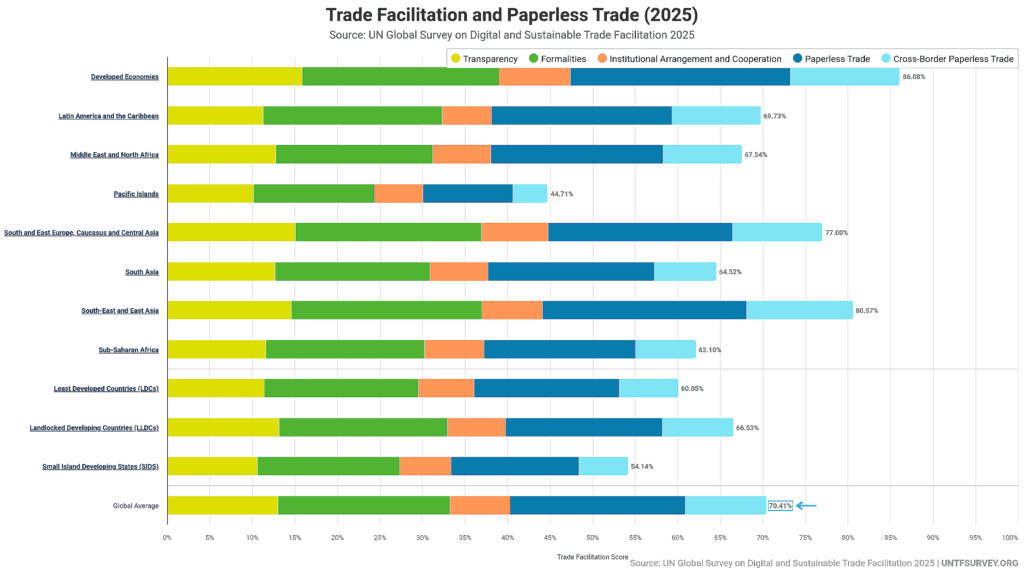
Having clarified this context, the authorities indicated that The global average implementation rate of trade facilitation and paperless trade measures reached 70,4% in 2025, a sustained increase from the 66,48% recorded in 2023. However, they cautioned that progress is uneven and that greater collective efforts are needed to reduce existing gaps.
The presentation was moderated by Yann Duval, Head of ESCAP's Trade Facilitation Section, and was attended by regional authorities and representatives of the private sector. During the opening, the UN Under-Secretary-General and Executive Secretary of ESCAP, Armida Salsiah Alisjahbana, he firmly emphasized:“The global trading environment has faced unprecedented challenges. Tariff measures have increased costs and uncertainty, while global disruptions have exposed vulnerabilities in supply chains. This reinforces the urgent need for more efficient, transparent, and resilient trading systems.
(I.e.Latin America and the Caribbean have shown progress, but challenges remain
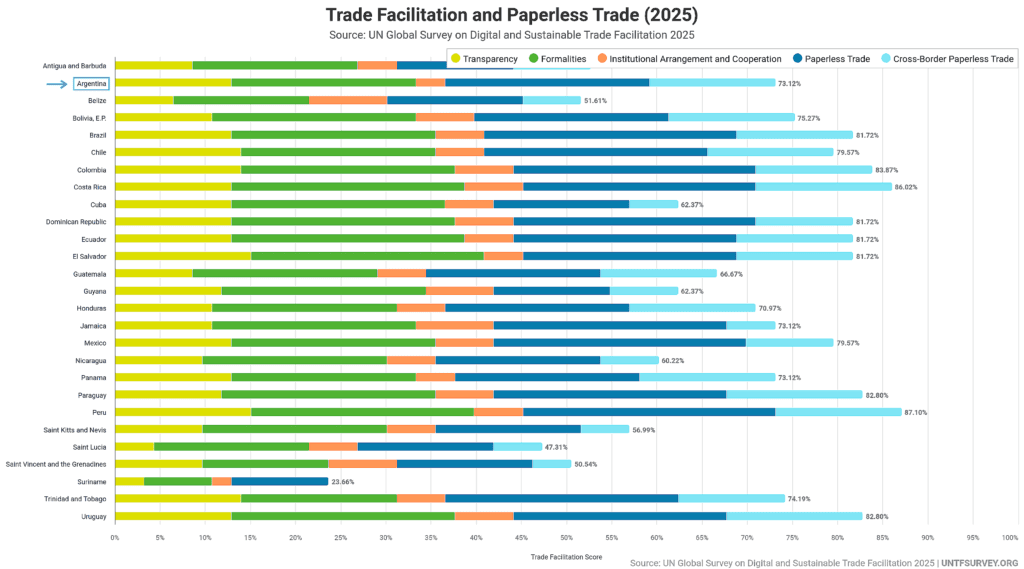
In representation of the Economic Commission for Latin America and the Caribbean (ECLAC), Sebastián Herreros emphasized, 22 countries from the region participated in this edition, reaching a average implementation rate of 73%. According to the data presented, most countries in Latin America and the Caribbean exceed or equal this average. For example, our country, Argentina, records a score of 73%, located in the regional average, along with Panama and Jamaica. This performance places it in the middle of the list of countries analyzed, below economies such as Chile and Mexico (80%), Brazil and El Salvador (82%), Uruguay and Paraguay (83%), Costa Rica (86%), and Peru, which leads the regional ranking with 87% implementation.
Mr. Herreros noted that, in the region, the greatest progress was seen in the Trade Facilitation Agreement (TFA) measures related to customs formalities, paperless trade, and transparency, demonstrating solid progress in implementing the commitments made under the TFA.
Despite the progress, Sebastián Herreros acknowledged that “Structural gaps persist related to institutional capacity, customs digitalization, and human and financial resources, especially in the Caribbean and Central America.. In addition, he warned that "Certain measures—such as the publication of procedures and tariffs, appeal mechanisms, and delegated oversight—still have low levels of adoption, particularly in relatively less developed countries."
Mr. Herreros stressed that “Greater regional coordination is essential to diversify exports, support the internationalization of small and medium-sized enterprises (SMEs) and expand the participation of Latin America and the Caribbean in global value chains.”
◾Global implications and roadmap
Following the presentation of the five regional commissions, the global implications of the survey were presented.. Poul Hansen, Head of UNCTAD's Trade Facilitation Section, He agreed with the initial diagnoses and warned that, although progress is important, it is still insufficient.
"Global progress is encouraging, but it is not equitable. Large gaps persist in cross-border digital trade, especially since this dimension is not yet covered by the WTO TFA. Legal frameworks and digital infrastructure need to be developed to close this gap.He stressed.
He also emphasized that basic measures such as transparency and formalities are well implemented, even in countries with limited institutional capacities, which constitutes a basis for moving toward more ambitious reforms. In this regard, He stressed the importance of strengthening national and regional coordination through National Trade Facilitation Committees and monitoring systems. as Reform Trackers.
In closing his speech, he was clear about the approach that governments should adopt: “Trade facilitation cannot be a privilege. It must be a tool for development, equity, and resilience. This requires data, resources, political will, and multilateral cooperation..
From the private sector, the message was consistent: it's time to move from diagnosis to action. Valérie Picard, representative of the International Chamber of Commerce (ICC), stated: "Data matters, especially in complex contexts. But What companies need today is action“Trade barriers are increasing, and we must transform them into concrete opportunities to compete.”
The ICC proposed three priorities To move forward, strengthen public-private cooperation by institutionalizing National Trade Facilitation Committees; accelerate digitalization with a focus on interoperability, so as not to exclude MSMEs from e-commerce; and move from pilot projects to effective implementation, with political will, financing, and sustained collaboration across sectors.
For those who wish to explore the level of implementation of trade facilitation measures in different regions and economies, the interactive platform for the UN 2025 Global Survey is available: https://www.untfsurvey.org/#start

Aduana News foi o primeiro jornal aduaneiro da Argentina a lançar sua versão digital. Com mais de 20 anos de trajetória, suas publicações e iniciativas têm como objetivo oferecer o conhecimento mais relevante sobre temas aduaneiros, contribuindo para a promoção do comércio seguro e da facilitação do comércio na região.