
During 2025, the Argentine textile sector underwent a structural transformation characterized by a rapid expansion of imports, a significant contraction of domestic production, and a substantial change in the regulatory framework for foreign trade. In this context, the textile sector was among those most affected by trade deregulation, both through tariff reductions and the expansion of simplified import regimes.
According to foreign trade data published by the National Institute of Statistics and Censuses (INDEC), total imports grew at a faster rate than exports in several months of 2025, with a sharp increase mainly due to larger import volumes. This trend was particularly pronounced in the apparel sector, where growth far exceeded the average for the manufacturing industry.
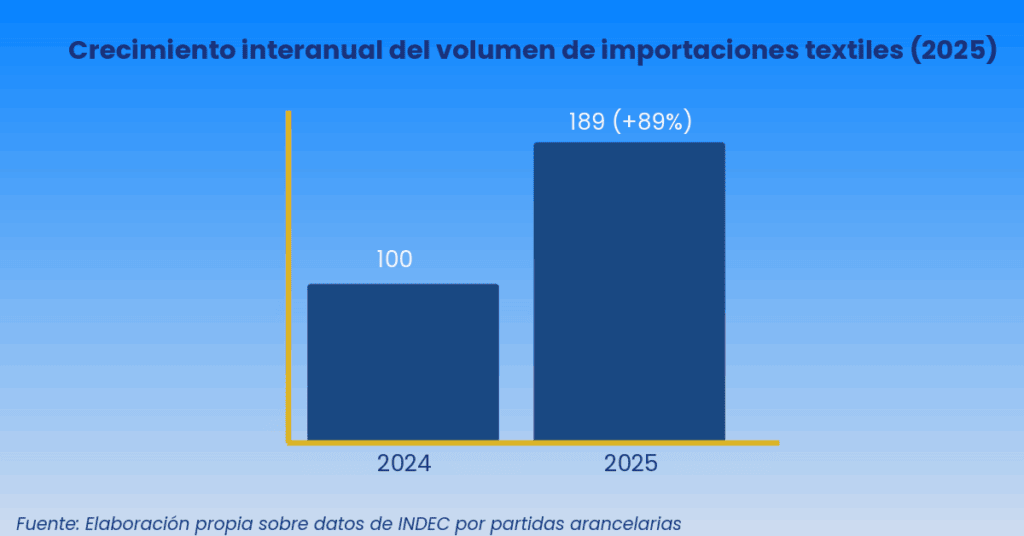
In numbers, between January and October 2025, imports in the textile and apparel sector reached a total volume of 332.696 tons, with an approximate value of USD 1.450 billion, representing a year-on-year increase of 89% in volume and 61% in value. These figures constitute historical highs for the sector and reflect a significant acceleration in the import process compared to previous years.
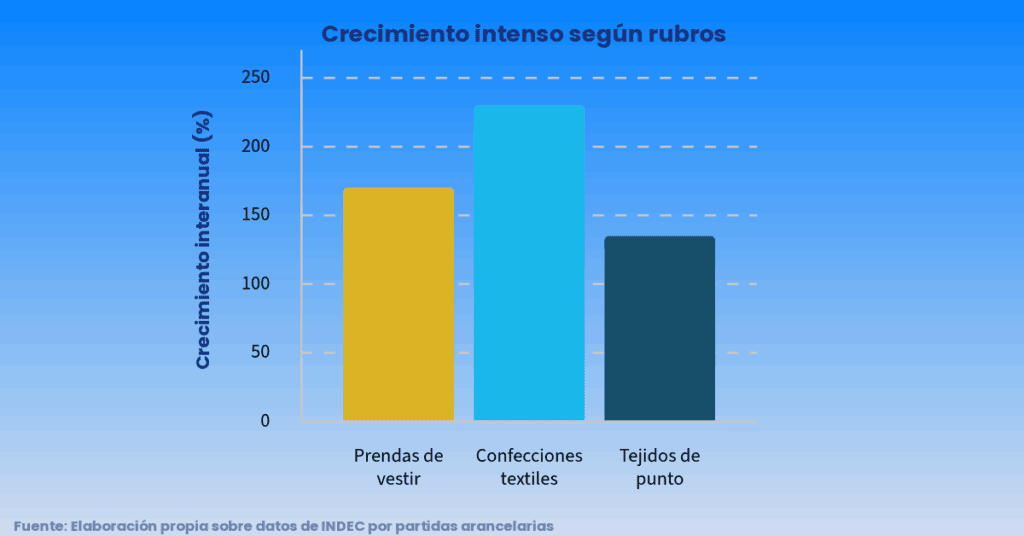
Intense growth by sector:
- Clothing: +166% year-on-year in volume.
- Textile manufacturing: +217% in volume.
- Knitted fabrics: +140% in quantity, reaching record levels.
These data show that the increase in imports was not limited to the supply of production inputs, but advanced decisively on the final links of the textile chain, replacing production.
China, the country of origin chosen for importing new clothing, and the United States for used clothing.
The geographic concentration of textile imports deepened, with China as the main country of origin, accounting for approximately 70% of total imports. In some sub-segments, such as knitwear and apparel, China's share far exceeded that average.
From a technical perspective, this concentration increased competitive asymmetry, since the products entered the Argentine market with prices significantly lower than local costs, due to economies of scale, lower labor costs and a reduced tariff scheme.
The main regulatory change that impacted the sector was Decree 236/2025, through which the Executive Branch established a significant reduction in import tariffs applicable to textiles, clothing, and footwear. The main modifications include:
- Clothing and footwear: reduction from 35% to 20%.
- Fabrics: reduction from 26% to 18%.
- Yarns: reduction to ranges of 12% to 16%, according to classification.
This decree altered the historical protection scheme of the textile sector, with the explicit objective of reducing domestic prices and increasing competition, but with adverse effects on the national productive structure, particularly in labor-intensive activities.
Another phenomenon of relevance to the Argentine textile sector: the entry of imported used clothing, a modality that until recent years had a practically zero presence in the country's formal foreign trade due to sanitary, environmental and commercial restrictions.
According to surveys by the Argentine Chamber of Clothing, in the first eight months of 2025 imports of used clothing reached approximately USD 2,2 million, compared to just USD 52.000 imported during all of 2024. This implies an increase of more than 40 times in year-on-year value, configuring an abrupt change in the composition of the imported clothing market.
The merchandise arrived mostly in bales or sacks weighing between 25 and 50 kilograms, primarily from the United States, a country where environmental regulations limit the final disposal of textile waste and promote its export as secondhand clothing. Although the absolute volume is still small compared to imports of new garments, the rate of growth is extremely rapid and marks a regulatory and commercial turning point.
From a technical perspective, the importation of used clothing introduces an additional level of competition for the local industry, especially in the lower-income segments where price is the main determinant of demand.
Furthermore, the expansion of this practice raises health and environmental concerns, given that used clothing requires specific hygiene, traceability, and waste management controls that historically justified its restriction. For the manufacturing sector, the liberalization of this flow implies not only direct economic competition but also a further devaluation of domestic products by introducing reused garments into the internal market that do not face the same regulatory, labor, and tax costs as local production.
On December 15, the Customs Broker Center of the Argentine Republic was notified by the Technical Import Division that the customs declaration system will require (from that date) an “authorization for used clothing” in accordance with the provisions of the Undersecretariat of Industrial Policy in addition to the disinfection certificate currently required, and covers the clothing items of the Mercosur Common Nomenclature heading 6309.
Regulations governing the courier system:
Alongside the opening of traditional trade, during 2025 the progress of the international shipment regime via courier, regulated by the Customs Collection and Control Agency (ARCA) (1), was consolidated.
The current regulations established the following for individuals:
- Maximum FOB value per shipment: USD 3.000.
- Maximum weight: 50 kg per package.
- Limit of units to 3 of the same species, to guarantee the character of personal use.
- A USD 400 franchise, exempt from import duties and statistical fees, with VAT remaining on the excess (Decree 1065/2024).
These provisions, along with 100% digitized procedures and simplified clearance, significantly reduced import costs and times for end consumers.
In the case of the textile sector, this regime facilitated the recurring entry of finished garments, especially low unit value Chinese clothing, which can be incorporated in quantity within the allowed limits, expanding the imported supply in the domestic market, evidenced by the boom of digital platforms such as “Shein”, “Temu” or similar.
The courier system acted as a complementary and amplifying channel for the import process. While traditional imports grew steadily, courier services allowed for a fragmentation of clothing imports, weakening economic controls and facilitating the direct entry of finished goods for consumption.
This model proved particularly detrimental to the clothing sector, as it competes directly with domestic production without requiring industrial scale or traditional commercial channels.
The effects of this process were clearly reflected in the production indicators published by INDEC. During 2025:
- Textile production fell by more than 20% year-on-year in some months.
- The utilization of the sector's installed capacity was around 32–33%, well below the industrial average.
- Business closures and job losses were recorded, especially in SMEs and garment workshops.
The combination of tariff reduction and courier expansion eroded the competitiveness of the local industry, reducing demand for domestic production and weakening the integration of the textile chain.
Conclusions
The analysis of the evolution of the Argentine textile sector during 2025 allows us to conclude that the country went through a process of opening and deregulation of trade of a structural nature, with profound effects on national production, employment and the sustainability of the textile-clothing chain.
First, there was an exceptional increase in textile imports, both in volume and value, with a particular focus on finished garments and apparel. This phenomenon, supported by official data from INDEC (National Institute of Statistics and Censuses), implied a direct substitution of local production, displacing the national industry in the final links of the chain, which have historically been more labor-intensive.
Secondly, the tariff reduction established by Decree 236/2025 substantially altered the sector's protection scheme, weakening the competitiveness of local producers against imported goods from countries with lower structural costs. This measure, aimed at containing consumer prices, resulted in a significant drop in production, capacity utilization, and employment in the textile industry, particularly in SMEs and garment workshops.
Furthermore, the expansion of the courier system regulated by ARCA acted as an amplifying factor in the import process, allowing the fragmented entry of finished garments through personal shipments, with high value limits and tax exemptions that significantly reduce the tax burden compared to the commercial import regime. In practice, this channel consolidated an alternative supply route for the domestic market, increasing direct competition with national production without requiring local scale or investment.
Adding to this scenario in 2025 was the emergence of used clothing imports, a novel phenomenon due to its magnitude and rapid growth. While its absolute volume is still lower than that of imported new clothing, its exponential expansion puts additional pressure on lower-priced segments, exacerbating the perceived unfair competition for local producers. Furthermore, this practice poses health, environmental, and regulatory risks by incorporating reused garments that do not face the same production, control, and regulatory compliance costs as the domestic industry.
Taken together, the combination of tariff liberalization, expansion of traditional imports, consolidation of the courier regime, and liberalization of used clothing imports created a highly adverse environment for the Argentine textile industry in 2025. From a technical perspective, this process weakened production integration, eroded installed capacity, and compromised the economic and social sustainability of a sector that is strategic in terms of employment and industrialization.
- Customs Collection and Control Agency (ARCA). (2024). General Resolution 5608/2024: Simplified import and export by Postal Service Providers (PSP/Courier), replacing Resolution No. 2.436/96 (ANA) and its amendments and supplementary provisions (RESOG-2024-5608-E-AFIP-ARCA).

Graduate in Foreign Trade (Universidad de la Marina Mercante), customs broker and customs transport agent. She works as a professor at the University of Belgrano and CAECE.