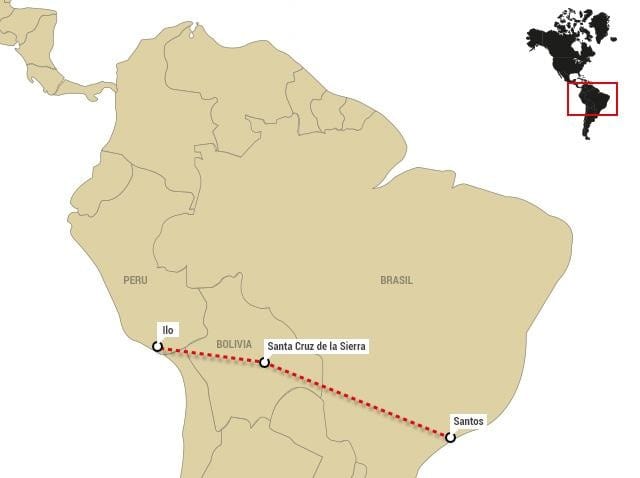
A train that can reach 300 or 350 kilometers per hour is the wish of President Evo Morales regarding the bioceanic project. He assures that it could take up to four hours to travel from Santa Cruz to La Paz.
The President was this Sunday (1.7.2018) at an infrastructure delivery ceremony in Cochabamba where he commented that there are Russia and Spain are interested in the regional project, as well as China, Germany and Switzerland.
"We have started the last stage of the project, the final design. We hope that the train we want will be a high-speed train, with a speed of 300 kilometers per hour," Morales said, according to the newspaper La Razón.
Morales said that the electric vehicle will be able to travel from Santa Cruz to La Paz in up to four hours and warned that the main problem would be the ascent towards the mountain range, which is why studies are already being carried out to resolve this eventuality.
The bioceanic train envisages the connection between the ports of Santos, in Brazil, and Ilo in Peru, to strengthen the link between the Atlantic and Pacific oceans. Bolivia, Brazil, Peru, Paraguay and Uruguay are current partners in the regional project.
Features
The Bioceanic Integration Railway Corridor (CFBI) will have the following particularities:
- A length total of 3 km:
*1 km in Brazil
*1 km in Bolivia
*340,5 km in Peru
Paraguay and Uruguay have joined the CFBI. There is a plan to establish a railway branch to Paraguayan territory.
– The CFBI is intended for the transport of goods and passengers.
Overall cost: about 15 billion dollars
Duration of the works: approx. 7 years
First year of operation Expected: 2025
Sources: IIRSA, La Razón

Aduana News foi o primeiro jornal aduaneiro da Argentina a lançar sua versão digital. Com mais de 20 anos de trajetória, suas publicações e iniciativas têm como objetivo oferecer o conhecimento mais relevante sobre temas aduaneiros, contribuindo para a promoção do comércio seguro e da facilitação do comércio na região.