
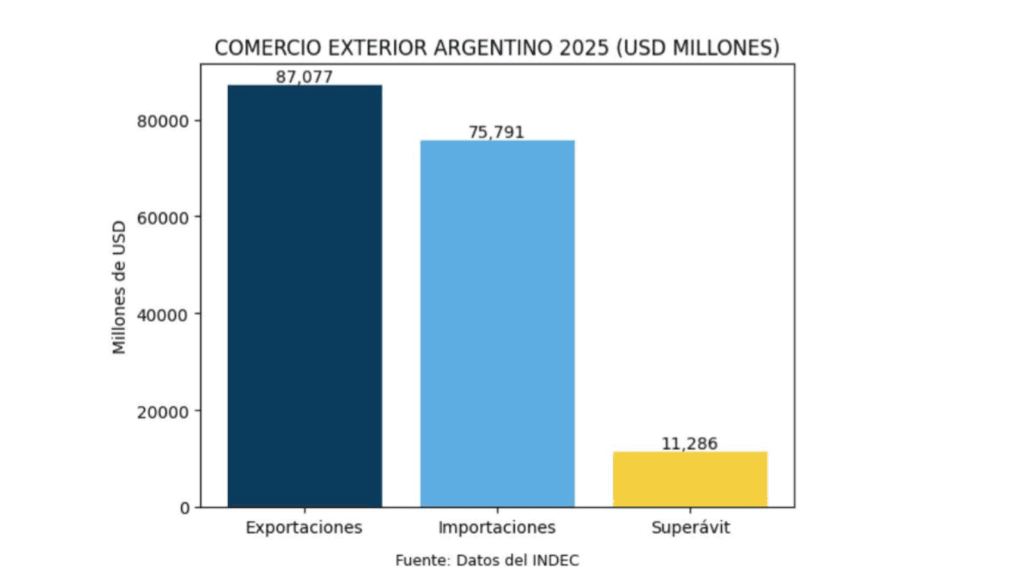
Argentine foreign trade closed 2025 with a USD 11.286 million surplus, a positive result but significantly lower than in 2024. The reduction in the balance was not due to a drop in exports, but to sharp increase in importsIn a context of increased economic activity and trade liberalization, the year left a clear signal: trade grew, but... external position became more demanding.
Goods: strong exports and an import rebound that reshaped the balance
exports of goods They totaled USD 87.077 billion, representing a year-on-year increase of 9,3%. This growth was primarily due to larger quantities exportedWhile international prices showed moderate variations, agriculture, energy, and mining sustained performance, with a growing contribution from the regions of Cuyo and Patagonia, which led the regional increases.
importsIn contrast, they grew by 24,7% and reached USD 75.791 billion. The increase was concentrated in intermediate goods, capital goods, and parts and accessoriesThis reflects an industry that has resumed its demand for supplies and equipment. An increase was also observed in the consumer goods, driven by an appreciated real exchange rate and by the easing of the Courier regime, which tripled its annual volume.
The result was a narrower surplus, in a year where internal recovery put pressure on the external front.
Services: a key component for understanding external dynamics
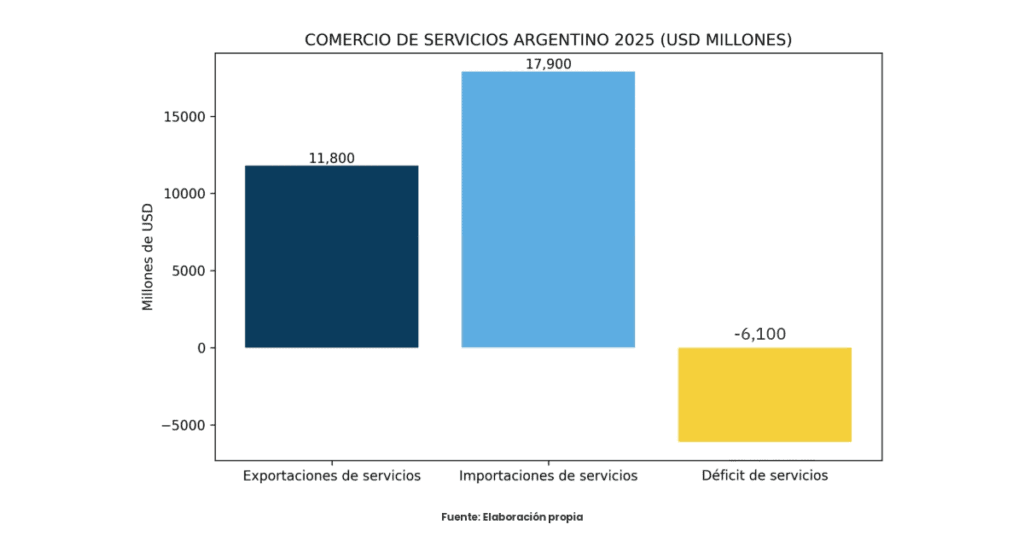
The trade in services, historically in deficit, played a decisive role in completing the diagnosis in 2025 (estimated figures).
(I.e.Service exports
They reached approximately $11.800 million, with an 8% year-on-year growth.
The main contributions came from:
-
- Knowledge-based services (KBS): nearly $8.000 millionconsolidating itself as the most dynamic segment.
- Business and professional services: around $2.300 million.
- Inbound tourism: some $1.500 millionwith gradual recovery.
◼Service imports
They totaled approximately $17.900 million, with a year-on-year increase of 12%.
The most relevant categories were:
-
- Outbound tourism: approximately $8.200 million, driven by the normalization of the exchange rate.
- Technology and corporate services: some $5.000 million.
- Freight and transport: around $4.700 millionaffected by international logistics costs.
Balance of services
The sector closed with a estimated deficit of -USD 6.100 billion, a marginal improvement compared to 2024, but still reflecting a structural pattern: Argentina It exports knowledge and imports mobility and logistics..
Overall balance: growth in trade and persistent external fragility
Taking goods and services together, 2025 left a scenario of greater commercial dynamism, but also of less external clearanceThe goods surplus acted as a buffer, but it decreased compared to the previous year. The services deficit remained, although partially offset.
The economy showed signs of recovery, but the scope for simultaneously sustaining growth, exchange rate stability, and reserve accumulation remains limited.
2026 Outlook: Opportunities and Challenges.
The year 2026 is projected to have a set of factors that could redefine the country's external profile:
- Energy and mining They will continue to gain weight, with Vaca Muerta and lithium as medium-term drivers.
- El agro It will continue to be a determining factor, conditioned by the campaign and the weather.
- La manufacturing industry It faces a mixed scenario: it can gain export competitiveness if the real exchange rate stabilizes and fluid access to inputs is guaranteed.
- The knowledge-based services They appear to be the most stable segment for contributing foreign currency, provided that a favorable regulatory framework is maintained.
Among the risks are the global slowdown, commodity price volatility, and changes in the trade policies of strategic partners.

The author has a degree in Administration and a Master's degree in International Relations (UNCBA), with an outstanding career as an official of the Customs Regulation and Control Agency (ARCA) for 39 years. A former OAS and Spanish Government fellow, he has been a university professor at undergraduate and graduate levels in various Argentine universities for 33 years, and a member of the Soft Landing World Network.
Foreign Trade specialist and independent consultant, he is the author of the books: "Customs Operations from A to Z", as well as"Intangibles: how to export services and not die trying"He has held important positions such as Deputy Director General of Metropolitan Customs Operations, Regional Director of the Waterway, and Administrator of the Customs of Córdoba and Rosario. He has served as First General Counsel at the General Directorate of Customs – Aduana Córdoba, and currently works as a foreign trade consultant.