
Latin America is a commercial continent, where metropolitan port areas play a central role in regional trade. Among the most important are the Río de la Plata (Argentina and Uruguay), the ports of Brazil, the Panama Canal Zone, and Callao in Peru. In this context, port modernization and digital logistics are becoming strategic priorities. Experts gathered this Friday (October 3, 2025) at the seminar “Port modernization in Latin America” of ALADI, agreed that infrastructure, digitalization, and public-private cooperation are essential to strengthening ports and optimizing logistics chains, boosting multimodal transport and promoting environmental sustainability, in line with ALADI Resolution 85 of August 18, 2023.
During the opening, Rafael Laurentino, head of the Department of Physical and Digital Integration of ALADI, He emphasized that logistics is a key driver of the region's economic and social development, connecting markets, reducing transaction costs, and improving productivity. "Infrastructure—ports, roads, railroads, and distribution centers—is essential to ensuring the connectivity necessary for the movement of goods," he noted. He also noted that the growth of trade and globalization have expanded the strategic role of ports, which today face multiple challenges and require more efficient and technological processes.
The ALADI representative emphasized the importance of implementing strategic plans and strengthening regional cooperation, promoting good logistics practices and infrastructure projects. "The goal is to consolidate logistics throughout the region, share experiences, and facilitate foreign trade through the modernization of ports, waterways, and bioceanic corridors," he concluded at the opening of the meeting.
Integrated operations
In that line, the dissertation began "Port logistics policies within the framework of supply chain dynamics in Latin America", By Juan Opertti, Logistics Manager for South America at Katoen Natie, who emphasized that the region's ports "have been called upon to be eligible nodes in the face of the new reality of supply chains." From the private sector's perspective, he noted that the current challenge goes beyond infrastructure and lies in the ability to articulate "efficient ports linked to non-port areas and resilient supply chains."
Opertti emphasized that global disruptions, whether health-related, climate-related, or geopolitical, "are here to stay," and that Latin America must move toward a model of controlled complexity that allows uncertainty to be transformed into opportunity. "Controlled complexity is an area of opportunity," he cited, echoing an MIT concept.
The specialist—with extensive port experience—also highlighted the importance of an integrated vision between the public and private sectors, where ports cease to be "isolated nodes" and become logistics platforms connected to free trade zones, industrial parks, and multimodal corridors. "Today, ports are not nodes." stand-alone, are nodes that are linked to the land side", integrating logistics, technology, and sustainability," he explained. In this context, he highlighted Latin America's potential to position itself as a smart logistics hub, capable of leveraging its strategic location, natural connectivity, and the Paraguay-Paraná waterway. "Peace is an intangible and strategic asset for investment to arrive and take root," he emphasized.
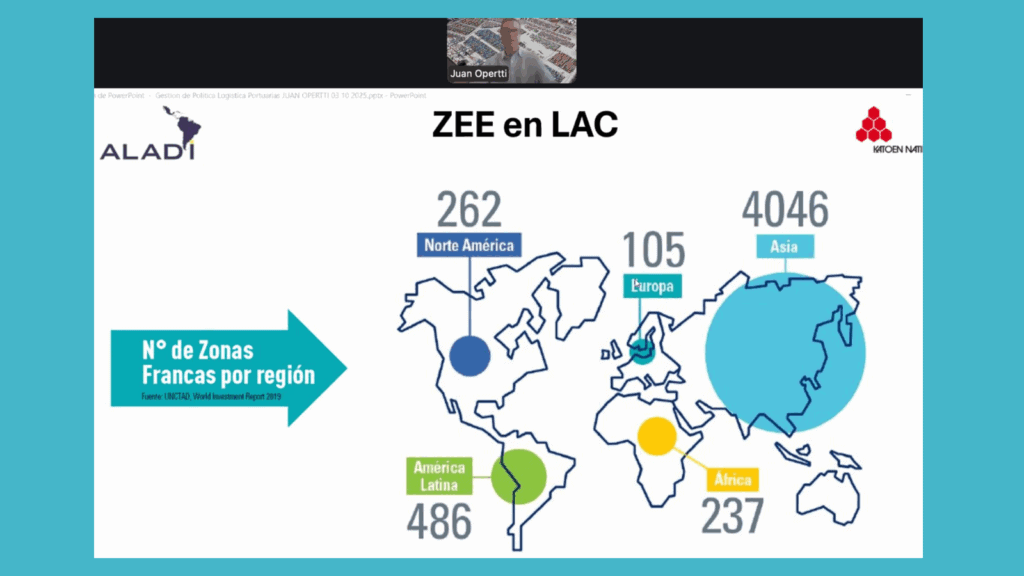
Opertti also addressed the impact of cross-border e-commerce and artificial intelligence on the configuration of supply chains, and the need to reduce inventories, shorten logistics cycles, and design port hubs that act as regional distribution centers. In this context, he emphasized the need to adopt state policies that strengthen special regimes, such as free trade zones—more than 400 of which are operating in Latin America—promoting their development in a complementary and intermodal manner, and enhancing digitalization and end-to-end visibility.
Finally, he emphasized that talent development, logistics training, data analytics, foreign trade, and sustainability must be central pillars. He concluded that Latin America can position itself not only as an infrastructure hub, but also as a hub for smart and sustainable logistics services, making sustainability a real competitive advantage.
Real transformation
In line with the vision put forward by Juan Opertti on smart and connected portsMariela Gutarra —Leader in Government and Digital Transformation and Head of the Information Technology Office of the National Port Authority of Peru (APN)— addressed the issue “Effective policies to stimulate port development: digitalization in the national port system”He highlighted digital transformation as a driver of competitiveness and regional cohesion, and underscored the importance of implementing policies that integrate the public, private, and academic sectors, as well as the logistics community, into the port modernization process.
“As Juan mentioned, digital port transformation is no longer something of the future: it's a reality and a current necessity,” he stated. The pandemic accelerated this process, forcing countries to adapt to sustain port and logistics operations. The challenge today is to consolidate a continuous digital culture that connects all stakeholders in the port ecosystem.
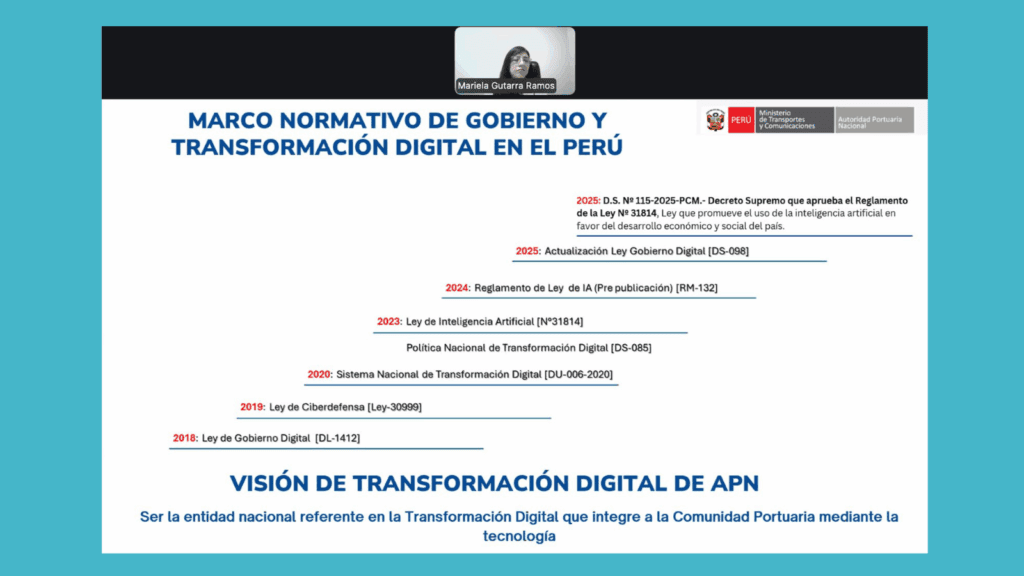
Gutarra also highlighted the role of human capital as a complement to technological and financial capital: "Combining talent, innovation, and resources generates true added value in supply chains." He reviewed Peru's regulatory advances, including a legal framework for digital transformation since 2018, the Artificial Intelligence Law, and the National Digital Transformation Policy for 2030, noting that the challenge now is to apply these standards practically in ports through sustained policies and concrete projects.
Among the real and emblematic initiatives, he mentioned the Callao Smart Port project, implemented since 2020, aimed at consolidating a hyperconnected, efficient, and sustainable port model, along with the use of emerging technologies—AI, IoT, digital twins, blockchain, and big data—to improve the visibility and interoperability of port systems. "We are inspired by international leaders like the Port of Antwerp to move toward smart ports," he explained.
He reiterated the importance of knowledge management and digital capabilities, with a focus on people: “Digital transformation doesn't start with technology, but with strategy and people. We need digital leaders and agile, horizontal, and collaborative organizations.”
On security, he highlighted the need to strengthen cyber resilience against the risks inherent in digitalization and mentioned the collaboration with the International Association of Ports and Harbors (IAPH) to develop guidelines on emerging technologies, from quantum computing to port automation.
Finally, he presented the National Port Development Plan for 2030, which promotes smarter, more sustainable, and interoperable ports, with maritime single windows and interoperable platforms (Port Community Systems), as well as pilot projects in ports like Chancay, which incorporate 5G technology, autonomous vehicles, and automated cranes. "We are building more sustainable, inclusive, and proactive ports, capable of responding to a more dynamic and complex global trade," he concluded, highlighting the adaptation of international best practices to the Latin American context.
Strategic customs
In this context, customs were highlighted as fundamental pillars of port modernization and trade facilitation. The representative of Peru emphasized that her customs agency “It is one of the most important and leading players in the digital transformation.”
“For many years, Peruvian Customs has made significant progress and today serves as an example for other port institutions,” he noted. “They have implemented artificial intelligence and promoted internal cultural transformation processes, consolidating their position as a regional benchmark.”
The official also recalled the recent celebration of Customs Day in Peru, where a discussion was held on the progress made and ongoing technological innovation projects. These interventions reflect how the region is undergoing a key stage of logistics and digital transformation, where customs, ports, and the private sector are converging on the same agenda: more agile, transparent, and competitive foreign trade.
From the private sector's perspective, Juan Opertti emphasized that customs plays an essential role not only in oversight, but also in facilitating international trade. "They have to inspect, because it's part of their mandate, but they must also take advantage of emerging technologies to reduce paperwork, simplify procedures, and streamline operations," he noted.
Opertti emphasized that digitalization allows for the decentralization of functions and improved cargo traceability, even outside traditional port areas. He underscored the value of extra-port controls and smart logistics corridors, where customs, health, and security agencies can act in a coordinated manner.
Finally, he emphasized that public-private collaboration is key to achieving more efficient processes: "The private sector can contribute technology and operational capacity, but the final decision must always rest with the customs official. Customs has the final say, as it is the authority over the merchandise. A country without a well-functioning Customs Office loses credibility and weakens institutionally..
Closing
The seminar, which brought together 147 participants, demonstrated how ports, customs, and the private sector are advancing together in digital transformation, multimodal transport, and the modernization of port infrastructure. These initiatives, promoted by ALADI, reinforce regional integration and environmental sustainability. In the words of Ambassador Didier Olmedo, Permanent Representative of Paraguay to ALADI and MERCOSUR: »Everything we do has one central focus: trade facilitation, which allows us to be more competitive and take full advantage of international trade opportunities.”

Aduana News foi o primeiro jornal aduaneiro da Argentina a lançar sua versão digital. Com mais de 20 anos de trajetória, suas publicações e iniciativas têm como objetivo oferecer o conhecimento mais relevante sobre temas aduaneiros, contribuindo para a promoção do comércio seguro e da facilitação do comércio na região.