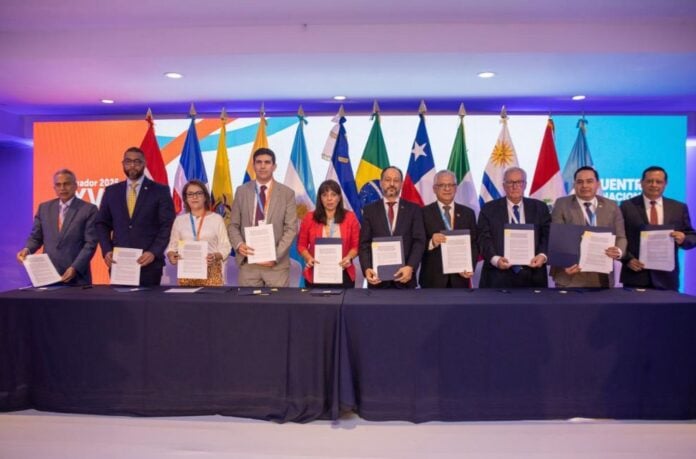
Within the framework of XXVII Regional Conference of Directors General of Customs of the Americas and the Caribbean, recently held in El Salvador, the blocks of the MERCOSUR and the Pacific Alliance signed a Mutual Recognition Agreement (MRA) between their Authorized Economic Operator (AEO/AEC) programs, with the aim of strengthening regional customs security and facilitating international trade.
The announcement was made in a timely manner by the World Customs Organization (WCO) and recently celebrated by the National Customs Directorate of Uruguay, who highlighted the strategic value of this step in strengthening the inter-bloc cooperation.
What is an AEO and why is it relevant?
The concept of Authorized Economic Operator (AEO) arises from the SAFE Regulatory Framework of the WCO, particularly of the Pillar 2, which promotes collaboration between customs and the private sector to strengthen the security of the international logistics chain. Through the AEO, companies that meet demanding security and traceability standards receive operational benefits and recognition from customs authorities.
One of the distinctive features of the OAS program is the possibility of subscribing Mutual Recognition Agreements (MRAs), through which countries formally recognize the national AEO programs of other States and grant equivalent benefits to their certified operators. The SAFE Framework (2021) establishes that mutual recognition is “a broad principle under which a measure adopted or an agreement appropriately established by one Customs administration is recognized and accepted by another Customs administration.”
Cooperation and concrete benefits
According to the National Customs Directorate of Uruguay, the agreement represents "a strategic advance to optimize cooperation between customs administrations, reduce operating times and costs, mitigate logistical risks, and improve the competitiveness of companies certified under these programs."
In this way, the implementation of the ARM between the customs of MERCOSUR and the Pacific Alliance This involves making its AEO/OEC programs compatible, avoiding duplication of controls and contributing to the balance between trade facilitation and effective customs control in the regional supply chain.
Projection: El Salvador advances toward regional recognition
At the same meeting, the National Customs Directorate of Uruguay signed a Joint Action Plan with the Customs of El Salvador, aimed at the future incorporation of this Central American country into the Regional Mutual Recognition Agreement (MRA) of Authorized Economic Operators (AEO), a plurilateral instrument signed in May 2022.
Uruguay is part of this regional agreement along with ten other customs administrations in Latin America and the Caribbean: Argentina, Bolivia, Brazil, Colombia, Costa Rica, Chile, Guatemala, Paraguay, Peru, and the Dominican Republic.
According to the National Customs Directorate of Uruguay, "El Salvador's future accession represents a significant step toward consolidating a regional network based on mutual trust, interoperability, and the standardization of security and trade facilitation standards."
These actions reaffirm the role of the AEO program as a tool to strengthen supply chain security, facilitate legitimate trade, and promote more efficient customs integration in the region.

Aduana News foi o primeiro jornal aduaneiro da Argentina a lançar sua versão digital. Com mais de 20 anos de trajetória, suas publicações e iniciativas têm como objetivo oferecer o conhecimento mais relevante sobre temas aduaneiros, contribuindo para a promoção do comércio seguro e da facilitação do comércio na região.