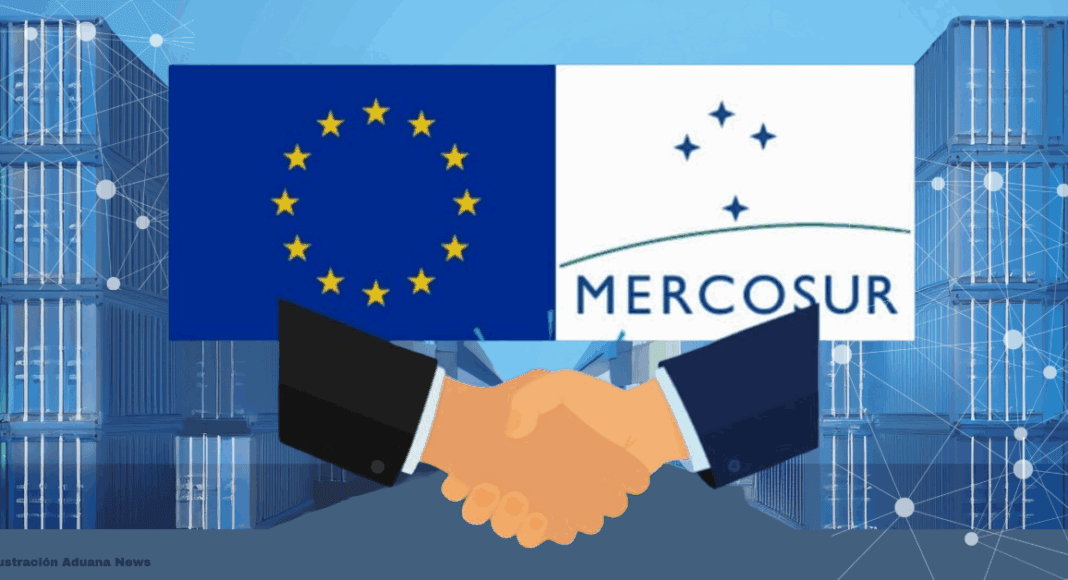

Finally, and after all the effort the process involved, the day arrived: this January 17, 2026 The official signing ceremony for the Association Agreement between MERCOSUR and the European Union is being held in Asunción, with the José Asunción Flores Grand Theater of the Central Bank of Paraguay serving as the venue. From a protocol standpoint, the ceremony will be presided over in some cases by the Heads of State and in others by the Ministers of Foreign Affairs. As part of the event, the heads of delegation from the member countries of the new MERCOSUR-European Union Agreement will address the attendees, followed by the signing of the instruments by the Ministers of Foreign Affairs of the MERCOSUR signatory states and the European Commissioner for Trade and Economic Security.
However, from the perspective of operational implications, tomorrow we will witness a step that redefines our trade landscape. With a potential market of 700 million consumers and a combined GDP of USD 22 trillion, the agreement seeks not only tariff reductions, but also a Reengineering of the international insertion of Mercosur in general and in particular for Argentina.
Beyond the headlines, for those of us who work in the day-to-day world of international trade, the real race begins:the technical suitability.”
Indeed, among the big changes On a technical level, I believe it is important to highlight the following:
- Possible leveling of the "Playing Field"?: One of the most relevant technical aspects is the elimination of competitive asymmetries. Until now, Argentina faced disadvantages compared to direct competitors already operating with the EU. This agreement aims to level the playing field, eliminating the "cost of not belonging" that affected the competitiveness of local exports.
- Tariff reduction: Asymmetry in Favor of MERCOSUR: The trade liberalization schedule has been designed with staggered timelines to allow for the adaptation of the regional production network. It includes immediate tariff elimination (0% tariff) for 15% of EU products entering MERCOSUR, and for 76% of MERCOSUR products entering the EU. The remaining tariffs are phased in gradually over 4, 7, 10, and 15 years.
- The Automotive Sector and Sustainable Mobility: The agreement contemplates a gradual and strategic opening for the automotive industry, with a long tariff reduction period for certain vehicles, new technologies and applicable special safeguard measures.
- Trade Facilitation and Non-Tariff Barriers: Beyond tariffs, the technical text emphasizes predictability regarding SPS (Sanitary and Phytosanitary) measures, an agile consultation mechanism, global standards, and alignment with international best practices in customs procedures, guaranteeing faster and more efficient merchandise clearance.
- Rules of Origin and the paradigm shift from certification to self-declaration: Historically, Mercosur operated under a certification system run by external entities. However, in recent years, the bloc has been incorporating a "self-certification" mechanism. It's worth noting that the agreement with the EU is based on the exporter's (or producer's) self-declaration of origin, and while there is a transition period to adapt the systems, self-certification for this agreement is now a reality.
- Foreign Direct Investment (FDI) and Supplies: The EU is already one of the main investors in Argentina with 40% of total FDI.
Conclusion
The signing of the Agreement is the starting point, not the goal. The window of opportunity now opening is pure gold for companies seeking to lead the market, especially in sectors with the greatest potential, such as agribusiness and services. Those who understand the fine print first will be the ones who best take advantage of the preferential tariffs from day one. It's time to plan. 2026 presents us with the task of doing our homework today (not for when it comes into effect).
The message for businesses is clear: take note and get to work now. Although national congresses must ratify the agreement and there will be phased implementation periods, the competitive advantage will belong to those who prepare in advance.
- Start planning an input audit: Analyze whether our products meet the criteria for substantial transformation (change of origin or regional added value, generally with a limit of non-originating materials of 50%).
- Accumulation of origin: Understanding how European inputs can help us "qualify" as originating in order to profitably re-export to the EU itself or within the bloc.
- Management systems: Implement records that allow for self-declaration to be supported in the event of a verification of origin years after the operation.
And this is just the beginning of a new stage…