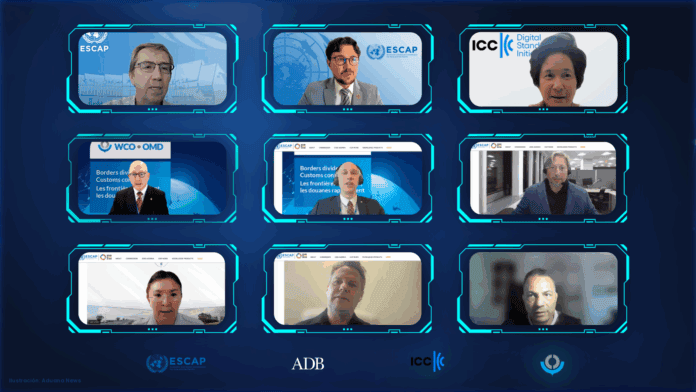
On April 24, 2025, international experts gathered to discuss the progress and ongoing challenges in implementing paperless cross-border trade during a high-level webinar organized by the United Nations Economic and Social Commission for Asia and the Pacific (UNESCAP), in collaboration with the World Customs Organization (WCO) and the Asian Development Bank (ADB). According to the organizers, more than 230 people participated in the session.
Yann Duval, Head of Trade Policy and Facilitation at UNESCAP, y Brendan O'Hearn, Acting Director of the WCO Compliance and Facilitation Directorate, opened the event by highlighting the importance of strengthening customs cooperation through the digital exchange of information, in the context of the growing push toward paperless trade.
Duval emphasized that this was the twentieth seminar in a series aimed at promoting the implementation of the Framework Agreement on Paperless Cross-Border Trade Facilitation in Asia and the Pacific (CPTA), a multilateral treaty that entered into force during the COVID-19 crisis in 2021.
“The real idea behind the agreement is to accelerate the mutual recognition of electronic trade data and documents, to facilitate trade but also ensure compliance. And regulatory compliance in trade today is a huge challenge, with all the tariffs and barriers being imposed,” said Mr. Duval.
In line with this objective, Mr. O'Hearn noted that today's interconnected global supply chains require more efficient customs data exchange systems. He presented key tools such as the WCO Data Model, Globally Connected Customs (GNC), and the Single Window Environment, which are essential for achieving cross-border interoperability and harmonization. He also emphasized the importance of integrating technologies such as blockchain and artificial intelligence, supported by strong regulatory frameworks and international trust.
Karl Flöhr, Technical Attaché of the WCO, added that these advances reflect the principles of the Revised Kyoto Convention, which promotes the use of information technologies to modernize customs operations. He mentioned the ICT Guidelines for Executives published in 2018, which are currently being updated.
These guidelines highlight the relationship between the core functions of the Revised Kyoto Convention and international standards, introducing the concept of Digital Customs. They also emphasize that Change management is critical for successful technology adoption, and that eSenior leadership plays a key role.
Global best practices from the US, EU, Finland, and Mongolia
The seminar's round table, moderated by Aleksei Bondarenko, UNESCAP trade facilitation expert, included valuable contributions from customs authorities in the United States, the European Union, Finland, and Mongolia.
William Slusher, U.S. Customs and Border Protection (CBP), presented the development of the G2G Network, a centralized and secure platform that uses cryptographic authentication. This system, based on the WCO Data Model, will replace multiple bilateral systems with a single, policy-based connection. Its initial use will focus on Authorized Economic Operator (AEO) programs, with pilot testing planned between May and September 2025.
Zahouani Saadaoui, Head of the eCustoms Sector of the European Commission, presented the EU Customs Single Window (EU CSW). This system, based on the Union Customs Code (UCC) and WCO standards, was designed from the ground up to:
- Reduce long-term costs through standardization
- Unify databases for better import and export management
- Simplify transition testing between import and export systems
Mr. Saadaoui indicated that the system already integrates data from the environmental, agricultural, and cultural sectors. He emphasized the importance of aligning digital systems with legal frameworks and harmonized trade practices. Although the system was developed for internal EU use, it also benefits third countries such as Brazil, which can issue export certificates compatible with European standards.
Mikael Gustafsson, Finnish Customs, He commented on Finland's experience in adopting the WCO Data Model, acknowledging initial challenges but sustained benefits. The model enabled simpler declarations, centralized databases, and more streamlined export processes.
Tsendsuren Davaa, senior official of the General Administration of Customs of Mongolia, described the country's modernization efforts since 2010 through a centralized web platform, risk management tools, and the adoption of the WCO Model. Mongolia already exchanges customs data with Russia and China and is developing C2C, G2G, and G2B data systems for licenses, vehicle authorizations, and tax documentation. It is also implementing an e-Transit Platform with UNCTAD support to differentiate in real time between goods in transit and imported goods.
Mr. Bondarenko praised Mongolia's gradual approach as a model for other countries: starting with small steps, scaling up progressively, and achieving remarkable results despite limited resources.
Final reflections: towards a unified framework
Pamela Mar, Executive Director of the ICC Digital Standards InitiativeHe concluded by stressing that customs data exchange must be based not only on technical tools, but also on common frameworks of interoperability and good governance.
He presented a comprehensive data framework developed by the ICC, which aligns customs, trade, financial, and logistics documents into a single structure. This structure is based on WCO and UN/CEFACT standards.
“Customs data exchange could become a model for the entire supply chain, fostering a decentralized ecosystem where data is shared with authorization, verification, and authentication,” said Ms. Mar. “Start with what you can, even if it's just a few documents. Every step brings efficiency, traceability, and simplicity, helping to make trade more inclusive.”
This article was prepared based on participation in the seminar and has been officially approved for dissemination in Latin America.
- The full seminar is available at this link.

Aduana News foi o primeiro jornal aduaneiro da Argentina a lançar sua versão digital. Com mais de 20 anos de trajetória, suas publicações e iniciativas têm como objetivo oferecer o conhecimento mais relevante sobre temas aduaneiros, contribuindo para a promoção do comércio seguro e da facilitação do comércio na região.