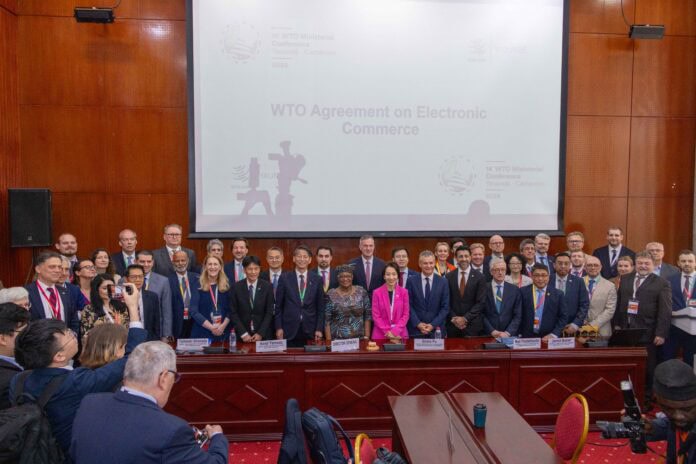
Sixty-six members of the World Trade Organization (WTO), representing approximately 70% of global trade, adopted on Saturday (28.03. 2026) a provisional pathway to implement the first core set of global rules on digital trade, during the 14th WTO Ministerial Conference (MC14), held in Yaoundé, the capital of Cameroon.
According to joint declarationThis provisional approach will facilitate the entry into force of the Agreement on Electronic Commerce while work continues on its formal incorporation into the WTO legal framework, a process that requires the full consensus of the organization's 166 Members.
According to the WTO, the Agreement on Electronic Commerce establishes rules that legally recognize digital transactions, facilitate paperless electronic trade and payments, promote interoperability and digital trust, and seek to expand the participation of developing countries in the digital economy.
Among the Members that supported this provisional approach are Australia, Japan, Singapore, Canada, China, the United Kingdom, Switzerland, the United Arab Emirates, Costa Rica, Peru, the Philippines, Mauritius, Gambia, the European Union —which participates as a Member of the WTO— and Argentina, along with other participants in the plurilateral initiative on electronic commerce.
La WTO Director-General Ngozi Okonjo-IwealaHe welcomed the effort. “By moving forward with the Electronic Commerce Agreement, participating economies are helping to establish a common regulatory framework that can reduce costs and open up new opportunities,” he said, further emphasizing that the multilateral trading system can adapt to current challenges.
In this context, it's worth noting that e-commerce is currently a fundamental pillar of the global economy, and digital activities represent an ever-increasing proportion of global GDP. In this regard, it is estimated that digital transactions account for more than 60% of global GDP, and the implementation of the agreement could generate approximately $159.000 billion in trade annually.
According to the official content, the Agreement will enter into force for Members that complete their internal procedures and, once ratified by at least 45 countries, will begin to be applied effectively, benefiting businesses, consumers and developing economies.

The moratorium on electronic transmissions is still under negotiation.
The continuation of the moratorium on customs duties applicable to electronic transmissions —whose The deadline is March 31st.— remains one of the most sensitive points on the agenda in Yaoundé.
While India, South Africa, and Bangladesh support its termination, arguing that it limits the fiscal space of developing countries, the United States and other developed Members promote making it permanent, highlighting that it contributes to the expansion of digital trade and the predictability of the international trading system.

Aduana News foi o primeiro jornal aduaneiro da Argentina a lançar sua versão digital. Com mais de 20 anos de trajetória, suas publicações e iniciativas têm como objetivo oferecer o conhecimento mais relevante sobre temas aduaneiros, contribuindo para a promoção do comércio seguro e da facilitação do comércio na região.