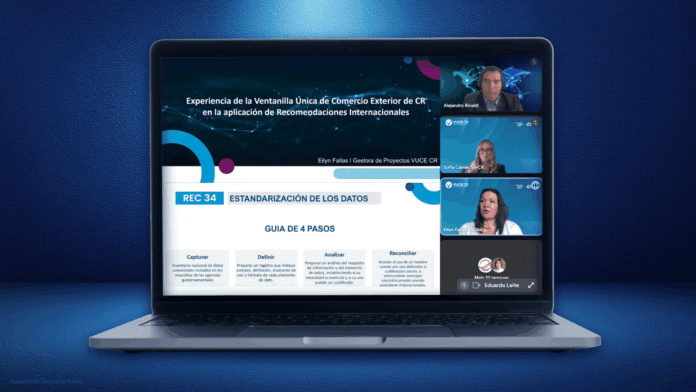
Interoperability, standardization and regional efficiency were the axes of the webinar “The UN/CEFACT Recommendations for Trade”, held on June 18, 2025. Focusing on the implementation of Single Windows for Foreign Trade (SWW) and organized by the Trade and Compliance Institute (TCI) under the auspices of UN/CEFACT, the meeting brought together officials, specialists and academics from 14 countries of Latin America and the Caribbean.
The seminar provided concrete tools for moving toward more agile, secure, and coordinated trade through the adoption of internationally recognized standards, such as UN/CEFACT Recommendations 33, 34, and 36. It also showcased successful cases, such as that of Costa Rica, which demonstrate how a coordinated and sustained national strategy can generate real economic impact.
The following is shared: validated content from the seminar for analysis and dissemination.
◼Chapter I: Eduardo Leite – UN/CEFACT Recommendations for International Trade
The UN/CEFACT Regional Rapporteur for Latin America and the Caribbean, Eduardo Leite, opened the seminar with an introductory presentation on the fundamental role played by the United Nations Centre for Trade Facilitation and e-Business in the field of international trade.
◼Chapter II: Alejandro Rinaldi – Codification Recommendations for International Trade
Alejandro Rinaldi, Coordinator of the ICT Working Group, focused his presentation on the codification recommendations developed by UN/CEFACT, highlighting their importance for the standardization and facilitation of international trade.
Rinaldi presented a detailed analysis of the main coding recommendations, among which he highlighted:
• Recommendation 3: Codes that represent country names (ISO), such as BR for Brazil, CR for Costa Rica, and UY for Uruguay.
• Recommendation 9: Codes to represent legal tender (ISO) currencies, such as BRB for the Brazilian Real, CRC for the Costa Rican Colón, and UYU for the Uruguayan Peso.
• Recommendation 10: IMO Ship Identification Codes, exemplified by code 9387426 for the container ship "MSC DANIT".
• Recommendation 5: INCOTERMS (ICC) abbreviations, such as CIF and FOB.
• Recommendation 16: : Code for Commercial and Transportation Locations (UN/LOCODE), such as “UY COA” for Carrasco Customs in Uruguay.
• Recommendation 17: Payment terms, such as “CONCREDOC/3M” for a 3-month confirmed payment.
• Recommendation 19: Modes of transport, such as code “7” for pipelines.
• Recommendation 20: Units of measurement, such as “KGM” for kilograms or “C62” for neutron.
• Recommendation 28: Codes for types of transport media, such as “53” for tanker or “531” for crude oil.
The expert emphasized that while there is a cost associated with implementing and maintaining these coding systems, the benefits are exponential in terms of added value. However, he pointed out an important paradox: at the local level, the benefit doesn't always justify the cost, while at the regional level, there is a huge waste of potential value.
Rinaldi concluded his presentation with a call to action regarding Recommendation 36 on Single Window Interoperability, inviting participants to explore this topic further through a follow-up form.
◼Chapter III: Sofía Camacho Rojas – Key Elements for the Establishment of VUCE
Sofía Camacho Rojas, TCI Focal Point in Costa Rica, dedicated her presentation to the key elements for establishing Single Windows for Foreign Trade (SWT), based on the recommendations of UN/CEFACT.
The discussant began by quoting Article 10, Section 4.1 of the WTO Trade Facilitation Agreement, which states: “Members shall endeavour to maintain or establish a single window enabling traders to submit to participating authorities or agencies the documentation and/or information required for the importation, exportation, or transit of goods through a single point of entry. After the examination of the documentation and/or information by the participating authorities or agencies, applicants shall be promptly notified of the results through the single window.”
Camacho Rojas structured his presentation around ten key elements for the successful establishment of a VUCE:
1. Definition of VUCE: Based on UN/CEFACT Recommendation 33, which defines the Single Window as "a service that promotes trade facilitation by enabling parties involved in trade and transport to submit standardized information and documents at a single point of entry, in order to satisfy all regulatory requirements related to import, export and transit. Data for each element need only be submitted electronically once."
2. Political WillHe highlighted three key aspects: political commitment, multi-agency coordination, and change management.
3. Legal Environment: Based on Recommendation 35, which covers the legal recognition of electronic documents, data protection and privacy, legal liability, information sharing between government agencies, and the institutional framework.
4. Leading Agency: He emphasized the crucial role of a coordinating agency with specific characteristics such as political authority and support, technical and administrative capacity, institutional neutrality, transparency, and accountability.
5. VUCE Model: He presented different models based on UN/CEFACT Recommendation 33.
6. Data Standardization: He explained the 4-step guide proposed in Recommendation 34.
7. VUCE Services: He illustrated with examples of successful implementations in Mauritius, Sweden and the United States.
8. Regional ContextHe emphasized important aspects such as the need for each country to have a National VUCE with a similar level of operation, well-defined national and regional legislation, and interoperability as a requirement for achieving regional objectives.
9. International Standards: He stressed the importance of adopting globally recognized standards.
10. Interoperability: Based on Recommendation 36, it emphasized the need for international exchange of accurate data.
The speaker concluded by emphasizing that proper project management is essential for the successful implementation of a VUCE.
Chapter IV: Eilyn Fallas Padilla – Experience of Costa Rica's Single Window for Foreign Trade
Eilyn Fallas Padilla, Project Manager at PROCOMER, shared Costa Rica's experience in implementing its Single Window for Foreign Trade and the application of the international recommendations of UN/CEFACT.
Fallas Padilla began his presentation by highlighting the fundamental principles of the Costa Rican VUCE: – Centralize, streamline and simplify procedures – Promote collaboration between government agencies – Establish themselves in strategic geographic areas
The speaker gave a historical overview of the evolution of VUCE in Costa Rica:
1996 - 2002: Phase of centralization and unification of procedures
2003 - 2013: Digitization of procedures
2022-present: Automation of procedures (Version 3 of VUCE CR)
Fallas Padilla presented concrete data on the economic impact generated by the inclusion of processes in the VUCE, highlighting benefits amounting to several million dollars ($3,03 million and $7,09 million in different stages of implementation).
Among the most notable achievements of the Costa Rican VUCE, the speaker mentioned:
– Advanced digitalization led by PROCOMER
– Incorporation of electronic payments through the National Electronic Payment System (SINPE) – Establishment of a robust legal framework.
Along the same lines, the efforts being made in:
-Development of a common data model between licenses
– Incorporation of all government agencies involved
– Interaction of the VUCE CR System with mobile applications
– Incorporation of QR code in procedures
– Implementation of a Unified Declaration
– Incorporation of the National Risk Management System.
As well as some of the current challenges, including achieving effective regional interoperability.
The Costa Rican experience was presented as a success story in the region, demonstrating how the implementation of international recommendations can translate into tangible benefits for a country's foreign trade.
◼Conclusion
The webinar "UN/CEFACT Recommendations for Trade" provided a valuable opportunity for the exchange of knowledge and experiences for the participants, representatives of various institutions in Latin America and the Caribbean. The broad participation of government entities, international organizations, academic institutions, and private companies from 14 countries in the region demonstrates the growing interest in implementing international standards for trade facilitation.
The presentations by experts Sofía Camacho Rojas, Alejandro Rinaldi, and Eilyn Fallas Padilla offered a comprehensive overview of the UN/CEFACT recommendations, with particular emphasis on the implementation of Single Windows for Foreign Trade. The case of Costa Rica, presented by Fallas Padilla, illustrated how the effective implementation of these recommendations can translate into concrete economic benefits and greater efficiency in foreign trade processes.
A highlight of the seminar was the emphasis on regional interoperability as a key factor in maximizing the benefits of Single Windows. As Mr. Rinaldi noted, while at the local level the implementation of standardized systems may not always justify the cost, at the regional level there is enormous potential value that is currently being untapped.
The event concluded with a call to action to further develop Recommendation 36 on Single Window Interoperability, underscoring the importance of regional collaboration to advance toward more integrated and efficient systems that facilitate trade in Latin America and the Caribbean.
🌐Interested parties can participate through the following link:
◼List of participating institutions by country
The seminar was attended by representatives from institutions in 14 Latin American and Caribbean countries, including:
- Argentina: ARCA Customs, General Directorate of Customs, SENASA, VUCE Argentina, Chamber of Foreign Trade of Córdoba, National University of Lanús, among others.
- Colombia: DIAN, Microsoft.
- Costa Rica: Ministry of Finance, PROCOMER, General Directorate of Customs, COMEX.
- El Salvador: Central Reserve Bank, CIEX, Court of Appeals for Internal Revenue and Customs.
- Guatemala: Ministry of Economy, SIECA.
- Panama: Customs, TCI.
- Paraguay: National Directorate of Tax Revenue, IESC
- Peru: Ministry of Foreign Trade and Tourism, MINCETUR.
- Dominican Republic: General Directorate of Customs.
- Uruguay: ALADI, National Customs Directorate, ADAU.
Representatives of institutions from other countries also participated, such as Belize, Bolivia, Chile and Venezuela, demonstrating the event's regional scope and the shared interest in trade facilitation through the implementation of international standards and interoperable Single Windows.

Aduana News foi o primeiro jornal aduaneiro da Argentina a lançar sua versão digital. Com mais de 20 anos de trajetória, suas publicações e iniciativas têm como objetivo oferecer o conhecimento mais relevante sobre temas aduaneiros, contribuindo para a promoção do comércio seguro e da facilitação do comércio na região.