

We're going to do something a little different this Friday. As always, we'll continue sharing opinions and the latest news. But today we want to invite you to explore our favorite reads of the year.
La 2025 edition The columnists' feature began on March 28th, with the aim of contributing to a better understanding of the importance of Customs as a central institution in foreign trade. Analysis of the most-read columns confirms, once again since 2022, that the content fulfilled this purpose and met the interests of a specialized audience.
The topics covered focused on regulatory and practical, offering useful information for daily operations; innovation and digitalizationhighlighting the trends of new technologies applied to Customs, such as artificial intelligence, blockchain and e-Commerce; history and institutional context, This allows us to appreciate the career of figures like Juan José Alberto Sortheix, who transcends the creation of a classification system and represents a commitment to global customs cooperation and technical excellence, serving as an example for future generations of specialists. This approach also addressed topics currently under development, such as Brazilian Customs Law. It also highlights the sustainability and the environment, showing how the institution, in line with multilateral agreements on the matter, contributes to promoting more sustainable foreign trade.
In this way, the columns form a valuable sample of the content that Aduana News published throughout the year.
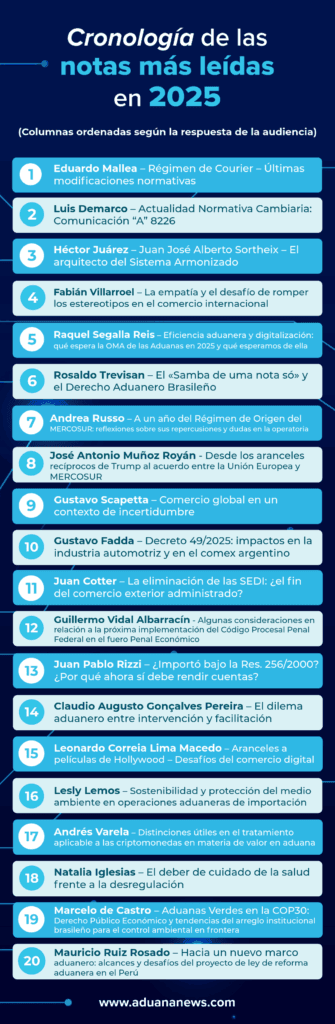
Here we present a summary of each note, with a link to access the full content and review topics of interest.
- Courier Regime – Latest regulatory changes. In early 2025, Eduardo MalleaA specialist in Customs Law and International Trade and former director of the General Directorate of Customs, analyzes the recent modifications to the Courier Regime. His column explains how Decree 1065/2024, by establishing a USD 400 duty-free allowance per non-commercial shipment, and RG 5608/2024, modified by RG 5631/2025, which unified the regulatory framework for PSP/Courier services, raised the import limit to USD 3.000 and allowed operational improvements, such as the use of bonded warehouses by service providers, impact the daily operations of importers and carriers. Read here.
- Current Exchange Regulations: Communication 'A' 8226This is the work presented on April 14, 2025 by the CPN Luis Ricardo Demarco, head of the COMEX technical area at Banco Santander, in which he analyzes the changes that would come into effect with Communication 'A' 8226. His column offered practical information for operators and companies that carry out transactions in foreign currency, helping to understand the impact of the regulations on operations. Read here
- Juan José Alberto Sortheix – The architect of the Harmonized System. The Dr. Hector Juarez AllendeMember of the National Tax Court, university professor and author of the book "The World Customs Organization: Past, Present and Future"It elaborates on the important legacy of Sortheix, born in San Miguel de Tucumán on March 9, 1930. He was a brilliant lawyer specializing in customs law, whose contribution to the development and fluidity of international trade in goods was extraordinary. Read here o Listen in podcast format
- Empathy and the challenge of breaking stereotypes in international trade. DrFabian VillarroelThe President of the Chilean Institute of International Trade and Director of Regulatory and Customs Affairs for DHL in Central and South America, writes a column that, at first glance, might seem like a self-help article. But it isn't. Villarroel's intention is to encourage reflection on the importance of public-private dialogue in international trade—especially between operators and customs authorities—adopting approaches based on empathy, understanding the needs and positions of all parties. Read here
- Customs efficiency and digitalization: what the WCO expects from Customs in 2025 and what we expect from it (Customs efficiency and digitalization: what OMA expects from Customs in 2025 and what we expect from it)The Brazilian academic, Raquel Segalla ReisIn his column (originally published in Portuguese), he addresses the theme proposed by the World Customs Organization (WCO) for its annual celebration on January 26, 2025. The WCO invited customs administrations to translate their commitments into concrete actions that facilitate trade, ensure security, and foster sustainable economic growth. As Ian Saunders, Secretary General of the WCO, summarized: "Customs fulfilling its commitment to efficiency, security, and prosperity".Read in Portuguese
- "One-Note Samba" and Brazilian Customs Law (O «Samba of a single note» eo Brazilian Customs DireitoThis column is from Rosaldo TrevisanHe holds a Doctorate in Law (UFPR) and is a Professor of Customs, Tax, and International Law at various educational institutions in Brazil and abroad. In his text, he presents a reflection on the iconic Brazilian song by Newton Ferreira de Mendonça and Tom Jobim. “Samba de uma nota só”and relates it to the evolution of Customs Law in Brazil. Just as a melody revolves around a central note, Brazilian customs legislation seeks to focus its efforts on the essence: clear codification, trade facilitation, and efficient control. Brazil is moving forward with the General Law of Foreign Trade (LGCE) and tax and administrative litigation reforms, while identifying areas that still require harmonization. The musical metaphor emphasizes the need to focus on the essentials, avoiding regulatory fragmentation and conflicts between customs and tax law.. Read in Portuguese
- One year after the MERCOSUR Origin Regime: reflections on its impact and operational concerns. The Lic. Andrea Russo, National Coordinator of Technical Committee No. 3 “Commercial Standards and Disciplines”The person in charge of MERCOSUR's rules of origin negotiations presents a column in line with their work for 2024. As the title indicates, a year has already passed since the implementation of the much-discussed "new ROM," or MERCOSUR Rules of Origin. Although the term "new" could be omitted, in practice, concerns and doubts still arise that require interpretation. This column aims to pave the way for the correct application of certain articles and support commercial operators in effectively accessing the benefits established by the regulations, offering clear tools for their use in daily operations. Read here
- From Trump's reciprocal tariffs to the agreement between the European Union and MercosurThis work corresponds to José Antonio Muñoz Royán, An inspector with the Spanish State Tax Administration Agency (AEAT), who approaches the topic from a technical, rather than political, perspective. The column analyzes the situation created by the reciprocal tariffs imposed during the Trump administration and the subsequent development of the agreement between the European Union and MERCOSUR, evaluating the merits of promoting free trade agreements versus the opposing stance of increasing protectionist measures. Read here
- Global trade in a context of uncertainty. The Master Gustavo Scarpetta It offers an overview of global trade, highlighting the trade war as the main factor impacting imports and exports worldwide. It also emphasizes other strategic changes transforming the dynamics of international trade: a process of regionalization accompanied by modifications to global value chains, the sustained growth of e-commerce, the increasing participation of Asia and its prospects for future expansion, and the rise in trade in services, which is growing at a faster rate than trade in goods. Read hereí
- Decree 49/2025: Impacts on the automotive industry and on Argentine foreign tradeThe International Trade Consultant Hector Gustavo Fadda This article analyzes Decree 49/2025, which represents an important step toward promoting alternative-fuel vehicles in Argentina. By reducing tariffs and establishing an annual import quota, the government seeks to facilitate access to more sustainable vehicles and lower costs for consumers. Read here
- The elimination of SEDI: The end of managed foreign trade?The academic Juan Patricio Cotter It elaborates on the repeal of the Import Statistics System (SEDI) by the National Executive Branch, a measure that eliminates the need to request prior authorizations or wait for validation from officials of the Secretariat of Commerce to purchase and import goods. It clarifies that, although the measure may seem purely statistical, it has a significant impact on foreign trade operations, since for 25 years, the SEDI and its predecessors functioned as an instrument of indirect trade administration, providing advance information and, in practice, regulating the importation of goods into Argentina. Read here
- Some considerations on the implementation of the Federal Criminal Procedure Code in the Economic Criminal CourtThe new president of the IAEA, Dr. Guillermo Vidal Albarracín, refers to the recent Resolution 143/2025 of the Ministry of Justice, which establishes the implementation of the Federal Criminal Procedure Code (CPPF) for all cases initiated in the Economic Criminal Court from August 11, 2025. This court is key —he maintains—, since it mainly investigates customs crimes and other economic crimes.Read here
- Did it matter under Resolution 256/2000? Why he must now be held accountable.Cordoba-based lawyer Dr. Juan Pablo Rizzi analyzes the Import Regime for Goods Included in Large Investment Projects (Resolution ME 256/2000), historically a key tool for companies seeking to modernize their infrastructure with tariff benefits. However, he warns that in the past, some importers were not properly audited by the regulatory authority, forcing them to indefinitely maintain the guarantees provided to ensure compliance with potential customs duties. Therefore, he points out that, following the modifications introduced by Resolution ME 319/2024, these importers are now able to conduct a kind of “self-audit,” with a deadline for submission in June 2025. Read here
- The Customs Dilemma between Intervention and Facilitation. (The customs dilemma between intervention and facilitation) is the work presented by the Brazilian academic, Dr. Claudio Augusto Gonçalves PereiraIn this work, the author analyzes how the role of customs administrations in the contemporary economy extends beyond traditional revenue collection and border control functions. In a context marked by the complexity of global value chains, the intensification of international trade, and the advancement of digital technologies, the author argues for a balanced approach that reconciles the protection of society and the economy with the objectives of trade intervention and facilitation. He also reflects on strengthening the institutional capacities of customs in the face of the increasing sophistication of transnational criminal organizations, which resort to illicit practices associated with foreign trade, such as smuggling, money laundering, international drug trafficking, and tax evasion, frequently exceeding the limits of ordinary customs control.Leather in Portuguese
- Tariffs on Hollywood Films – Challenges of Digital Tradesystem. (Rates on Hollywood Films – Challenges for Digital CommerceThe reflection of Leonardo MacedoThe article, written by a member of the CARF (Brazilian Council for Tax Appeals), stems from former President Trump's surprise announcement of a 100% tariff on all foreign-produced films, justified on national security grounds and with instructions for the U.S. Trade Representative to impose duties on "each and every film" produced outside the country. According to the author, this measure raises significant legal and commercial concerns, particularly within the framework of World Trade Organization (WTO) regulations. At the heart of the debate is Decision 4.1 of the Customs Valuation Agreement (CVA), which poses challenges for the classification, valuation, and taxation of digital goods and audiovisual services in international trade. Read here
- Sustainability and environmental protection in customs import operationsThis emerging topic is developed by the Professional Leslye Lemos, From the Audit Division of the Risk Management and Control Area of the National Customs Directorate in Uruguay. In particular, it explores the recent approval of regulations for the waste management plan for electrical and electronic equipment entering the country. According to Lemos, customs plays a key role as regulatory entities, promoting compliance with environmental regulations and restricting trade in products harmful to the population. These sustainability policies not only protect the environment but also improve the reputation of companies that adapt to regulatory compliance, promoting responsible trade committed to society.Read here
- Useful distinctions in the treatment applicable to cryptocurrencies in matters of customs value. According to Dr. Andrés Varela, Its topic is particularly relevant for two reasons: first, it is current and pertinent, given that administrative and judicial questions have already been raised about it; second, it coincides with the approval of a new instrument within the framework of the World Customs Organization, which provides clarity on the treatment of cryptocurrencies in terms of customs value.Read here
- The duty of care for health in the face of deregulationThe Lic. Natalia Iglesias, a specialist in Foreign Trade and Customs Broker, analyzes how the deregulation of import controls poses a dilemma: although the final destination of the products is always a user, the flexibility of controls according to the entry regime can generate unequal health protection.Read here
- Green Customs at COP30: Economic Public Law and Environmental Control at the BorderFrom Manaus, Marcelo de Castro The report analyzes COP30 in Belém, highlighting that the choice of the Amazon as the host country is not merely symbolic: it shifts the center of climate negotiations to the heart of the rainforest, revealing the tension between conservation, development, and inequality. The Amazonian frontier becomes a laboratory of environmental challenges: Indigenous territories, protected areas, legal and illegal mining, timber and wildlife trafficking, hazardous waste routes, and bioeconomy demands overlap. In this scenario, Brazilian customs evolves from a technical body to a strategic actor, deciding what enters, what leaves, and what is formalized, directly influencing the coherence between Brazil's climate commitments and their actual implementation.
- Towards a new customs framework in Peru: scope and challenges. The Dr. Mauricio Ruiz Rosado It explains that Peru's General Customs Law (Legislative Decree No. 1053, 2009), inspired by the Kyoto Convention, originally prioritized trade facilitation and logistical efficiency. However, successive amendments increased customs control and oversight, prioritizing fines and the collection of additional taxes, and reducing SUNAT's facilitative approach. It notes that in September 2025, Bill No. 121218/2025-CR was introduced, proposing a comprehensive reform of the customs framework, with approximately 80% of the articles modified, seeking to restore trade facilitation and streamline logistics operations, without neglecting customs control. It anticipates that this will entail mandatory training for officials and operators on the new regulations. Read here.
In closing
Finally, we emphasize that, beyond the 2025 timeline, all these columns are especially relevant due to the development of the topics covered, which are of interest to both professionals and students. Each text is a living piece: It offers perspectives, rigorous analysis, and practical reflections that enrich knowledge and can be applied in the workplace or academia. We invite you to review them again.

Aduana News foi o primeiro jornal aduaneiro da Argentina a lançar sua versão digital. Com mais de 20 anos de trajetória, suas publicações e iniciativas têm como objetivo oferecer o conhecimento mais relevante sobre temas aduaneiros, contribuindo para a promoção do comércio seguro e da facilitação do comércio na região.