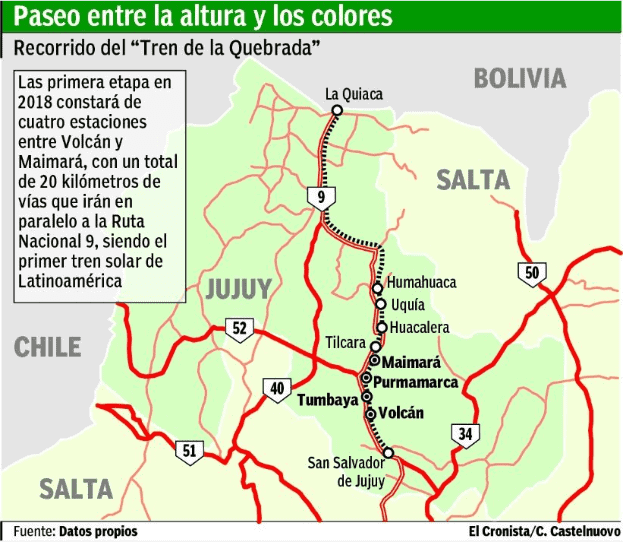
In February 2018, work began on the Tren de la Quebrada railway corridor, the first tourist train in Latin America to be powered by solar energy and the second in the world, after the Byron Bay in Australia. The railway will connect Volcán with San Salvador de Jujuy, Purmamarca and Maimará (Jujuy, Argentina), a 20-kilometer route.
As reported by the magazine OpeningThe second stage of construction of the vehicle will take place this year and corresponds to the extension of the route to the city of Humahuaca and, later, to La Quiaca, a city that is located almost 300 kilometers away from San Salvador de Jujuy and is located on the border with Bolivia.
Inca Trail
The project's near future goal is for the train to operate the railway route to the city of Uyuni and Lake Titicaca (Bolivia), as well as the one that links the city of Cusco with Machu Picchu (Peru), known as the Inca Trail. "The solar train will follow the route of the Belgrano Cargas railway, which was deactivated 25 years ago, on the Inca Trail, which was the first trade route in South America," said engineer Pablo Rodríguez Messina.
La Quebrada will be a small train, consisting of a motor car and a wagon, with capacity for 240 passengers. It will also have photovoltaic panels on the roofs to be powered by solar energy and hydraulic diesel. The construction of the train will involve international specialists who already worked on the creation of the Byron Bay.
The first phase of the railway corridor will require an investment of 9 million dollars, while the second will need an additional 6 million dollars.. Meanwhile, Rodriguez said.
The first section of the work, which connects Volcán with Maimará, is expected to be ready next August and the Quebrada will travel this route in three hours., at a speed of 30 kilometres per hour. The train will make three round trips a day, and each station will have a theme related to Jujuy's gastronomy, carnival or culture.

Aduana News foi o primeiro jornal aduaneiro da Argentina a lançar sua versão digital. Com mais de 20 anos de trajetória, suas publicações e iniciativas têm como objetivo oferecer o conhecimento mais relevante sobre temas aduaneiros, contribuindo para a promoção do comércio seguro e da facilitação do comércio na região.