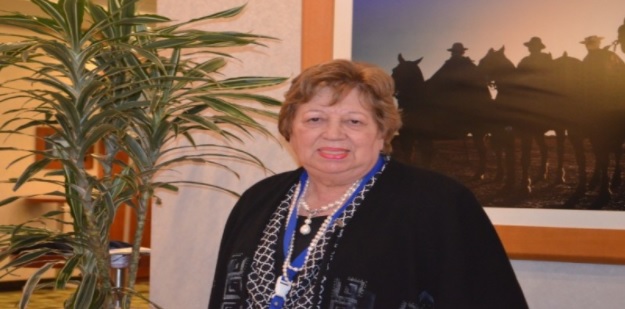
With sharp thinking and polished sensitivity, De Langhe de Falcone responds with wisdom and agility. This woman, a lawyer since she was 21, is the architect of managing judicial change in the Province of Jujuy: Falcone demands honesty from judges to recover the value of justice. Despite her low profile, she was the only judge from the interior of the country who spoke at the 2018 International Conference of Women Judges. Visiting Buenos Aires, she spoke with Aduana News about these issues.
In response to the demand for better justice, what changes do you suggest?
I practiced law for more than forty years before entering the judiciary. When I entered, I set myself a goal: to try to make people believe in justice. Now that I am President of the Judiciary of the Province of Jujuy, I am making the greatest efforts imaginable, with concrete actions, so that people begin to believe in justice even if I do not see the final result. It is very difficult… because I believe that changes are needed.
On the one hand, modifying the Criminal Procedure Code as the substantive Code. Why do I say the Criminal Procedure Code? Because justice takes time due to the number of appeals that exist, so it is necessary to limit such appeals. This is said by a person who before being a judge has practiced the profession, and I also have a very well-known career in the Province of Jujuy, where I have seen that unfortunately colleagues misuse these appeals, thinking that in this way they will obtain the release of people or more economic gain for themselves. So, we must limit these appeals that lengthen the proceedings, that is, end the "procedural chicanery." As the slogan says, "slow justice is not justice"; and it is true. People ask themselves: Why doesn't he go to jail? or they say "I don't see a sentence." And they don't go to jail or there is no sentence for such procedural reasons. In addition, there are bad judges. For this reason, I would also reduce their terms, and even control them more.
Regarding the slow processes of justice, do you think that modernizing the State would speed up judicial proceedings?
First, I think of the human question. Technology can never replace the human being. We need judges with specialization in the areas in which they are going to act, this is the human condition. We need honest judges, honesty, like truth, is born from the training that each one of them has. As long as there is no honesty, efficiency and capacity, no matter how much technology exists, it is useless. Technology does not overcome the human condition, which must come first and technology next to it.
What changes have been made to the Judiciary of Jujuy?
We have an IT Department that is making sure that the files are beginning to be "paperless", because the paperwork has to be reduced due to a physical space issue. I warn again, I am demanding more specialization in jurisdictions such as Administrative Litigation, Civil and Commercial, Labor and Criminal. But the summonses are already notified online.
What motivated the creation of the first environmental courts in Jujuy?
I must say that when I was sworn in as a member of the Supreme Court of Justice, I have never brought up the partisan issue in a ruling, I leave this on record. Since 2015, when this Government took office, there was a huge judicial reform that established a series of conditions that had not been seen in the province for forty years. First, the Evaluating Court was created because Jujuy does not have a Council of the Judiciary. This Evaluating Court with a president, vice president, members of the university, the legislature, the judiciary, the bar association and the magistrates' association, examines the candidates for Defender, Prosecutor, Judge and Chamber Member. Before, it was all political "finger-pointing." Now, people take the exam. The case arrives from the University of Tucumán in a sealed envelope, the background is evaluated and the personal interview is conducted. Whoever gets the highest score will be included in a shortlist, which is sent to the Governor to choose the person.
This package of laws includes the creation of the Environmental Courts, the Court of Gender Violence, the Court of Cassation and the Tax Criminal Court. In addition, the decentralization of justice implies creating courts in Libertador General San Martín or Ledesma, whose building I have already inaugurated; we began the construction of the judicial city in Perico, on May 23 I will lay the foundation stone in Tilcara and in 2019 in Abra Pampa, plus Humahuaca. In other words, the current Governor has made a decentralization of Justice never seen before in Jujuy.
You have spoken at the International Conference of Women Judges on the environment. Why are you interested in the environment?
They told me about the Association of Women Judges of Argentina (AMJA) and said: “Dr. Falcone, since Jujuy has the only environmental court with judicial jurisdiction and because the country would implement the model, we invited you to speak on the subject. So I studied the law and the respective cases in depth. I loved it. Now I will expand my knowledge about the environment.”
What message would you leave to society?
The only message I want to give to society is that we should tolerate each other more, not talk too much. To talk you have to know, to know you have to study, to study you have to know and knowledge does not take up space or age. Thinking that if we are doing badly, there are many who are worse off than us. Only in the tolerance of diversity of thought is there coexistence.
My father told me: ¨Don't forget. God created you and when he created you he broke the mold. He created another, he broke a different mold from the previous one and so on…¨
What did he mean by that? That one is different from the other, but God has put us all together in a society. So, by tolerating each other, coexistence is possible.

Aduana News foi o primeiro jornal aduaneiro da Argentina a lançar sua versão digital. Com mais de 20 anos de trajetória, suas publicações e iniciativas têm como objetivo oferecer o conhecimento mais relevante sobre temas aduaneiros, contribuindo para a promoção do comércio seguro e da facilitação do comércio na região.