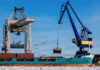
The national government has digitized the Maritime Import Cargo Manifest with the purpose of facilitating trade, improving control of merchandise, as well as simplifying and modernizing customs procedures.
This was announced by the Director General of Customs, Diego Dávila, on Tuesday (24.7.2018) when he explained that the measure was implemented following the creation of the Directorate of Customs Process Reengineering.
"We believe that the only way to streamline is through a policy in terms of simplified processes accompanied by cutting-edge technology," said Dávila.
This system involves the digitalization of more than 70.000 documents that are produced per month and more than 850.000 per year, explained Dávila, who presented the Maritime Cargo Manifest together with Agustín Laurnagaray, director of Customs Process Reengineering and Javier Zabaljauregui, deputy general director of Metropolitan Customs Operations.
Digital simplification
From now on, maritime transport operators will have to do a single digital presentation before leaving the port of origin, therefore, verification of containers in Argentina will be done online.
To carry out the procedure, the Customs Transport Agent (ATA), the new entity that represents the carrier, must enter the information into the Malvina Computer System (SIM), with a level 4 Tax Code.
Public-private work
The measure, implemented by AFIP-Aduana, was carried out in conjunction with the Argentine Association of International Freight Agents (AAACI), the Customs Brokers Center (CDA) and the Navigation Center.
"The great achievement of the negotiation process with the transporters was to agree on the universe of information that must be provided to Customs in advance in order to carry out an intelligent analysis of the cargo before the ship docks," said Zabaljauregui.
Advantages of the measure
The new online system "will provide an improvement in the two fundamental pillars such as control and inspection, which will allow for better supervision of the trade in goods," explained Dávila. In addition, "Customs will reduce by half the amount of data to be completed regarding advance information," he added.
The containers that "come to the port of Buenos Aires will have information about their origin, which will allow for saving from 30 to 50 dollars per procedure for operators," the director explained.
Officials stressed that the measure facilitates both foreign trade and maritime transport, since it eliminates paper, reduces circulation costs -because boat owners do not have to go to the port to bring the documentation- and unifies the information presentations that they had to make to declare the cargo of the ships.
Thus, such simplification allows for more efficient and intelligent controls by Customs, since the information can be monitored from the SIM.
Implementación
The implementation schedule is divided into four stages, with the first one starting on August 20. "And by November," said Dávila, the Maritime Manifest for Import Cargo can be managed in a unified and digital manner in its entirety.

Aduana News is the first Argentine customs newspaper to launch its digital version. With 20 years of experience, its publications and initiatives aim to provide the most relevant knowledge on customs issues in order to contribute to safe trade in the region.