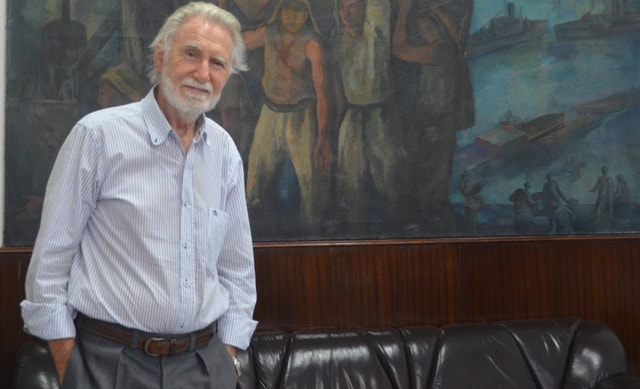
Ricardo Xavier Basaldúa resigned from the presidency of the National Tax Court. The decision raises a host of questions. What is the reason for the resignation? What is the current situation of the Tax Court? Why preserve its specialty, independence and autonomy? After noon, in the building on Avenida Julio A. Roca, the jurist spoke before the court. Aduana News on all these issues and referred to the legal security that the National Tax Court guarantees: “It must be a place that encourages legal security, a court that resolves in accordance with the law and does not bow to pressure from anyone.”
Question: How do you assess your tenure as President of the National Tax Court?
Answer: During my term as President of the National Tax Court (TFN), there has been progress in information technology. At this time, all agreements are being signed with Token and the members are preparing to do the same with the sentences that are signed by the three people in the room, which are not individual like those of a first instance judge. This advance in information technology is overcoming difficulties; the Judiciary has a different system. As a result of management, we have tried to preserve the specialized personnel and the independence of the Court, but we have not managed to call for public competitions because it is not up to the TFN to carry them out, so we have been left with that aspiration, which could not be fulfilled during the governments of Néstor and Cristina Kirchner. Nor with the government of Macri. In that sense, we tried to manage it as best as possible.
An important achievement is that we have been awarded the building of the National Reinsurance Institute (INdeR), an organisation that was dissolved, but in order to move there, eight floors must be built attached to that building to accommodate the entire TFN staff, which includes around 250 people. The TFN is independent: it is reasonable that it should also have its own building. This measure was promised by this government.
In addition, we have received a loan from the Inter-American Development Bank (IDB) with the support of the Secretariat of Public Revenue, which allowed us to begin the process of digitizing files. There is progress in this regard, which will improve conditions, because the fact that there are so many files is not only an inconvenience for people, but it also puts the building at risk, which was not designed to contain so much paper. The IDB's contribution allowed us to acquire computers, printers and scanners to do this task. A step forward has been taken, accompanying the phenomenon of modernization. In the last two years, new processes have been seen with electronic files. There is still a long way to go. There needs to be a manual so that lawyers know how to handle themselves at this stage: we are on the right track.
Question: What is the situation of TFN staff?
Answer: The inherited economic situation was much more complicated than it seemed, and as a result, there are deficiencies that have been dragging on, such as the lack of public competitions, which could not be reversed during my administration. There have been more than twelve years without a public competition in the public administration, so there is no administrative career either. We faced this problem at the beginning, in some way, by hiring specialized people, but they are not stable and the salaries continue to be very low. Therefore, the people we have trained for several years are leaving for the private sector. On the other hand, restrictions on appointing people arose; as a result, we have not even managed to replace those who left. As President, it is very frustrating not to be able to appoint people because there is a decree that prevents the appointment. The TFN has always had a staff of about 250 people, but now we have 200. The trials that are heard in the court, both by the DGI and the Customs, are increasingly numerous and the amounts at stake are very significant.
Question: What are your thoughts on TFN staff?
Answer: My reflection is that the TFN is valued, unquestionably, for its specialization. When you enter a court as a lawyer or accountant or advanced student, you must be prepared to receive a specialization. They come here to learn tax law and customs law, specialties that are not studied in depth at universities, taxation and foreign trade are not studied in depth. When these people spend four or five years working side by side with the legal secretary and the court member, they acquire a great deal of learning, and they also have training courses. I have been giving courses on Updating Customs Law at the University of Buenos Aires for many years; this, obviously, gives them points in their administrative career through competitions; courses are also given at the National Treasury Attorney's Office for the State's body of attorneys. In this sense, preparation is part of the task of the court. It happens that the TFN is a school within the State.. It is therefore very regrettable that the State, once it has trained professionals, does not make the effort to retain them through competitions and promotion to permanent status. It is a serious problem: we only have 20 percent permanent staff. Added to this is the fact that remuneration in public administration is not good, which is frustrating for anyone who takes the helm. The performance fee, that is, what lawyers pay to come to litigate at the TFN, is not recognized as a resource of our own; consequently it is not returned to us in a timely manner so that we, with those resources, can improve our justice service.
During my administration, it was achieved that the Legal Secretaries of the TFN, who earned half the salary of the Legal Secretaries of the Judiciary, performing the same task, had similar remunerations.
Question: How has the TFN evolved?
Answer: In 1991, the Treaty of Asunción was signed, which created Mercosur. Since then, there has been an increase in foreign trade, which has multiplied by four or five. Imports and exports have increased, and consequently, lawsuits; consequently, the structure of the court is inadequate to respond efficiently to the issuance of sentences. I have proposed creating one more customs chamber. When I took over as a member, in 1992, I found a typewriter and, months later, computers were brought to us. That was a revolution. Now we are facing another challenge, the electronic file. As president, I have had to initiate the signing with a security token, which is a novelty and presents some problems when it comes to a collegiate body, where an agreement has to be signed by the 21 members and a chronological order must be followed. This means that each member has to be signing the agreement successively. If the chain is interrupted, delays occur, the President has to sign last. Added to this is the fact that the Internet is quite difficult. We have been forced to have the same system as the rest of the public administration, which presents us with serious problems because in the administration the files are public, but in the case of both the DGI and the TFN we have to preserve tax secrecy because there are personal data that must remain confidential and are not available for public consultation. As a result, we are moving forward with a system that is not the most appropriate for the TFN and that must be adapted. It has caused delays and there are requests from Modernization as to why we are not moving faster in the implementation of the electronic file, and they do not realize that the electronic file is complicated when tax secrecy must be preserved. All this means that the TFN presents special problems. In addition, we have to ensure the link with the Chamber of Administrative Litigation, which uses another computer system.
We are faced with difficulties due to a lack of knowledge and understanding of sectors of the public administration. We are a department that is within the orbit of the administration, but at the same time it is autonomous and must be impartial in order to resolve issues between individuals and the Treasury (DGI and DGA). This creates friction for us. We have had disagreements with the central administration because we are an organisation that necessarily, in order to fulfil its function, has to be equidistant from both parties. The TFN cannot be subject to instructions, as is normal in other bodies of the administration.
Question: Who could replace you and what do you wish for whoever does?
Answer: Now that I have resigned to retire, I can be replaced by any member of the TFN chosen by the President of the Nation. Since the person who takes over as president of the TFN has a new task, in addition to serving as a member, it is really hard. I want the TFN to preserve the most important thing it has: specialization. In addition, it must preserve its independence and self-sufficiency, since they are its reason for being. It must be a place that provides legal security, a court that resolves according to the law, that does not bow to pressure from anyone; then, this function will make investors want to invest in our country, because in the face of erroneous administrative decisions, whether from the DGI or the DGA, there is a special and impartial court that guarantees the rule of law.
The TFN plays an important role because it is the only specialized jurisdictional body available to those who are going to raise issues that require special knowledge from those who judge. All decisions of the TFN can be appealed before the Federal Administrative Litigation Chamber. But there we do not find, currently, the specialization that exists in the TFN, because the chambers are mainly made up of specialists in Administrative Law. There are few judges specialized in Tax and Customs Law. Before there was an unwritten law: in the Federal Administrative Litigation chambers, it was sought that there were two administrative experts and one tax expert, but this has been lost in favor of administrative experts. A judge specialized in the subject matter, knowing what it is about, can resolve with greater fairness. The approach made by the judge who is not close to the world of Customs or the DGI is very difficult. Specialized justice is in the TFN, but it has been lost, to a certain extent, in higher instances. This is a serious problem that must be considered when appointing judges.
Question: What are your plans for the future?
Answer: I have a calling for teaching. I joined the TFN in 1992. I graduated as a lawyer in 1965 and in 1966 I entered the public administration at the National Tax Office. I learned a lot from a boss like Dr. Juan José Alberto Sortheix, Director and later Undersecretary of the Treasury in its current name, then a senior official of the Customs Cooperation Council (OMA), who directed the work to develop the harmonized system of merchandise designation that is used throughout the world. I also entered the Faculty of Law at the University of Buenos Aires in 1967 as a second assistant. I continued my teaching career until I became a consulting professor. I never abandoned teaching: I was a professor of Commercial Law and then of Foreign Trade and Customs Law. Therefore, I will continue teaching at various universities such as UBA, UCA, Austral, San Andrés, that is, I am trying to train customs and foreign trade professionals at the postgraduate level.
Question: Will you write any books on foreign trade?
Answer: I am always writing a book. I have just written one on the Regime of Origin of Goods and I am currently writing about Integration Law. On the other hand, I write papers, because I participate in conferences on the specialty in different countries. I also attend the World Meetings on Customs Law that have been held since 1995; this year it will be in Seville, in September. It is an interesting and enriching experience to be in contact with customs officers from all over the world.
***
Ricardo Xavier Basaldúa (77 years old, does not smoke or drink)
* Husband and father
* Hobbies: writing, reading, hiking, traveling and music
* Background sounds: Bach, Beethoven, Mozart
* Dream: having grandchildren
* Life quote: Nothing but Justice

Aduana News foi o primeiro jornal aduaneiro da Argentina a lançar sua versão digital. Com mais de 20 anos de trajetória, suas publicações e iniciativas têm como objetivo oferecer o conhecimento mais relevante sobre temas aduaneiros, contribuindo para a promoção do comércio seguro e da facilitação do comércio na região.