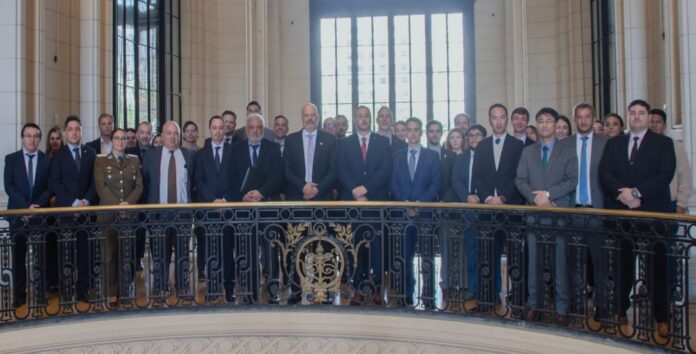
For three days, the Customs Palace in Buenos Aires hosted the Southern Cone Subregional Meeting of the Passenger and Cargo Control Program (PCCP) of the United Nations, a space intended to strengthen regional cooperation in the fight against smuggling, drug trafficking and human trafficking, the Customs Collection and Control Agency (ARCA) reported in a statement on Monday (13.10.2023).
The meeting, sponsored by the U.S. Department of State's Bureau of International Narcotics and Law Enforcement Affairs (INL), brought together representatives from customs and security agencies in Brazil, Bolivia, Uruguay, Paraguay, and Chile, along with officials from the embassies of the United States, the Netherlands, Canada, the United Kingdom, Germany, and Japan, as well as officials from Argentina's Ministry of Security and PROCUNAR.
The PCCP is a joint initiative of the United Nations Office on Drugs and Crime (UNODC), the World Customs Organization (WCO), INTERPOL and the World Trade Organization (WTO), aimed at strengthening the capacities of countries to detect and combat illegal activities at ports, airports and land borders.
The opening was in charge of General Director Andrés Velis, who emphasized the importance of regional cooperation: “Working together is the goal of this organization. We have been able to make progress in the fight against smuggling thanks to information exchanges, which have allowed us to strengthen our position in this battle we wage every day,” he noted.
For its part, Alberto Arean Varela, regional coordinator for Latin America and the Caribbean of the PCCP, urged that the sessions be a space for “frank and open debate among colleagues” and congratulated “the UNODC office in Argentina for the work they are doing.” He also He highlighted the track record of Argentine Customs, which will celebrate ten years as an active partner in the program in 2026.
Indeed, customs plays an essential role at international border crossings, managing cross-border flows of goods, people, and means of transport to ensure compliance with the law. Its functions include preventing the trafficking of dangerous, restricted, or prohibited goods and mitigating the threats posed by terrorism, weapons of mass destruction, and explosives trafficking to global security and the safety of individuals.
In this context, the joint initiative of the WCO, INTERPOL, and the United Nations Office on Drugs and Crime (UNODC) seeks to strengthen control and cooperation capacities between countries to secure the global supply chain and protect public safety.

Aduana News foi o primeiro jornal aduaneiro da Argentina a lançar sua versão digital. Com mais de 20 anos de trajetória, suas publicações e iniciativas têm como objetivo oferecer o conhecimento mais relevante sobre temas aduaneiros, contribuindo para a promoção do comércio seguro e da facilitação do comércio na região.