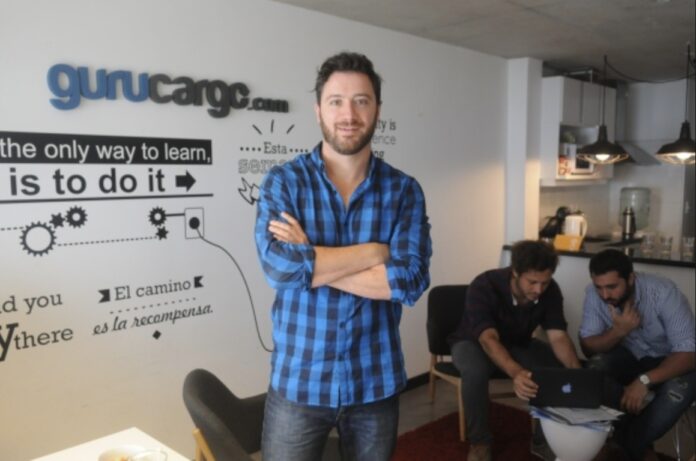
There are bottlenecks that hinder the growth and competitiveness of small and medium-sized businesses. One of them is foreign trade operations. In 2013, three Uruguayan entrepreneurs identified the need to make transparent and facilitate the logistical information required to carry out one of these operations.
Thus, Alejandro Esperanza, Eric Waizman and Andrés Israel created the Gurucargo technological platform, which provides information so that importers and exporters seeking to contract maritime freight services have digital access to prices, credit options and carrier ratings and can book the logistics service online.
Their training and experience in the maritime sector enabled the creation of a secure, measurable, automated and technological tool, which offers information that was difficult to access and remained in the hands of intermediaries.
This initiative was awarded by the National Agency for Research and Innovation (ANII) of Uruguay in 2018, Aduana News spoke with Alejandro Esperanza, founder of Gurucargo, who gave us his vision of this B2B tool, a positive change for the development of foreign trade.
Question: What can you tell us about Gurucargo?
Answer: Gurucargo is a new company created by three entrepreneurs linked to the logistics industry. I worked for a shipping company, Mediterráneo Shipping, for eight years; I was a manager in Uruguay. Then I was lucky enough to study at the Torcuato Di Tella University. This motivated me to join Andrés Israel and Eric Waizman to create Gurucargo, in order to make international logistics management simpler and more efficient. Over the years we have been incorporating other areas, we try to combine the potential of the software with the experience of those who operate this industry to achieve efficiency. In the Internet era, more fluid processes are needed, as well as instant, transparent information, to make life simpler and more entertaining for small and medium-sized companies that operate with import and export.
Question: How does Gurucargo generate its income?
Answer: Gurucargo is a free platform for importers and exporters. We always seek the income of suppliers who operate in the system because we offer them a channel to acquire new clients. That is the way we monetize. We do it through the sale of software. Gurucargo is a Market Place, that is, a space where buyers and sellers meet in a professional ecosystem, but we give sellers a software called “Digital Forwarder”, which allows them to automate the sales processes for their own clients, but they also feed Gurucargo. So, the Market Place and the software are what allow us to monetize. We collect payment through different channels: monthly memberships, bank transactions, tracking or online tracking of the container. We adapt to what the market allows us, trying to be in the places in the region where we operate.
Question: In how many countries in the region are you located?
Answer: In Latin America we operate in eight markets: Mexico, Brazil, Uruguay, Chile, Colombia, Argentina, Peru and Panama. When I say “we operate” I mean that we have importers and exporters who are registered and consult the platform regularly. We also sell our software as automation, web platform and app to Germany, Italy, Spain and Canada. I clarify that they are suppliers who rent our software to automate sales with their own clients.
Question: What means do you use to simplify Customs management in foreign trade?
Answer: Customs is a cross-cutting issue in foreign trade because each transaction requires customs execution and each country has its own rules and methodologies. We provide the technology so that suppliers can sell customs services, but we do not directly execute customs management as a platform. We can sell the customs clearance service, but we do not carry out customs management because it is local, that is, in some countries a credential is required that qualifies you before the State to carry out the customs procedure. In Uruguay it depends on the cost of the operation, while in Mexico it depends on the amount of cargo. We adapt to the market but the one who sells the transaction is the supplier, not Gurucargo.com. In Mexico we are doing an experiment that started this year and that Gurucargo can provide if the supplier does not offer it, to provide a “one stop shop” service, that is, to go to the platform and say, for example: “I am buying a container with furniture in China and I want to put it at the door of my warehouse in Mexico City”, that is, to have the complete service with insurance and dispatch. We even have Chinese companies as “partners” that inspect containers at factories so that one can have the management of foreign trade in one place and demystify how complicated it is. In Argentina, for about ten years, a more personalized management has been needed in terms of dispatch, so we leave the service to the clients so that they can carry it out with the trusted supplier, that is why we work on international services such as freight, insurance or services at origin.

Question: How many employees do you have at Gurucargo?
Answer: We are a small company: ten people, of which 50% are dedicated to software development. We have an operational office in Mexico where we have a broader activity, we will open another one in Peru; if not, we operate from Montevideo. We operate like this because we are a software company. Uruguay is good for the services and the legislation it has for the export of technology.
Question: What is the social benefit they offer?
Answer: We are Endevor entrepreneurs and within the network there are activities to expand the entrepreneurial vocation. Gurucargo does not have a social focus because its focus is commercial, aimed at empowering small and medium-sized companies so that they can compete with large corporations in their international trade operations. We help to buy better, which makes prices more competitive and so do companies. We know that small and medium-sized companies are the ones that employ the most people in the labor market.
Question: How many clients does Gurucargo have?
Answer: We have almost 7200 registered companies that have made one or more inquiries during the year. When I say companies, I don't just mean that a person came in and registered. We go through a process that we call protocol where we contact companies, check their activity, use artificial intelligence algorithms to measure certain attitudes in order to verify whether they are inquiries with the intention of purchasing or not. We put emphasis on technology to reduce costs and be operational in various markets without having to spend more capital than what we invest in what is our main focus: satisfied customers and a professional ecosystem.
Question: What are the challenges for 2019?
Answer: Our main challenge is always to cover the largest number of traffics with automatic rates. This is a market where, when requesting a quote, they take between 4 and 5 days to respond, because there are internal routes in countries, there are handling or manipulation costs at airports and ports, and each port has its own cost. It takes time to reach the final price. Our challenge is to get there before anyone else with automatic prices. We have already achieved this on routes such as China-Latin America, we are achieving it on the United States-Latin America route, and we are also overcoming the last obstacles to achieve the Europe-Latin America route. The challenge has to do with streamlining dynamic prices, so that demand and supply meet automatically, similar to what happens with the sale of airline tickets. We are working with the shipping companies.
The second challenge is to bring to the market, through technology, more certainty in what has to do with the loss of cargo at the last minute on the suppliers' side, and on the importers' side, the postponement of cargo without explanation. I give as an example an importer who is going to bring cargo from China; many times the ships come full and pass the cargo to the next ship; this hits the importer twice, because the cargo arrives 7 days later and many times it is merchandise sensitive to transit time. In the same way, suppliers make several reservations but finally load in one, they are phantom reservations or phantom bookings or roll overs made by the shipping companies, which hit the importers; sometimes they say they will pay in 45 days and they do so in 55. So we believe that with technology there can be a guarantee on both sides, we are working with international companies trying to make Smart Contracts so that they can be executed through blockchain; that brings certainty and does not leave it to free will. We try to make carrying a container easier and simpler, like buying a ticket online and getting on a plane. In other words, we seek to reduce the “chacritas” (small shops) as they say in Uruguay, or the “kiosquitos” (small kiosks) in Argentina, which only delay processes and increase costs, which, in the long term, are paid by the consumer. We were invited by the Inter-American Development Bank to participate in a VUCE initiative with experts to make international trade simpler.
Question: What advice would you give to someone who has to undertake a project in this time of uncertainty?
Answer: Entrepreneurship is a path of work from Monday to Sunday. Surely the entrepreneur has more flexible hours, but in terms of the number of hours he works more than an employee. But if one undertakes what he likes, it is pleasant; it is not the traditional concept of work, one enjoys what one is doing. Therefore, when starting a business, my recommendation is to do something that is passionate and fun. Starting a business is not just inventing something; it can be managing something in a different way, making it more economical and being successful. It is a path of effort and it has to be supported by those around us, because sometimes one has emotional lows, but the effort is worth it. Change is positive.
***
Alejandro Esperanza (35 years old)
- Bachelor of International Studies. MBA from Torcuato Di Tella University. Course in Go to Market and Innovation at Stanford University
- Husband and father
- Hobby: playing football
- Phrase: “This week is key.” You have to work every week to generate positive change.

Aduana News foi o primeiro jornal aduaneiro da Argentina a lançar sua versão digital. Com mais de 20 anos de trajetória, suas publicações e iniciativas têm como objetivo oferecer o conhecimento mais relevante sobre temas aduaneiros, contribuindo para a promoção do comércio seguro e da facilitação do comércio na região.