




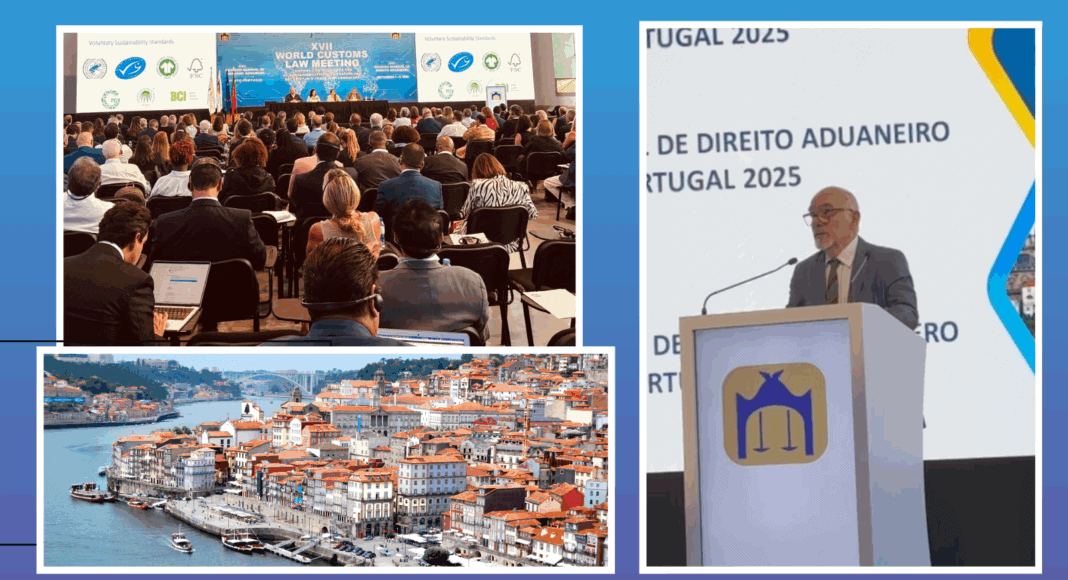

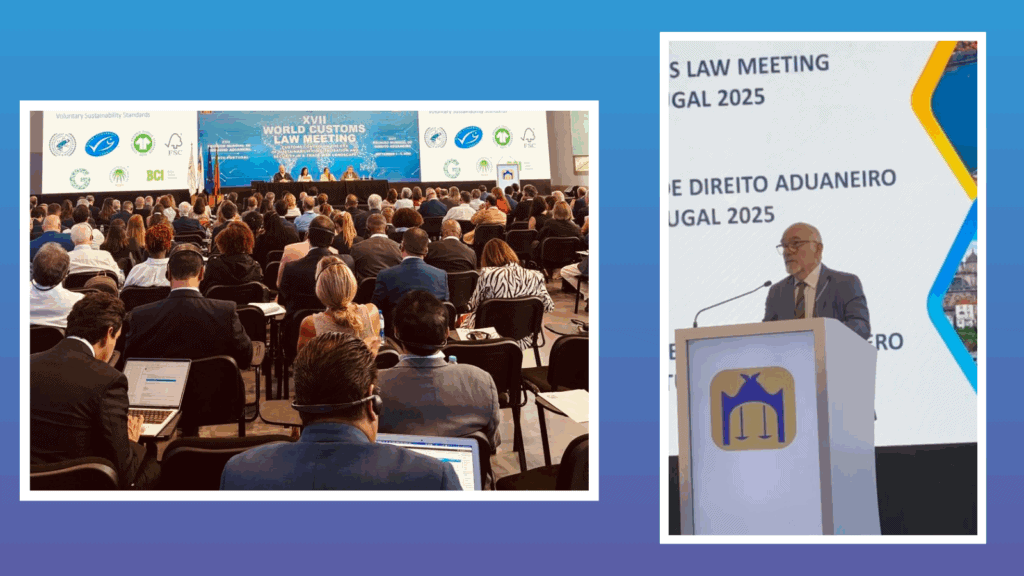
The XVII World Customs Law Meeting, held in Porto, Portugal, continued with its second day, focused on strategic debates. 5 Friday of September of 2025The experts addressed two topics: 'Programs and legislation: customs security' and 'Harmonization and integration: geopolitical and commercial instability'.
Those who have not yet read the first part published in Aduana News You can consult it to learn about the opening of the meeting and the initial framework of the debates.
Below are the main developments and presentations that marked the day.
Programs and Legislation: Customs Security
Brazil played a prominent role in the 17th World Customs Law Meeting. The day began with a conference on Fabiano Coelho, Undersecretary of Customs Administration of the Federal Revenue Authority of Brazil, who spoke about “Risks to security, the protection of citizens, and legitimate international trade”His intervention set the tone for the debate, highlighting the need to balance customs controls with trade facilitation.
The official recalled that Customs has an essential control role, but that it must also include a facilitation component, "for which we are heading towards the search for good practices”. In this regard, he noted that, although the rule dates back to 1960, “In ten years, more has been achieved than in a century, showing a clear evolution of customs law in Brazil."He valued the forum as an opportunity to foster greater dialogue at this stage.
Mr. Coelho emphasized the importance of addressing challenges at the borders and mentioned that export control measures are currently being taken, something that was previously uncommon, driven by the growing risks. "This marks a necessary cultural transformation in Brazil, given that, although we are a century-old organization with many strengths, we also carry practices that require modification."He reflected.
In this context, he stressed that “We must evolve towards Artificial Intelligence and current demands", highlighting the progress made in remote control, although he clarified that"the control must be combined”. He also warned that “process intelligence is essential for the fight against illicit"and emphasized the importance of investing in training and adding professionals to this new philosophy.
Finally, he highlighted his country's measures aligned with foreign trade, such as the Authorized Economic Operator Program, the Compliant Shipping Program, Customs Transit Initiatives, the Venue Module, Remote Physical Conferences, the Single Foreign Trade Portal, and Siscomex 3.0.
Regarding the Brazilian Customs, Coelho highlighted that, despite having a small staff, “is extremely qualified"and has a high degree of integration with the tax administration through systems such as Edbv (customs data management), Sped (Public Digital Writing System), Roc da RTC (commercial operations registry for tax control) and Sivana (integration platform for risk management and operations control).Our risk management relies heavily on data analysis.”, he explained, mentioning information from invoices, transportation, tolls, import operations, and tax secrecy, among others, as a differential value of the operation. He concluded by emphasizing that “Investing in learning and training is essential to consolidate changes and accept these challenges.”.
In this context, the Dr. Rosaldo Tervisan, Conselheiro no Administrative Council of Fiscal Resources of Brazil, acted as moderator and highlighted the importance of MERCOSUR in the framework of international trade. He pointed out the need for an agreement with the European Union, emphasizing that this vision must also be shared by European partners, as it represents a strategic alternative. He also emphasized the critical need to complete the update of the MERCOSUR Customs Code.
(I.e.Panel: Secure Supply Chains and the Evolution of the AEO to the Trust and Check Trader
Also from Brazil, Fernando Pieri Leonardo, president of the Brazilian Association of Customs Studies (ABEAD), opened the next panel by highlighting the importance of the Authorized Economic Operator (AEO) and the transition of customs from a traditionally collection role to a function oriented towards the security of international trade. He pointed out that risk management is essential for more efficient control and recalled that, although there are currently 18.000 qualified companies, the number is still insufficient. “Knowing what needs to be controlled is the biggest challenge. We're moving away from controlling what's legal to focusing on what requires oversight., Pieri said, anticipating the reform of the Customs Law by 2040.
With this start, the panel continued with the experience of the European Union, Presented by Anna Jerzewska, Commercial Director at Global Customs, DSVThe specialist emphasized that the Authorized Economic Operator (AEO), as a trusted and oversight body, is essential. "In the near future, we will be working on this issue, and communication between the private and public sectors will be crucial," she noted.
He highlighted the need to update the EU Customs Code to create a new version of the AEO, focused on data management and new information systems. “Trust and control go hand in hand, and must be worked with online data", Jerzewska pointed out, referring to the scheme Trust and Check (AEO S, AEO C, AEO F S+C), which requires making all data on the movement of goods, including transport and logistics, available to customs authorities in real time, as well as allowing benefits such as self-assessment, self-release, and deferred payment.
Ms. Jerzewska also warned of the challenges for SMEs: "Many will not become T&C operators and will not benefit from current facilitations when using intermediaries. Policymakers need to allow T&C facilities to be extended directly to non-T&C operators."
He concluded by pointing out that “The bill is still undefined. Details are lacking regarding benefits, format, and application in each state. Questions remain while we await the final version.
Meanwhile, Gabriela Sousa, Head of Customs for Portugal and Spain at Siemens Energy, introduced the private perspective, highlighting that "Companies are ambassadors at Customs, so their vision is key in reviewing these changes."". He noted that many companies lack the knowledge or economic capacity of large corporations, so they require special attention. He added that "Studying the legislation isn't enough; it's essential to understand the logistics and actual operations, which reveal a different reality..
Ms. Sousa explained that the AEO reform is based on three pillars: 1) a new partnership with economic operators; 2) smarter customs controls; and 3) modernized e-commerce. However, she emphasized that the decision to obtain AEO certification remains a voluntary, cost-benefit assessment for companies. She noted that the benefits of facilitating international trade and customs simplifications are not always perceived by small and medium-sized enterprises, and that the loss of competitiveness can be a significant factor for those who choose not to obtain certification.
He also highlighted that the criteria for qualification as Trusted and Controlled Operator These include IT/systems and interfaces, internal customs control procedures, and qualified human resources, given that AEO status alone does not guarantee compliance with the additional requirements. Among the challenges identified were: impacts on non-T&C operators, international competitiveness, real-time data exchange, investment requirements, and direct responsibilities. The advantages, however, include centralized clearance, enhanced customs simplifications, independent authorization for the exit of goods, and competitive benefits, both commercial and financial.
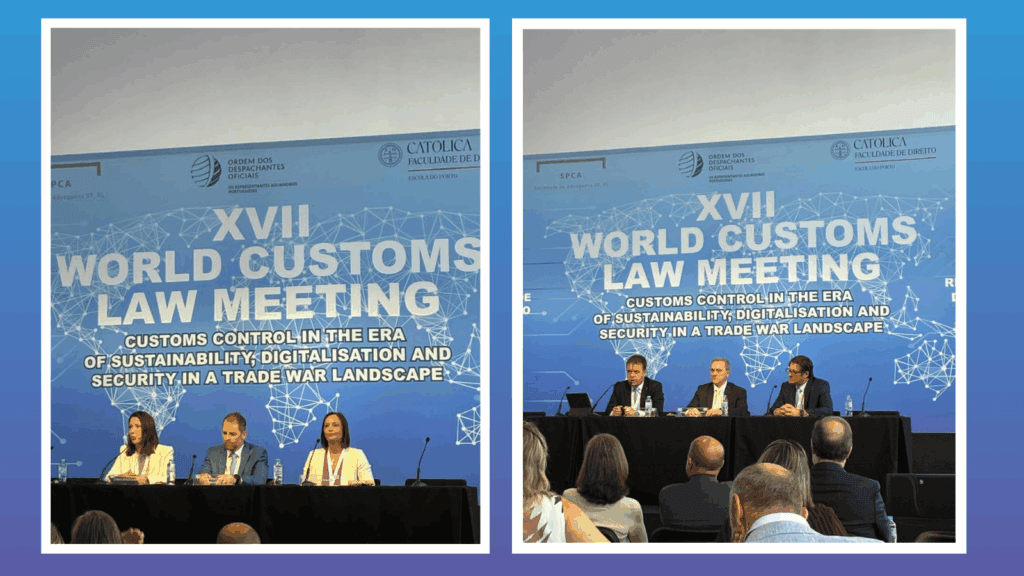
(I.e.Customs authorities roundtable: Customs Control in the design and implementation of security risk profiles and in the prevention of customs crimes
After the private panel, the customs authorities of Panama, Spain and Portugal They also had their say, contributing their experience to strengthen security and efficiency in international trade. In detail.
Soraya Valdivieso, Director General of the National Customs Authority of PanamaHe reflected on the current situation, noting that "it's time to move from paper to action," emphasizing that Customs' role "is focused on collection, facilitation, and security." He detailed the progress made in Panama and emphasized that "the canal is ours," clarifying that 80% of customs operations are transit operations, not import or export operations.
Regarding the contributions of Panamanian Customs, he mentioned: "Intelligent Risk Profiles," to analyze data, routes, and patterns; "Selective and Technological Control," through scanners and automatic alerts; "Active Crime Prevention," through national and international cooperation; and "Intelligence and Counterintelligence," to prevent smuggling and increase security controls. Among the notable projects, he mentioned: Customs Logistics Integration Project (PILA) and the "Invisible Shield", a control, monitoring, and video surveillance center that integrates scanners and cameras. He also highlighted border integration with Costa Rica, allowing for pre-screening and optimization of trade flows.
María Ángeles Marín Ramírez, Deputy Director General of Inspection and Investigation of the Department of Customs and Excise of Spain, indicated that “customs control is multidisciplinary; before it was about tax collection, now it protects financial interests, legal trade, human safety, and the environment.” He highlighted contemporary challenges: the COVID pandemic, Brexit, the conflict in Ukraine, Israel, and Gaza, the increase in cocaine trafficking to the EU, US tariff policies, and e-commerce. He emphasized that “the challenge is to simplify customs regulations and organize data exchange, enabling its protection” and that “the use of Artificial Intelligence must be supervised by humans,” although AI-based reports are already available.
Ana Cristina Trovão, Deputy Director of the Customs Management Area of the Portuguese Tax and Customs AuthorityHe reflected on the effects of e-commerce and the difficulty of controlling a high volume of shipments. He noted that "greater integration and trust are needed, and every operator must assume responsibility to protect citizens." He explained that millions of small shipments escape control and that the EU is considering imposing fees to limit purchases, although their application is not uniform. He also emphasized that "the product could have a passport certifying its compliance and connection to a declaration program" and warned that "the tariff war can generate under-invoicing and manipulation of origin," behaviors that require effective control.
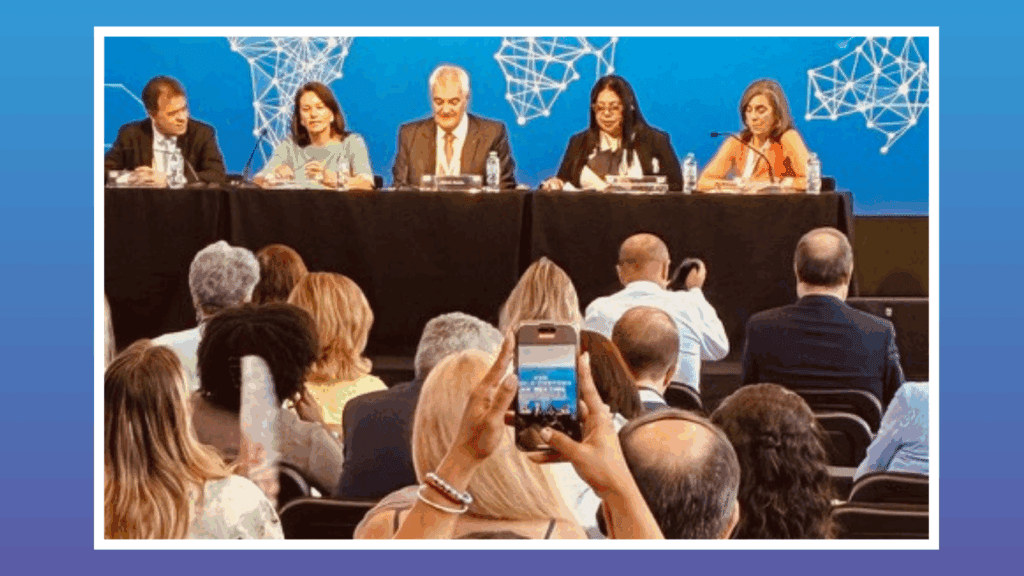
Harmonization and integration: Geopolitical and commercial instability
The afternoon continued with a interactive session entitled “Tariff increases, anti-dumping duties, sanctions, and export controls are factors in trade wars.”, in which participants analyzed the global challenges of international trade.
He highlighted the intervention of the Dr. Hans-Michael Wolffgang, Professor and Director of the Institute of Customs and International Trade Law at the University of Münster, Germany, who, in his role as moderator, brilliantly presented the topic, pointing out that recent actions by the United States and the traditional rules of the World Trade Organization do not seem to fit current realities.
Foreign trade professionals also had their space. Alejandro Ramos Gil, former president of ASAPRA, CAAAREM and IIFA, Monterrey, Mexico, analyzed the global context in the face of tariff clashes. Ramos Gil warned that “The topic is too volatile and what is presented may change.”, stressing that these disputes generate legal uncertainty in the market.
The expert conducted a detailed analysis of the effects of measures derived from US presidential decisions, first examining the Constitution and the powers of Congress, as well as case law and history of possible unconstitutionalities. He highlighted the recent decision of the New York Court, stating that "Elephants cannot be accommodated in mousetraps", and noted that it now remains to be seen whether the case will reach the Supreme Court.
Regarding the objectives of this "tariff war," Ramos Gil stated that it seeks to correct the fiscal regime through increased tariff revenue, although he questioned its reasonableness given the US's trade deficits with countries such as China, Mexico, Vietnam, and Canada. He noted that the measure could generate inflation and lead to significant logistical changes, shifting the production of certain products out of China, a time-consuming and costly process.
Meanwhile, Manuel Fontaine, Director of the Faculty of Law of Porto of the Catholic University of Portugal, He estimated that this trade war, which began in April 2025, would have consequences for the WTO. He noted: "The threshold established by the GATT is being violated; an example of this is Article 1, on the most-favored-nation principle, one of the most important principles. This rule is being violated. Consequently, they could request a consultation panel, and in fact, six have already been submitted, including those of China and Brazil. Furthermore, national security issues are not subject to review without having to demonstrate the reasons. Fortunately, there are WTO precedents where this argument was rejected, based on the requirement that the reason why security is being affected must be demonstrated."He cited several cases, including the 2022 US ruling on steel and aluminum products, explaining that the US measures were not "taken in a time of war or other emergency in international relations." However, he noted that an appeal blocks the report from becoming binding, so even if they are illegal, the decisions are affected by procedural consequences. "The WTO isn't reacting. It doesn't want to take a position, perhaps because the US is one of its main members, and it's probably waiting for the storm to blow over; ultimately, this is a temporary issue.""He finished.
(I.e.Comments by Dr. Ricardo X Basaldúa on MERCOSUR and security
And in that space for dialogue, Dr. Ricardo X. Basaldúa, former President of the Argentine National Tribunal and founding member of the International Academy of Customs Law, present in Porto, asked to speak to highlight important considerations regarding the global uncertainty regarding tariffs and security. He noted that "The US aims for security, while China seeks to gain ground""and warned that measures against Brazil could push it towards China. He stressed that "Brazil should assert itself in MERCOSURR”, a space for peace linked to regional security. With his characteristic clarity, he concluded by emphasizing that "expanding spaces for dialogue is essential, since attempting to resolve everything solely through rules is insufficient in a world lacking legal consensus." In this context, he warned about the paralysis affecting the WTO and pointed to the search for arbitration as an alternative under development.
Customs Vocational Training
Following interesting discussions on the geopolitical landscape, and with the goal of strengthening the efficiency, effectiveness, and integrity of customs worldwide, ICLA included a session dedicated to professional customs training in its program. The presentation was given by Karolyn Salcedo, former Director of Capacity Development for the Americas and the Caribbean at the World Customs Organization (WCO), who stressed that "The role of Customs is constantly evolving and facing challenges; some are short-lived, while others generate profound changes.«, citing as an example «"e-commerce and the commercial value of this modality." Salcedo stressed that "Efficiency and safety are objectives that require training and education", and stressed that"The WCO PICARD programme is of immense importance, as it promotes professionalism and research to support customs studies. Finally, he noted that current challenges include "Technological progress, global crises, crime, data protection, cybercrime, the environment, and gender equality., aspects that "should be incorporated into the PICARD program."
This panel culminated with the words of Alejandro Arola, president of the Customs Foundation for the Dissemination of Knowledge and Customs Law, who highlighted the relevance of addressing this topic after the debates on the various challenges facing the sector and the need for ongoing training.
In that same framework, the Dr. Rosaldo Trevisan He hosted a space specifically geared toward technical attendees, in which works on customs law from different countries were presented, thus contributing to the dissemination and exchange of specialized knowledge.
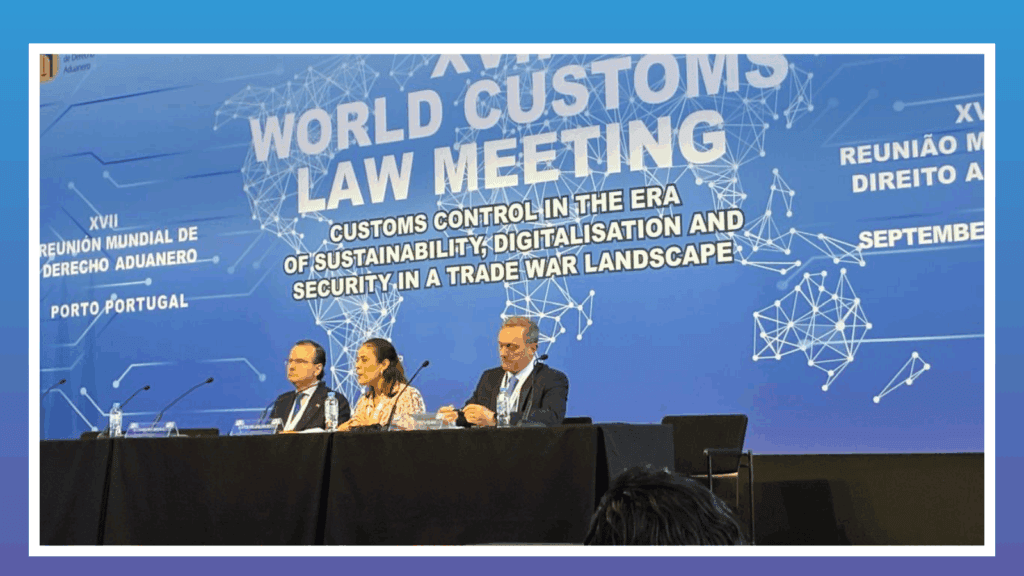
Closing ceremony
Thus, the XVII World Meeting on Customs Law, organized by the International Academy of Customs Law (ICLA), concluded again with a notable closing, reaffirming the success and leadership of the meeting. The participation of delegations from 33 countries and the words of gratitude of the Dr. Andrés Rohde Ponce, President of ICLA, and Dr. Claudia Reis Duarte, Secretary of State for Fiscal Affairs of Portugal, They underlined the importance of this meeting, full of innovative ideas that will contribute to the modernization of the customs sector and the economic, social, and political development of our societies.
📍 The next edition has already confirmed its location: Rio de Janeiro Brazil, will be the venue for the 18th World Meeting on Customs Law.
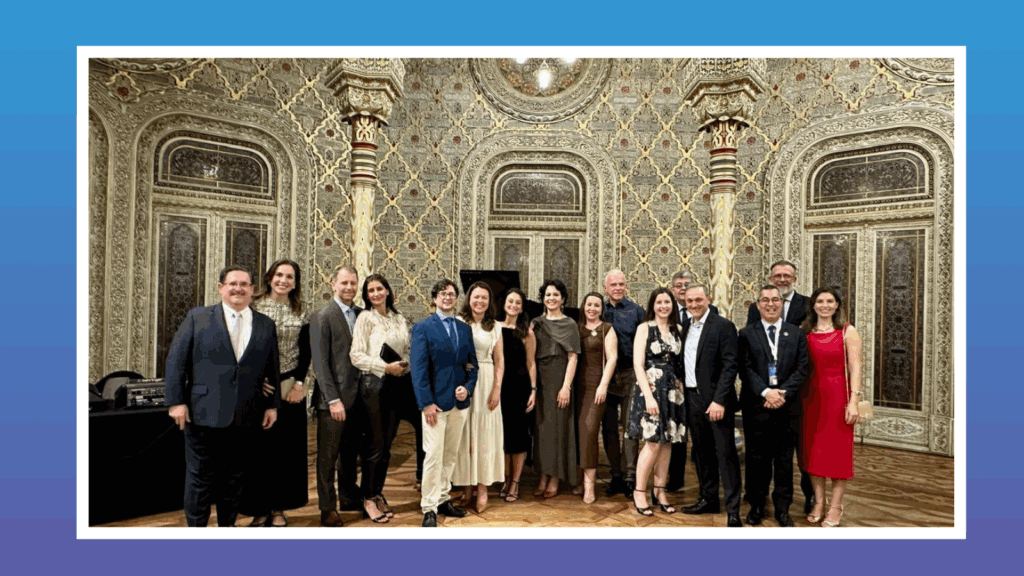
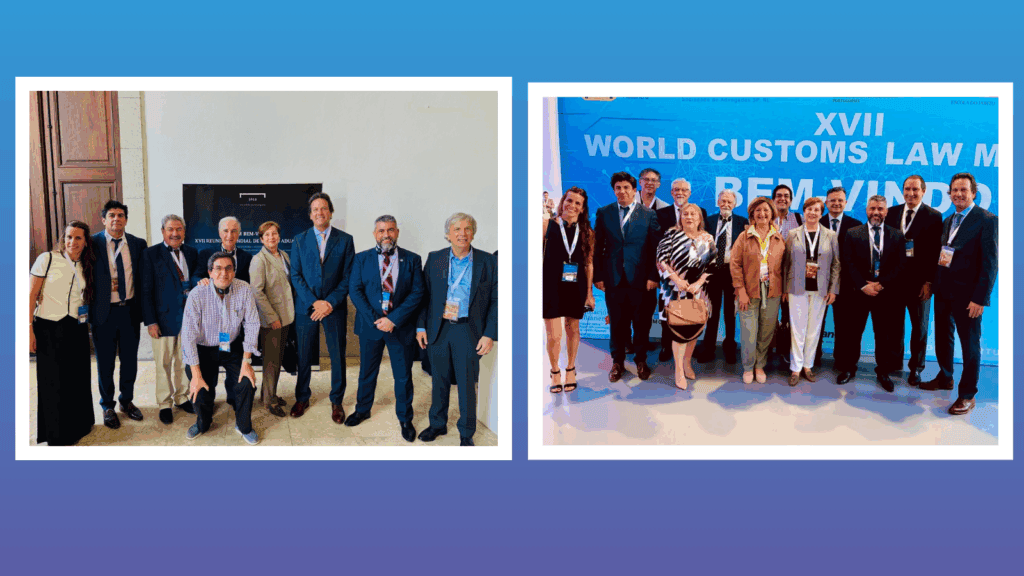
Finally, it is worth highlighting the presence of the Argentine, Brazilian and Uruguayan delegations. The Argentine delegation , for example, featured Ricardo X. Basáldúa, Juan Cotter, Horacio Alais, Ricardo Torres Brizuela, Ana Gottifredi, Ana Sumchski, Francisco Menéndez, Harry Schuring, Guillermo F. Coronel, María José Etulain and Héctor Juárez, among other prominent participants.
For its part, the Brazilian delegation (left) included, in addition to the aforementioned speakers, renowned academics such as Raquel Segalla Reis, Cláudio Augusto Gonçalves Pereira, president of the São Paulo Customs Brokers Union (SINDASP), and Elson Isayama. Also present were José Carlos Raposo Barbosa, president of the National Federation of Customs Brokers (FEADUANEIROS). Last but not least, Laura Caffera, Raúl González Berro, and Pedro Labandera, Uruguayan representatives (right) along with numerous other renowned professionals from the region's customs and foreign trade sector.

Aduana News foi o primeiro jornal aduaneiro da Argentina a lançar sua versão digital. Com mais de 20 anos de trajetória, suas publicações e iniciativas têm como objetivo oferecer o conhecimento mais relevante sobre temas aduaneiros, contribuindo para a promoção do comércio seguro e da facilitação do comércio na região.