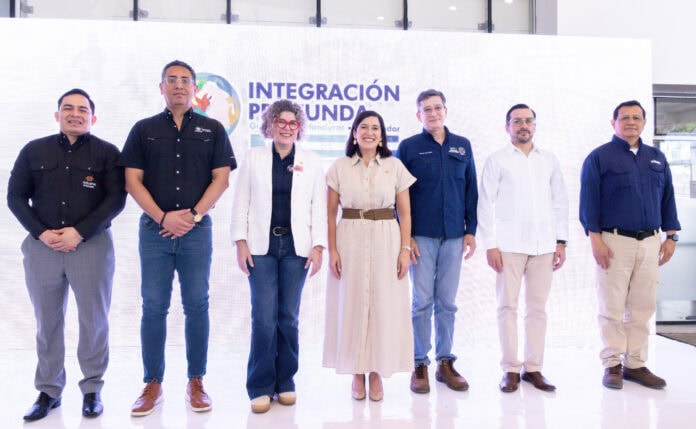
The governments of El Salvador and Guatemala officially launched integrated customs and immigration operations on Thursday (18.06.2025/XNUMX/XNUMX). Anguiatú – La Ermita land border crossing, a fundamental action to strengthen regional integration and facilitate bilateral trade. This border is the main export route for Salvadoran exports to the Atlantic, through the port of Santo Tomás de Castilla in Guatemala.
The official event brought together prominent authorities from both countries, including the Ministers of Economy, María Luisa Hayem (El Salvador) and Gabriela García (Guatemala); to the Secretary General of the Secretariat of Central American Economic Integration (SIECA)Francisco A. Lima Mena; Salvadoran Minister of Finance Jerson Posada; Guatemalan Superintendent of the SAT (Tax Administration Service), Werner Ovalle Ramírez; Guatemalan Vice Minister of Integration and Foreign Trade Héctor Marroquín; and Customs Directors General Benjamín Mayorga (El Salvador) and Edwin Curtidor (Guatemala).
This new operating model allows officials of customs and immigration of both countries work in a coordinated manner in one side of the border, Streamlining and simplifying international transit operations. The initiative represents a significant step forward toward modernizing border processes and improving regional competitiveness, according to a SIECA statement.
During the event, the MMinister of Economy of El Salvador, María Luisa Hayem, highlighted:
"This integration will allow Salvadoran exports to transit without the driver having to leave the vehicle and will allow for a single immigration check, creating competitive conditions for companies targeting the United States..
MMinister of Economy of Guatemala, Gabriela García, he highlighted:“The success of this step is just the beginning. We are working to implement integrated controls at another border crossing, consolidating a logistics corridor that will boost bilateral trade and contribute to making the Northern Triangle a barrier-free area..
El Minister of Finance of El Salvador, Jerson Posada, He stressed:“This measure will primarily benefit foreign trade operators, and as part of the supply chain, the entire population will benefit."
El Superintendent of the SAT of Guatemala, Werner Ovalle Ramírez, highlighted: This model simplifies trade and the movement of people and goods, strengthens controls, improves competitiveness, and promotes sustainable economic development, demonstrating that Central America can move forward together."
Finally, the Secretary General of SIECA, Francisco A. Lima Mena, stated: "This achievement is the result of joint work within the framework of the Deep Integration Process, which aims for customs union and free transit between Guatemala, El Salvador, and Honduras, representing tangible progress toward full integration."
In addition, the technical body explained the main benefits of this integration, namely:
- Reduction of border waiting times for cargo transport.
- Approval of business hours, with 24/7 operation in both countries.
- Reduction of logistics costs and simplification of procedures.
- Single immigration control for cargo transport.
- Greater institutional coordination and strengthening of business competitiveness.
It is worth noting that this progress reflects the firm political commitment of the States Parties with the implementation of the Deep Integration Process in the subregion, in full alignment with the Central American Strategy for Trade Facilitation and Competitiveness, which prioritizes Coordinated Border Management.

Aduana News foi o primeiro jornal aduaneiro da Argentina a lançar sua versão digital. Com mais de 20 anos de trajetória, suas publicações e iniciativas têm como objetivo oferecer o conhecimento mais relevante sobre temas aduaneiros, contribuindo para a promoção do comércio seguro e da facilitação do comércio na região.