The World Trade Organization (WTO) estimates that merchandise trade will grow by 1,7% this year, compared to an expansion of 2,7% in 2022, in the new Global Trade Outlook and Statistics report.
The WTO said the estimates were due to the continuing impact of the war in Ukraine, inflation and turmoil in financial markets, stressing the importance of international cooperation.
Trade between countries will continue to evolve slowly, despite GDP forecasts for 2023 improving in recent months (2,4%), although uncertainties have contradicted the most optimistic forecasts.
As a result, both Trade and GDP will be lower in 2023 than their averages of 2,6% and 2,7% growth, rrespectively, in the last twelve years.
In view of this, the WTO Director-General Ngozi Okonjo-Iweala He recalled that “Trade continues to be a force for resilience in the global economy, but will continue to be under pressure from external factors in 2023.” And he considered it important to “Invest in the multilateral cooperation in the field of trade.”

Trade growth in 2,7 was already 2022% lower than economists had estimated, and this was mainly due to the results of the October-December quarter, affected by the increase in commodity prices, stricter monetary policies to contain inflation and the resurgence of Covid-19 in China in the final stretch of the year.
In 2023, the estimate of 1,7% growth in international trade is better than expected, precisely because of the increase in demand for consumer goods in China, once the Asian country lifted all pandemic measures and reopened its economy to the world.
The WTO also attributes the rise in interest rates by central banks around the world to taming inflation. However, the financial weaknesses that this process has revealed may lead to greater instability. “The recent banking crises in the United States and Europe underline the possible existence of further vulnerabilities arising from a change in the interest rate environment,” the report states, adding: “A miscalculation can have negative consequences for the global economy and trade.”
All these factors make the forecasts for 2024 more uncertain than usual. For now, the WTO believes that world trade could rebound by up to 3% and that GDP could grow by 2%.
Trade in digitally provided services
Another piece of data from the WTO estimates that allows us to identify a trend concerns the activity of the services sector, which is growing strongly, driven by trade.
According to the report, in the last decade, IT services have been the most dynamic service sector. World exports of these services amounted to US$3,82 trillion in 2022, representing a 45% increase over pre-pandemic levels.
Punctually, the Digital provision of services includes services that are marketed across borders via computer networks, i.e. through the Internet, apps, emails, voice or video calls and, increasingly, through digital intermediation platforms, such as online gaming, music and video streaming, and distance learning. such as trade in commercial services.
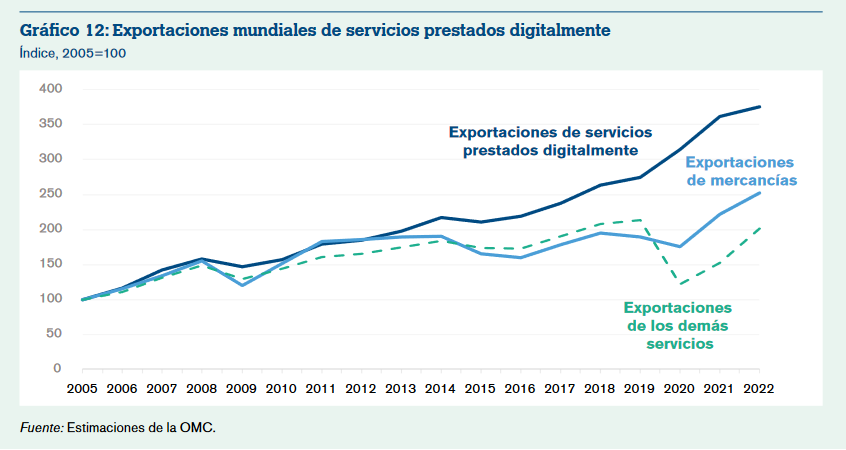
The WTO noted that Europe accounts for more than half of global exports of digitally delivered services. It said Asia's exports have grown at a faster pace than those of the rest of the world.
In 2022, almost a quarter of digitally delivered services came from Asian economies, and 19% from North America, Central and South America and the Caribbean. The Middle East also saw an acceleration in trade growth.Full report)

Aduana News foi o primeiro jornal aduaneiro da Argentina a lançar sua versão digital. Com mais de 20 anos de trajetória, suas publicações e iniciativas têm como objetivo oferecer o conhecimento mais relevante sobre temas aduaneiros, contribuindo para a promoção do comércio seguro e da facilitação do comércio na região.