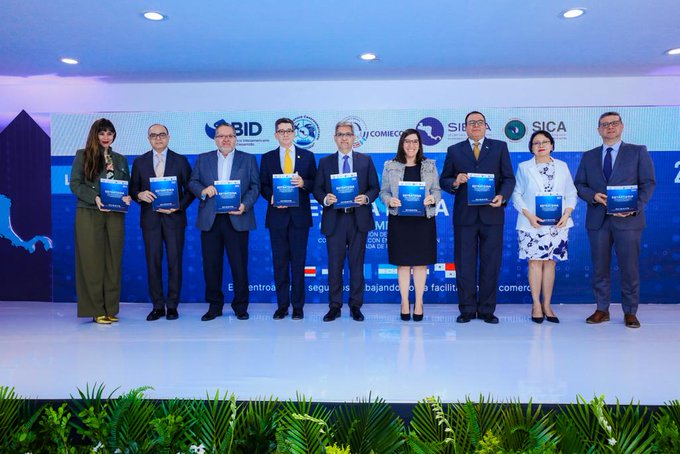
The Government of El Salvador, in charge of the Pro Tempore Presidency of SICA, launched on Tuesday (06.12.2023) the “Central American Trade Facilitation and Competitiveness Strategy with Emphasis on Coordinated Border Management 2023", whose implementation seeks to advance digital transformation throughout the region and contribute to economic improvement.
The hybrid event (in-person/online) was organized by the Secretariat for Central American Economic Integration (SIECA), in coordination with the Pro Tempore Presidency of El Salvador and financed by the Inter-American Development Bank (IDB), in addition to having the technical assistance of the Economic Commission for Latin America and the Caribbean (ECLAC).
María Lusa Hayelem, Minister of Economy, he highlighted during the announcement: “From this day on, Central America has a novel planning instrument that will allow it to become an increasingly competitive region through the simplification of procedures, cost reduction and streamlining the movement of goods.”
In turn, the Secretary General of SIECA, Francisco A. Lima He said: “It is a historic milestone that allows us to visualize the effort of more than a year of work in the construction of this regional instrument.”
"The Central American Strategy for Trade Facilitation and Competitiveness with an Emphasis on Coordinated Border Management was developed under the leadership of Guatemala, Honduras, El Salvador, Costa Rica, Nicaragua and Panama, and had the technical and administrative coordination of SIECA, the technical and financial support of the IDB and the technical accompaniment of the World Bank."
In this regard, Lima explained that “in November 2022, COMIECO instructed that the Trade Facilitation Strategy implemented in 2015 be updated. Technological changes and new trends in global trade motivated COMIECO to undertake the new task in light of the reality we face to strengthen our intraregional market, and aware of taking advantage of the growing opportunities that nearshoring offers us to deepen trade relations.”
Thus, the strategy is based on five pillars: Efficient and agile controls for the lifting and clearance of goods and mobility of people; Simplification and digitalization of procedures and formalities; Harmonization and homologation of standards and regulations; Infrastructure, mobility and logistics and Mobility of people for tourism, business, medical, academic, etc., SMEs and cross-border communities.
Central America, For each pillar component, common regional parameters have been defined based on international best practices. Their implementation will be tailored to the requirements of each border post, port and airport.
“In this way, the region reaffirms its commitment to continue with the implementation of digital transformation through the Central American Digital Trade Platform (PDCC), a project also launched last week," the authorities said.
Representatives of the Council of Ministers of Economic Integration (COMIECO) as well as the forum of Vice Ministers of Economic Integration, Customs Committee, among other regional authorities linked to foreign trade processes and the private sector participated in the event.Product)

Aduana News foi o primeiro jornal aduaneiro da Argentina a lançar sua versão digital. Com mais de 20 anos de trajetória, suas publicações e iniciativas têm como objetivo oferecer o conhecimento mais relevante sobre temas aduaneiros, contribuindo para a promoção do comércio seguro e da facilitação do comércio na região.