Víctor Dosoretz is one of the leading figures in foreign trade in Argentina. Recently, he has become the voice of the new Incoterms, the clauses used in sales contracts to define the obligations of exporters and importers. As President of the International Chamber of Commerce (ICC) in Argentina, he reveals why this language is important in more than one hundred countries. And he maintains that “Incoterms are a trade facilitation tool.” Accompanied by experts from the Argentine Chamber of Commerce and Services (CAC), Sebastián Ferrari and Carlos María Bagnasco, they speak with Aduana News of changes, SMEs and training, of the need to adapt to a good practice that facilitates any commercial operation, each of them contributing their points of view.
Terms in trade
What are Incoterms?
Incoterms are related to the International Chamber of Commerce (ICC) base, the organization that defines, writes and updates them. They are Guidelines so that in approaches through international trade, the world community can have clear rules and understand through them how to make transactions. For this reason, the ICC updates them considering experience and needs. Incoterms 2020 are not something new but an update.
Carlos María Bragnasco adds: «Among other considerations, Incoterms determine the responsibilities, costs and points of risk transfer between sellers and buyers in international trade transactions. However, These rules can be used perfectly in domestic trade.
Any trade transaction could undoubtedly be assigned an Incoterm. For example, it would be possible to distinguish three different Incoterms for purchases in a supermarket:
ExWorks: This is the method of buying and selling that we usually use. In this case, the seller leaves the merchandise available at their own facilities and it is the buyers who assume all the risk, from the moment they acquire the products until they take them home. It is even the buyer who assumes the risk and costs of loading that merchandise.
FCA Deposit: As a second option, buyers could order the goods online or by phone and then pick them up by car. In this case, the seller would assume the risks and costs of loading the goods onto the buyer's means of transport. Once the goods are loaded onto the vehicle, the seller's responsibility would be transferred to the buyer.
DPU Buyer's address: Finally, you can order the products and request home delivery. In this case, the seller assumes all the risks and costs until the goods are delivered to the agreed place (buyer's address). In addition, he will be responsible for the risk and cost of unloading the products at the destination..
Now let's look at an example of an intercompany transaction:
A wine company located in Mendoza wants to sell Malbec wines to a client in Buenos Aires. The buyer and seller may not know each other and may not agree on who would assume the risks in the event of a loss. To do so, they could use an Incoterm, such as CIP Buenos Aires Incoterms 2020, via Truck.
Here, the seller's liability will end when he leaves the goods at a designated point available to the means of transport that will take the load to Buenos Aires. As for costs, the seller must contract and pay for that transport, as well as insurance in the name of the buyer with a minimum coverage of 110% and clause "A".
As we can see, Incoterms are not only a good practice in international operations but also in domestic sales, since clearly define the responsibilities of the parties, facilitating any commercial operation."
mother tongue
How many countries use Incoterms and in how many languages?
The ICC is present in over a hundred countriesWithout being precise, we understand that Incoterms are used in approximately one hundred countries worldwide. Regarding languages, the latest version has been translated into more than twenty-seven languages.
Beyond the languages into which it is translated, in the case of Argentina, it is in Spanish and also in English, which is why part of the name appears with its initials in EnglishEach acronym in the Incoterms has its name in English.
Beyond the official translation of the Incoterms, it is advisable to read the text in English because it is the mother tongue in which it was written and there may be differences in the translations: Spanish is not the same in Spain as in Argentina or Chile.
Essential Guidelines
What is the importance of Incoterms in international contracting?
Incoterms are essential in international contracting. These rules express the guidelines on which the conditions of business are agreed upon, where they are specified. rights, risks and costs to be assumed by the signatory parties of the international sales contract. This is the great contribution of the International Chamber of Commerce in this type of transactions.
Incoterms apply only to trade transactions involving tangible goods.
What are the important changes between Incoterms 2010 and Incoterms 2020 that are worth highlighting?
All Incoterms are important. We cannot mention just a few. The universe of rules is essential, since each of them applies to a type of transaction. The dynamism of commercial activity leads to the need to include or specify in detail some situations. For example, there were differences of interpretation with the Ex Works.
Successive versions of Incoterms do not override their predecessors, so even though the 2020 version eliminates DAT and includes DPU, anyone who wants can continue using the previous versions of Incoterms that include DAT. DAP: Delivery and transmission of risk at a point or place agreed by the buyer and seller at the destination, completed once the merchandise is unloaded from the means of transport. The exporter does not pay import duties.
The experts of the ICC Commission on Law and Trade Practices replaced the term DAT because it had not been used in the last ten years. They specified that the place where the transfer of a discharge takes place does not have to do with a port terminal but can be any point on the map.
Facilitation, the key
In addition to the creation of new Incoterms and the elimination of others, what are the issues that are incorporated into the development of this new version that are more in line with international operations and trade facilitation?
The ICC, within the working groups, has a Customs and Trade Facilitation Commission that deals with customs issues at a global level. It was the commission that worked most with the WTO to approve the Trade Facilitation Agreement, which is the framework through which each of the countries that subscribe to the WTO recommendations adopts these technical issues to the resolutions of each state. That is why each country had to adopt it; Argentina did so in July 2017.
The Trade facilitation issues are not isolated. Argentina, in addition to the Single Window for Foreign Trade (VUCE), has a Facilitation Commission, in an embryonic but important stage.
In parallel, there is another global trend, which is the Authorized Economic Operator (AEO). The experiences that are shared in the committees serve the business community as elements to incorporate. In fact, the country recently had an update of the AEO. As can be seen, the issues are linked in a global trade ecosystem.
Incoterms 2020 incorporates these developments in global trade. As mentioned at the launch of Incoterms 2020 in Argentina, ICC has been interpreting the developments in world trade since 1936. At one time, it was the emergence of ships and airplanes; today, facilitation, the digital era and new technologies are emerging. Surely, in ten years or less, other types of transformations will have to be incorporated.
Incoterms 2020 They set clear rules for counterparties where all operators can analyze purchase-sale contracts at a global level. All subjects have the same guidelines, understand the risks, obligations and transfer points of the goods. For this reason, the Incoterms are trade facilitation.
Given the evolution of international trade and customs interaction, is it possible to incorporate budgets that are not included and that relate to customs matters such as the tariff heading taking into account the merchandise being marketed?
These are two issues that must be dealt with separately. The classification of tariff headings is related to agreements made in Brussels where the general concepts are decided. Then, each country incorporates other digits with the typology of each customs office. Undoubtedly, since the Fourth Industrial Revolution and new technologies, the revision and expansion of tariff headings is necessary. The dynamism of technology requires this work. For example, when digital cameras emerged twenty years ago, they were classified as cameras, although they had another type of technology. They had an image capture device similar to a scanner, which was somewhat disruptive. This example applies to other issues. Customs are not responsible for the processing of the evolution, but it is about classifications at a global level, with the centre in Brussels, from where it is distributed to all regions of the world. There is no longer any discretion, no one can consider a different tariff classification for the same product because it is classified and this is the object of what is known in English as HS Codes or tariff codes.
Incoterms are rules that do not interfere with the specifics of products, prices or transactions.
Customs around the world use values that can be FOB or FOB plus transport and insurance, at the valuation level. This involves determining the tax base, but not the classification. Once the classification is finished, customs takes certain values as the tax base and from there the Incoterms become important, in order to facilitate trade.
SMEs to the world
How do the latest changes affect exporting SMEs?
Changes linked to technology help, promote and facilitate SMEs to export. Now there are resources for a micro, small or medium-sized company to venture into foreign trade. CAC has the “SMEs to the world” program. This initiative, which won an award at the WTO Ministerial in 2017, is a virtual showroom for SMEs that lack the knowledge or resources and want to go out into the world, to do so. Conclusion: the new tools give SMEs a fantastic opportunity to trade globally.
In the “SMEs to the world” program, Incoterms 2020 are involved. But since ICC Argentina offers training on the new rules. The text of the publication has the particularity of presenting more user-friendly tables and helps to choose the rule for each case. This is interesting for an SME that cannot finance a foreign trade department when it is taking its first steps in internationalisation. It is an advantage to have more user-friendly tools at the beginning.
Any tool that facilitates trade has two good consequences. First: lower costs. Second: shorter procedures. These two benefits combine very well for SMEs, because they allow them to enter global value chains with better quality, at a lower price and in less time. For this reason, SMEs are able to: Official tools enable SMEs to be able to save costs and time in the performance of its foreign trade transactions.
Would it be advisable to review updates in a period of less than 10 years?
The ICC is an organization with experienced and suitable teams to decide the necessary timing. You are not required to update it every ten years.From 1980 to the present, the rules were adapted every ten years in response to the emergence of the aforementioned disruptions.
New changes
What are the changes in Incoterms 2020?
The new Incoterm DPU (Delivered at Place Unloaded), the elimination of the Incoterm DAT, the modification of Insurance in CIF and CIP, The change in insurance only applies to CIP. It is now type A, comprehensive. (London Institute charging clauses).
Regarding the FCA, an explanatory note was simply included, reflecting a situation that generally occurs in international trade operations: the parties incorporate the Incoterm FCA into the sales contract and agree to pay for the goods by collection or documentary credit. Even when the exporter will not place the goods on the ship under the FCA term, the banking institution will possibly request the presentation of the BL with the legend on board, to start the payment mechanism. To overcome this problem, an optional mechanism is proposed.
An important change is that a In mobile applicationcotermsThe App will show the latest news and information, allowing you to stay up to date minute by minute.
Incorporation of services
Is the ICC considering incorporating trade in services?
The ICC is not thinking about how it will incorporate services. In fact, services are already incorporated. The Digital Economy Commission is one of the most dynamic where the members are the most important players in the world. At the 2017 ministerial meeting, the first time that the private sector had a say, The biggest evolution since the WTO has had to do with e-commerce. Currently, work is still being done on cross-border issues. This is part of the contributions that the WTO has made on these issues. The WCO is then adopting in a parallel and joint manner these advances that are taking place within the WTO.
Training before 2020
Where can people interested in the subject be educated? Incoterms, whose next update will come into force in January 2020?
The ICC Argentina is the place with the expertise and responsibility to report on this matter.
Interested persons can contact us by email or by phone at ICC Argentina. The trainers have a training strategy based on the update that comes with the official publication included in two languages. In addition, they have courses for approved experts certified by ICC Argentina. This constitutes the indispensable tool for professionals in the sector. In addition, there will be a Keynote lecture on October 17 with Dr. Burghard Picture, one of the authors of the Incoterms.-
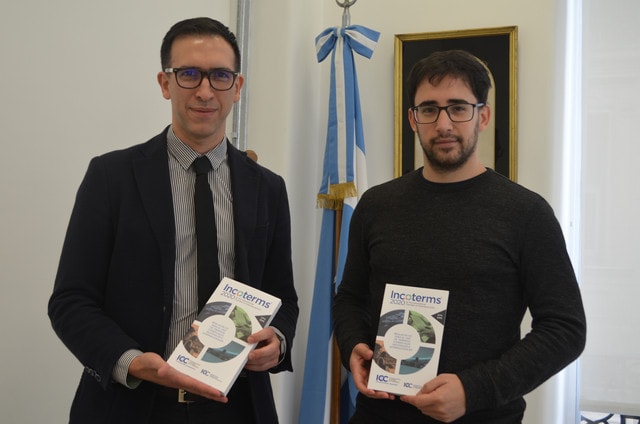
Sebastián Ferrari and Carlos María Bagnasco, Incoterms 2020 trainers at ICC Argentina. Photo: Aduana News

Aduana News foi o primeiro jornal aduaneiro da Argentina a lançar sua versão digital. Com mais de 20 anos de trajetória, suas publicações e iniciativas têm como objetivo oferecer o conhecimento mais relevante sobre temas aduaneiros, contribuindo para a promoção do comércio seguro e da facilitação do comércio na região.