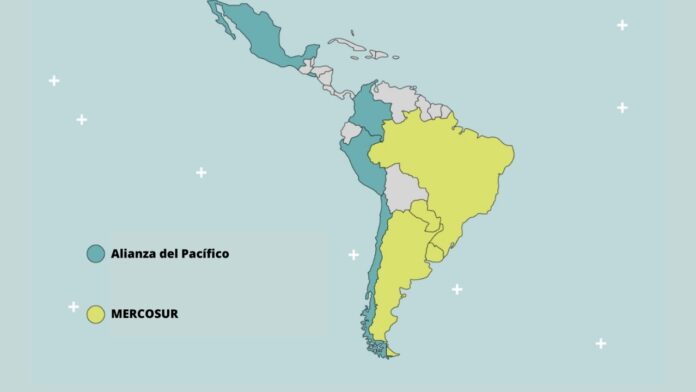
In December 2021, the Economic Commission for Latin America and the Caribbean (ECLAC) published a study on the Pacific Alliance (Chile, Colombia, Mexico and Peru) and MERCOSUR (Argentina, Brazil, Paraguay and Uruguay) outlining recommendations for advancing the convergence of the blocs in relation to trade facilitation.
In the 34-page document, whose author is Fabián Villarroel, the following are reviewed: actions implemented, achievements reached by the two blocks in this regard, as well as others current international instruments related to trade facilitation. The result obtained offers opportunities for the 8 countries to make progress in this initiative related to the simplification and harmonization of procedures and information flows associated with the import and export of goods.
The relevance of this progress, the study argues, lies in the fact that the Pacific Alliance (PA) and MERCOSUR are the integration processes with the greatest scope in terms of GDP and population in Latin America. It details that “together, the 8 countries represent 81% of the population and 86% of the GDP of the region.” And it states that “they account for 89% of exports and 88% of the inflows of Foreign Direct Investment from Latin American and Caribbean countries.”
In this regard, the study points out that the countries that make up the two blocs signed a Joint Declaration at the XIII Presidential Summit of the Pacific Alliance in 2018. This instrument highlights the purpose of reaching an eventual Free Trade Framework Agreement.
Actions implemented
In the analysis of the actions implemented To do this, the following points are found:
- Regarding the figure of the Authorized Economic Operator (OAS) that arises from the SAFE Framework of the World Customs Organization (WCO) and that was incorporated in Article 7.7 of the Trade Facilitation Agreement (TFA) of the WTO, the ECLAC document finds that, to date, 7 of the 8 countries have notified Article 7.7 of the TFA in Category A, but the degrees of implementation and above all the scope of coverage, with respect to the operators reached, differs in each of them.
- As for Mutual Recognition Agreements (MRA), the study details the regional agreements signed on the matter. That is: the document signed by the General Directors of Customs of the Pacific Alliance in Puerto Vallarta in the 2018 and the instrument signed by MERCOSUR, in November 2019, in Sao Paulo, Brazil. In parallel, the Pacific Alliance and MERCOSUR signed an Action Plan for the implementation of an MRA between the two blocs (financed by the IDB) on July 7 from 2019, in Lima, Peru. In addition, the Declaration that the same countries, excluding Mexico, signed in June 2019 in the context of the WCO General Council in Brussels, in order to work on a Regional AEO MRA (financial and technical support from the Global Alliance for Trade Facilitation). This initiative, which involves eleven members from the region, is known as Action Plan for Mutual Recognition of OAS Programs in the Americas and the Caribbean. They all show the existence of political will and technical elements to advance trade facilitation., points out the ECLAC study.
- Foreign Trade Single Windows (VUCE), that is, the initiative that involves digitalization and reduction of time and cost to carry out commercial transactions, the document states that in this area, the Pacific Alliance is somewhat ahead, not only because the development of its VUCE is more homogeneous among its members, but because the Additional Protocol to the AP Framework Agreement itself, in its Chapter 5 on Trade Facilitation, considers the commitment to move towards interoperability.
- Another interesting point is the implementation of the Digital Certificate of Origin (COD) of ALADI and exchange of experiences in the use of the phytosanitary certificate in the region. On this matter, the research says that the four members of the AP, through single windows, already exchange certificates of origin digitally, as well as electronic phytosanitary certificates, and are working on the implementation of the electronic exchange of customs declaration data and the zoosanitary certificate. Meanwhile, the MERCOSUR countries have been implementing the Digital Certificate of Origin bilaterally, creating experiences between Argentina – Brazil, Argentina – Uruguay, and also with Chile.
Regarding these actions and achievements analyzed, the study indicates that the OEA, the VUCE and the digital certification are aspects in which important advances are registered. It highlights the existence of political will and technical elements that show a convergence of both blocks. Therefore, the possibility of concretizing the Mutual Recognition Agreement of Authorized Economic Operator in the medium term is valid, the document states.
Other instruments
On the other hand, the report finds a multiplicity of bilateral or regional instruments with trade facilitation content between the countries of both blocks. The 8 members of the AP and MERCOSUR are also part of ALADI, and in this area they maintain various integration mechanisms in force, both bilateral and subregional. Therefore, it suggests the construction of an agenda in this matter to consider the harmonization of the pertinent disciplines in each regulatory body, in order not to generate contradictory or conflicting provisions.
The study also recommends pending disciplines. The members of the AP and MERCOSUR do not develop or even mention in their notifications of the WTO Trade Facilitation Agreement or in their regional agreements, the subject of sanctions, including under this term customs crimes (smuggling and fraud) and administrative violations (fines). According to the study, one of the most relevant issues when talking about convergence is to introduce more forcefully the concept of “voluntary compliance” in Customs, taking into account the WCO Regulatory Framework on Voluntary Compliance. “The vision of a Customs focused on sanctioning is archaic,” it emphasizes and suggests promoting voluntary compliance by economic operators, through the establishment of “self-reporting” mechanisms, training programs, advance resolutions, simple procedures, publicity, among others.
Another substantial issue that AP and MERCOSUR could review is the slogan of E-commerce. This type of exchange is no longer a minor issue in international trade. According to the review, the MERCOSUR Trade Facilitation Agreement does not refer to this issue. Meanwhile, Chapter 5 on Trade Facilitation and Customs Cooperation of the Additional Protocol of the AP does not do so either, although said agreement contains a specific chapter referring to Electronic Commerce (Chapter 13). For this reason, the report states that “it represents an opportunity for the two blocks to work together on innovative solutions that take into account a reality and need, to the extent that it can be a vehicle to increase trade between both and benefit their companies.” It therefore recommends considering greater digitalization of processes, advance information systems, risk management, exchange of information between customs and with other border agencies, and special procedures and channels, among other elements.
The document refers similarly to the consequences that the covid-19 pandemic caused in international trade and regulationsIt seems reasonable that one of the areas of work of both blocks is the creation of common protocols when facing this type of emergency situations to give continuity to the logistics chain with regional recognition; in addition, coordinate contingency procedures at common borders that allow the expeditious transit of means of transport and define unified procedures regarding the entry of critical supplies (medicines, vaccines, respirators) or donations that facilitate a more expeditious entry, promoting VUCE, for example. Likewise, agree on special benefits for the OEA in times of emergency and move towards processes that incorporate greater digitalization throughout the chain, including non-intrusive reviews.
In short, the study provides fresh ideas and highlights the importance of the existing opportunities that open up the convergence between the AP and MERCOSUR in terms of trade facilitation. It therefore emphasizes: “In addition to being two blocks with greater economic and commercial weight within the region, the convergence between the two occurs in a context where international trade is changing.”
In a spirit of collaboration, the Economic Commission for Latin America and the Caribbean published this recent document as part of the activities of the partnership with one of the largest German political foundations, the Konrad Adenauer Foundation.Options for convergence between the Pacific Alliance and MERCOSUR in trade facilitation)

Aduana News foi o primeiro jornal aduaneiro da Argentina a lançar sua versão digital. Com mais de 20 anos de trajetória, suas publicações e iniciativas têm como objetivo oferecer o conhecimento mais relevante sobre temas aduaneiros, contribuindo para a promoção do comércio seguro e da facilitação do comércio na região.