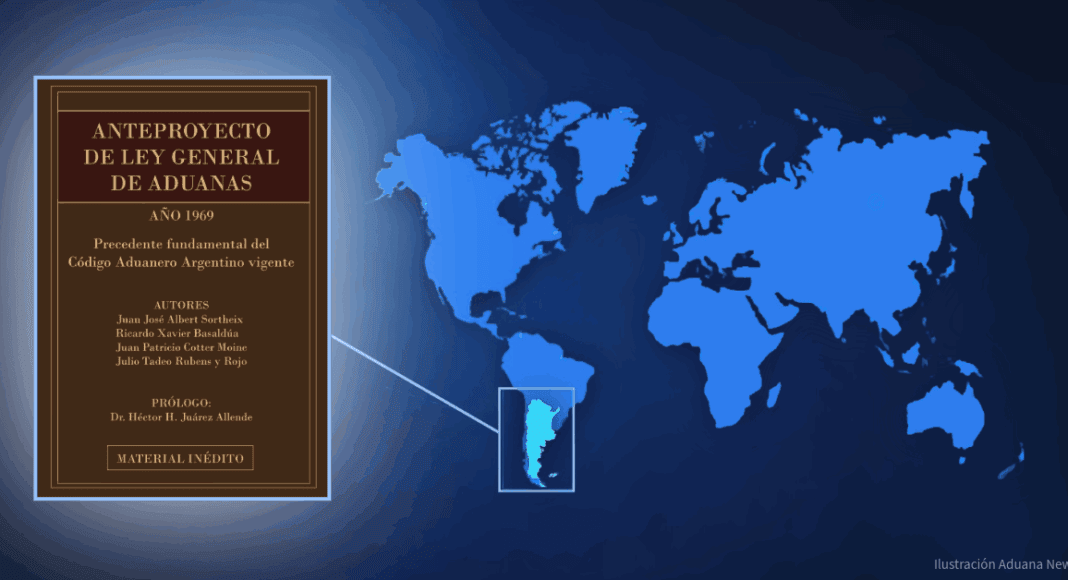

In the framework of the International Customs DayToday, a key piece of national legal memory is presented: the unpublished edition of Draft General Customs Law of 1969This document constitutes the fundamental precedent and structural matrix on which the current Customs Code (Law 22.415) was built, which governs Argentine foreign trade since 1981.
The presentation coincides with the World Customs Organization's (WCO) 2026 motto: “Protecting society through vigilance and commitmentIn line with this objective, the Dr. Hector H. Juarez AllendeJudge of the National Tax Court and academic in charge of this historical recovery, highlights a text that in 1969 already laid the foundations of legal certainty and efficiency that the global system demands today.
The preliminary draft was written by a «golden generation» of specialists: the doctors Juan José Alberto Sortheix, Ricardo Xavier Basaldúa, Juan Patricio Cotter Moine (father) and Julio Tadeo Rubens y RojoHis work not only anticipated modern customs law in Argentina, but also aligned the country with the international models and principles of the WCO.
Let us remember that January 26th is a special date for the World Customs Organization, as it commemorates the first session of this organization, created in 1952 as the Customs Cooperation Council, with the aim of optimizing the efficiency and effectiveness of customs administrations. In particular, the WCO promotes the harmonized treatment of the international flow of goods and the development of global and uniform solutions for customs classification and valuation. In this context, member countries—including Argentina—have the opportunity to highlight their efforts and contributions in this area.
"This is an extraordinary discovery, as a fundamental piece—until now absent from the country's legal historiography—is finally available to academics, professionals, and students.“Juárez Allende explained to Aduana News. He also emphasized that the recovery of the document was made possible thanks to the generosity of Dr. Ricardo Xavier Basaldúa, who preserved it in his personal collection. According to him, neither the Ministry of Economy nor the heirs of the other co-authors had a copy, so without this safeguard, this valuable precedent of Argentine customs law would have been lost.”
The previously unpublished draft allows for a reassessment of a document that, despite not having come into force at the time, constituted the primary and clearly principal source of the customs code formalized years later. The reader is invited to analyze and compare the numerous similarities and identicalities between these two legal frameworks.
Serving the community
The work is presented with study material from the Preliminary Draft as an introduction, organized into five parts. The first addresses the historical contextDescribing the customs legal scenario prior to the Customs Code of 1981, characterized by regulatory dispersion and legal uncertainty, which motivated the impetus of a pioneering effort of comprehensive codification in line with the international technical advances of the time.
The second part develops a technical analysis of the Preliminary Draft, highlighting its systematic structure, the definition of essential concepts and the incorporation of legal innovations that balanced the prerogatives of the State with the guarantees of the administered, laying decisive foundations for the current Customs Code.
The third section presents a profile of the authors, highlighting the academic and professional excellence of those who, as early as 1969, were committed to the modernization of Argentine customs law.
Part four examines the direct influence of the Preliminary Draft on the Custom code, demonstrating how it contributed structure, terminology and institutions that provided stability, legal certainty and regional recognition to Argentine legislation.
Finally, the fifth part offers a international and comparative law perspectiveThis section demonstrates how the 1969 Draft Bill aligned with European models and principles later consolidated in international instruments such as the Kyoto Convention—approved under the presidency of Argentine Juan José Sortheix in 1974—and the Harmonized System, also developed under his leadership at the WCO. It highlights the comprehensive review system established by the text, anticipating the global trend toward stricter jurisdictional control in customs matters. By specifying precise and regulated mechanisms for ensuring legality, this commitment to due process and legal certainty positioned the Argentine experience as a leading model, recognized as a benchmark for the modernization of other legal systems.
Thus, the PDF publication, along with a facsimile version of the original, is now available and highlights the commitment of Argentinians to current customs regulations, the development of international trade, and the protection of society. We celebrate the release of this work and invite you to download it in the context of International Customs Day 2026, as part of this special commemoration and in full accordance with the objectives of the WCO.
Preliminary draft LGA RA 1969
Blueprint LGA RA 1969 – Facsimilar Edition

Aduana News foi o primeiro jornal aduaneiro da Argentina a lançar sua versão digital. Com mais de 20 anos de trajetória, suas publicações e iniciativas têm como objetivo oferecer o conhecimento mais relevante sobre temas aduaneiros, contribuindo para a promoção do comércio seguro e da facilitação do comércio na região.