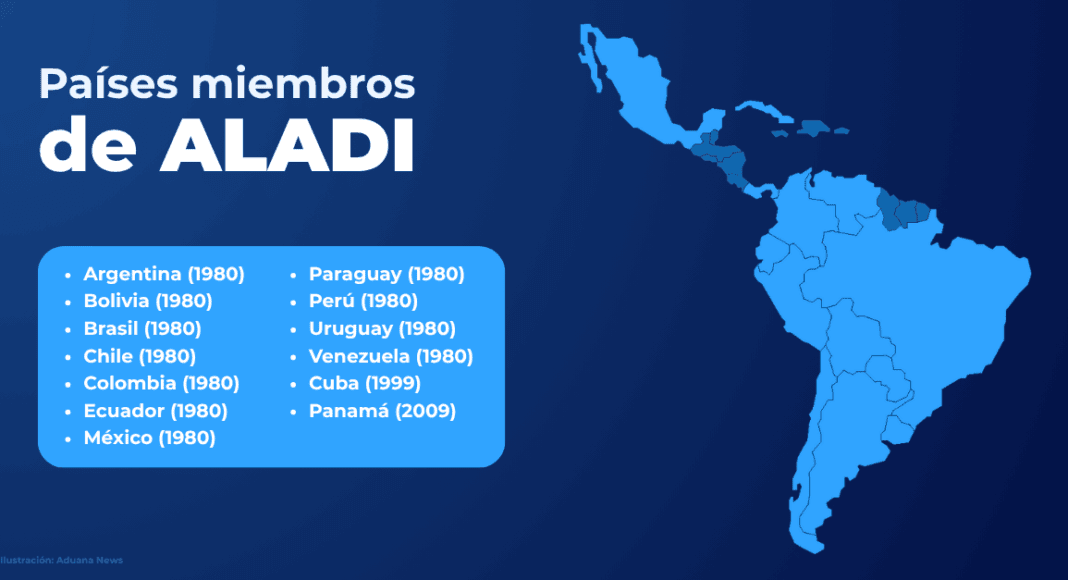

The cycle of "ALADI up to date» it was proposed to carry out a technical analysis, as well as a critical and strategic reflection on the multilateral trading system, in a context of epochal change that challenges our ways of managing trade relations. This change not only impacts tariff terms, but also affects all dimensions related to global and regional trade. The event was aptly moderated by Sergio Abreu, Secretary General of ALADI.
In that way, referents from Argentina, Brazil and Mexico participated in the panel to review current challenges from their respective areas of expertise. With a technical-commercial perspective and a political-strategic focus, the discussion sought to formulate recommendations for ALADI member countries on how to address the tariff war.
Below are the highlights of each intervention.
?? Juan Carlos Baker – Mexico
During his speech entitled “Effects on the multilateral trading system”, former Undersecretary of Foreign Trade of Mexico and current international consultant, Baker, offered a clear diagnosis of the progressive deterioration of the global system.
He argued that the crisis in the commercial system didn't emerge overnight, but had been brewing for some time: "In the commercial sphere, many of us had already been aware that, for some years, something had broken."
In this context, Latin American countries such as Mexico, Chile, and Peru actively participated in modern treaties and trade liberalization processes, adapting to the new global dynamic. Mercosur, on the other hand, began to show signs of lag, with more rigid structures and slower responses to environmental changes.
“All of this was already happening, but we were managing it, looking for ways to keep trade active despite the cracks in the global institutional architecture.”
The most abrupt break, he noted, came with the first Trump administration and was exacerbated by the COVID-19 pandemic: "The pandemic—and especially what followed—made it clear that many of the traditional rules of international trade were beginning to be abandoned."
Concepts like National security They came to the fore, displacing free tradeIn 2025, he stressed, it's no longer about perceptions but measurable realities: reciprocal tariffs, revived trade wars, and growing distrust in multilateral institutions.
Faced with this, he proposed three possible scenarios:
- Optimistic scenario: Global players recognize the risks and agree to curb the escalation, pushing for real reform of the system. “There are already encouraging signs: for example, the recent announcement of a tariff truce between China and the United States… What is relevant is the message of de-escalation.”
- Intermediate stageCountries accept that full free trade will not return, and are moving toward agreements with greater state control, integrating new agendas like modern treaties like the USMCA. "This could be where we are now."
- Negative scenario: The logic of confrontation prevails, trade wars intensify, and medium-sized countries are trapped. "The goal is no longer to grow the pie to share it, but to protect what we already have."
In his conclusion, Baker warned that the future of international trade is not sealed, but will depend on the collective will to avoid fragmentation: “What happens will depend on our ability to engage in dialogue, build consensus, and remember that trade, beyond tariffs, is a tool for development and global cooperation."
?? Ricardo Sennes – Brazil
Sennes, a specialist in political and economic scenarios and the formulation and implementation of public policies, addressed the topic "The region in the face of the new economic and trade scenario." In his analysis, he highlighted two major dimensions of transformation: on the one hand, the dismantling of the multilateral system; and on the other, the diversification of the international integration strategies adopted by the countries of the region.
1. The weakening of global multilateralism. In line with the Mexican expert's statement, Sennes emphasized that "we are clearly at a time of dismantling some multilateral systems for managing international issues," not only within the UN framework, but also in the area of global trade. He explained that organizations such as the World Bank and the WTO are facing a loss of relevance. "The entire system that was created through more or less cooperative management after World War II has, in recent years, been heading more or less toward a crisis."
This retreat is not a response to a strategy of reform or adjustment, but rather to a more destructive attitude: "The proposal of the major powers (...) is not for a reform, a change, an adjustment of these multilateral institutions, but basically for, possibly, a moment of even greater crisis."
2Latin America faces a fragmented international mapSennes identified four distinct subregions within Latin America, with distinct logics of global integration: Mexico (closely linked to the US and Canada), Central America and the Caribbean, northern South America (Colombia, Venezuela, Ecuador), and the southern part of the continent (Brazil, Argentina, Chile). "These are four areas with four distinct economic and political impacts, due to their greater or lesser proximity to the United States, but also due to their international integration."
3. The two currents in US foreign policy During Donald Trump's administration, Sennes distinguished at least two main currents:
- On the one hand, pure commercial nationalists, who view trade from a mercantilist perspective: "The main objective of countries is to overcome trade in goods." This view is, for Sennes, "very strange for a knowledge-based economy."
- On the other hand, the hawkish, sectors focused on national security with a more belligerent geopolitical vision: "They are looking for a military confrontation in the next 10 years that will possibly have China as the main enemy."
Both currents agree on an erosion of the multilateral order: "At the end of this process, we will have a world where (...) there will be a sequence of bilateral negotiations (...) with many more restrictions, tariffs and non-tariff barriers."
4. Risks for Latin America Sennes warned that the region faces an adverse environment for development and emphasized that a more fragile international system would negatively affect Latin America in the long term, given the lack of clear rules and effective forums. He also expressed concern about the lack of governance in key areas of the knowledge economy, such as artificial intelligence, data transmission, and data center management, which will continue to create obstacles to its development.
5. An asymmetric and vulnerable economic insertionFinally, he analyzed Latin America's relationship with the major powers. In the case of Brazil, for example, while trade with China is significant, "it's focused on three products; it's not a broad exchange (...) it's basically three commodities." Meanwhile, China is making progress with technological and strategic investments in multiple sectors. Relations with Europe are "more balanced," and with the US, although they represent a smaller volume of trade, they are "a little more balanced."
?? Andrés Malamud – Argentina
The senior researcher at the Institute of Social Sciences at the University of Lisbon organized his presentation around two axes: what's happening in the world and how it impacts Latin America. He noted that we are undergoing a hegemonic transition, where a declining power (the U.S.) is challenged by an emerging one (China). However, he added a novel factor: the self-sabotage of the dominant power, which erodes the system from within (a phenomenon that worsened with Trump). He considered the region based on:
1. GeographyHe emphasized the importance of a country's place in the world: geopolitics—the articulation between space and power—defines who has access to development. He asserted that Latin America has not developed, in part, because the door has not been opened to it, unlike countries like Germany, Japan, and South Korea, which have received international support.
2. DemographicsLatin America "is aging before it becomes rich," losing the benefit of the demographic dividend. Although better positioned than Africa, its future depends on its relationship with developed countries, which are the ones that can open the door to development. He emphasized that neither isolation nor disconnection is beneficial.
3. ForkHe described a structural divide in Latin America: one part more aligned with the United States (Mexico, Central America), and the other with China (South America), especially due to demand for commodities. This fracture prevents a common regional strategy.
4. ProspectsHe described Latin America as the continent of mediocrity: neither tragic nor promising. With average growth rates, it fails to make significant progress in development. Even so, in an increasingly turbulent world, Latin America's relative stability could be a source of consolation or even an advantage.
5. HeterogeneityHe presented a framework with four groups of countries based on political stability and economic growth. He emphasized that Uruguay, Chile, Panama, and Costa Rica combine growth and stability. At the other extreme are countries with low stability and low growth, such as Venezuela. Intermediate cases, such as Peru and Argentina, show partial institutional stability with fragile economies.
Malamud concluded that there is no single recipe for the region, given its heterogeneity. Furthermore, the countries that function best are small, but lack leverage. He argued that "as long as Argentina, Brazil, and Mexico do not become solid economic and democratic engines, regional integration will remain difficult, as more stable countries tend to distance themselves from unstable ones, not integrate with them."
Final reflection: How can ALADI member countries respond to a tariff war?
In the global scenario increasingly strained by trade disputes, regional integration ceases to be an end in itself and becomes a strategic, flexible tool and results-oriented.
From Argentina, political scientist Andrés Malamud proposes three keys: “anchor the external agenda in stable partners"like the European Union," "learn from successful bilateral models" such as that of Mexico with the United States, and "not abandon regional construction," even if progress must be gradual and specific.
From Mexico, former Undersecretary of Foreign Trade Juan Carlos Baker He emphasizes that, due to the size of the Latin American economies, “look out"is a necessary condition for growth. His country, which has consolidated an "asymmetric negotiation with a power," can offer a model for exploring bilateral avenues "without renouncing the regional aspect."
Ricardo Sennes, Brazilian analyst, urges caution due to the "structural limitations in regional leadership" and proposes a "parsimonious but feasible" agenda. He highlights Europe as the partner with the "lowest political cost and greatest predictability" and suggests that integration should focus on strategic areas such as logistics infrastructure, digital economy and data management.
In short, as Malamud summarizes, “sticking to solid agreements”—like the one being negotiated with the European Union—can be, like Ulysses' mast, the key to “sailing a course through global storms.”

Aduana News foi o primeiro jornal aduaneiro da Argentina a lançar sua versão digital. Com mais de 20 anos de trajetória, suas publicações e iniciativas têm como objetivo oferecer o conhecimento mais relevante sobre temas aduaneiros, contribuindo para a promoção do comércio seguro e da facilitação do comércio na região.