

In Argentina, the issue of digitalisation of trade was the subject of debate. For the transformation to make significant progress, it is essential that all stakeholders align their efforts. The International Chamber of Commerce (ICC) is driving this issue forward.
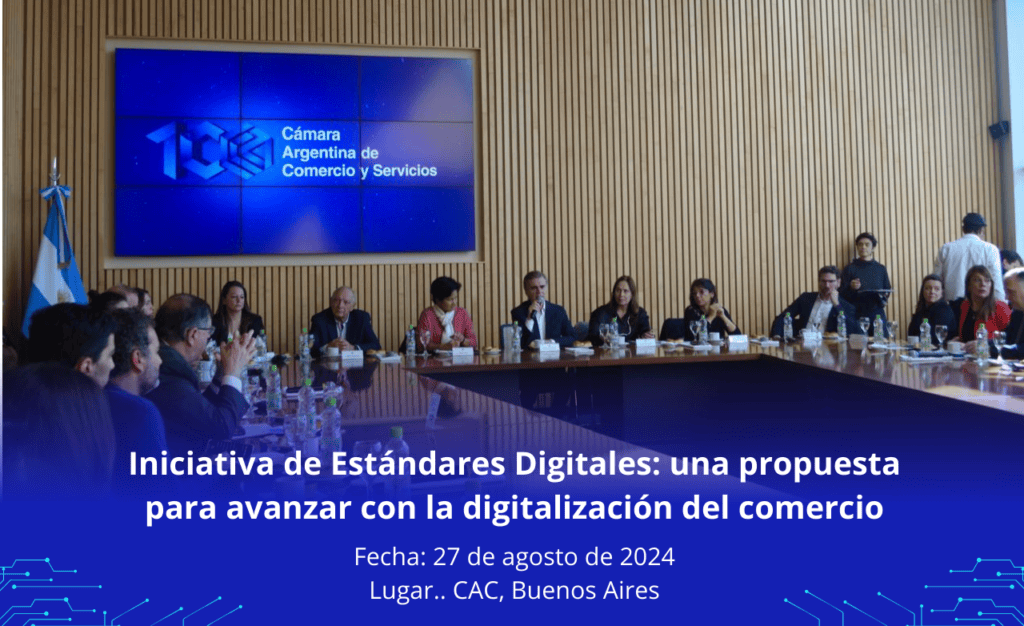
At a recent session, the president of the ICC Argentina National Committee (chaired in the country by the CAC), Marcelo Elizondo, welcomed Pamela Mar, who is leading the International Chamber of Commerce's “Digital Standards Initiative” (DSI) at a global level. In her role as representative of the Argentine chapter that carries out coordination tasks in the Americas, Elizondo highlighted the importance of the participation of the DSI director in the country, as well as in the region.
Elizondo referred to the DSI, a project designed to digitally transform end-to-end supply chains. “La Digitalisation in the business world has advanced very dynamically, but there is a delay in the public sector. For this reason, we are promoting a joint public-private effort. An effort in which different institutions participate and from which the reference initiative has emerged, as well as the United Nations Model Law.”
Thus, the participation of Pamela Mar on the panel “Where does the region stand? The Digital Standards Initiative as a platform to advance the digitalization of trade.”
At the outset, he outlined the nature of the project. The Digital Standards Initiative is a programme of “deep and intense” collaboration between the public and private sectors aimed at accelerating the development of a harmonised and digitalised business environment at a global level, as a key factor for growth. It operates in accordance with these management standards and under the guidance of a Board of Directors made up of the ICC, the World Customs Organisation, the World Trade Organisation, the Asian Development Bank and Enterprise Singapore.
Along the same lines, Pamela Mar referred to digital commerce, that is, the trade of goods and services that is carried out through the use of digital technologies in various aspects, which affects the exchange of information and data between companies (B2B) and governments (B2G), interoperability that is carried out through the Single Window.
This trend is very important in the countries of the Association of Southeast Asian Nations (ASEAN), the European Union, as well as in the World Trade Organization (WTO), which has just published the standardized text on global electronic commerce. Basically, -Mar said- digital commerce allows saving money and time, speeding up trade, facilitating the creation of jobs and opportunities for SMEs, as well as simplifying the use of paper. In short, “digital commerce is based on trade facilitation and paperless trade.”
This shift towards digital information exchange can improve efficiency, transparency and sustainability in global supply chains. To this end, Pamela Mar suggested that governments make changes and create enabling conditions by adopting global digital standards, building capacity, updating laws and developing digital trust.
With that focus, the DSI director also addressed the creation of the FIT Alliance, a collaboration between BIMCO, the Digital Container Shipping Association (DCSA), the International Federation of Shippers' Associations (FIATA), the International Chamber of Commerce (ICC) and the Society for Worldwide Interbank Financial Telecommunication (Swift). The objective is to promote the digital delivery of trade data. The alliance seeks, in this sense, the commitment of all actors in the supply chain, starting with the knowledge of the Global Bill of Lading.
This digitalisation process has been going on for several years. At a global level, work is already underway with China, Thailand, Malaysia, Japan, Spain, Colombia and Mexico.
Latin America
Focusing on Latin America, Mar commented that the region presents challenges and opportunities for digital trade. Specifically, he said that Argentina's trading partners are moving forward in adopting the United Nations Model Law on Electronic Records (Brazil, the United States, China, India, Chile and Paraguay).
Beyond the Model Law, the DSI director listed recommendations to help the government facilitate digital trade. In detail:
- Engage and educate the public sector,
- deepen the implementation of measures for trade facilitation and paperless trade,
- prepare the implementation of legal reforms,
- reorient trade policy around digitalization,
- Engaging the private sector in standards and digitalisation,
- create a digital ecosystem with fintech, innovators and service providers,
- develop a national digital identity,
- enable digital trade and finance.
Following the discussion, Pamela encouraged the promotion of the Digital Standards Initiative so that Argentina “can be one of the leaders in shaping digital commerce in the region.”
Argentina
This was followed by a very interesting panel on “Digitalization of international trade in Argentina: current situation and proposals" where Maria Jose Llabot and Marina Azzara They explained the facets of leading the Digital Standards Initiative at ICC Argentina through the public-private combination.
The legal and technological approach was very well commented by María José Llabot. The regulatory frameworks that the Model Law calls for and those existing in Argentina were compared in order to be able to talk with the Legislative Branch. The 36 standardized documents on the path to digitalization in foreign trade were issued, of which the most recent was chosen. e-Bill of Lading.
El e-Bill of Lading – continued Llabot- It is an original electronic document that offers a more efficient, secure and sustainable alternative to a complex process. “It works as a receipt, contract and title deed that allows the transport of goods. In addition, its interoperability works between shipping companies and international banks.”
However, existing initiatives are not able to achieve 100% adaptation in the country. According to the status report compiled by ICC Argentina, there is a lack of interoperability between the different foreign trade players, a lack of validation by the different agencies (Customs-Commerce-AFIP), a lack of dissemination regarding its benefits and a lack of vision from the technology sector to accelerate the "paperless" conversion.
In this regard, ICC Argentina highlighted the need for “electronic systematization.” Indeed, digitalization offers immediate access to the document, improved security (encryption and digital signature protect the integrity of the document), transparency and traceability (real-time tracking), integration with other systems (automating processes, and data interoperability). It also offers environmental sustainability (reduction of paper and other physical resources).
Marina Azzara added that a “digital document” not only improves interoperability, but also ensures the exchange of data in global commercial operations. Blockchain technology is involved in this process, where Argentina has initiatives involved in the journey (Evergreen Shipping Agency, the Navigation Center and CERA are some examples).
Additionally, Argentina has a new portal for the Single Window for Foreign Trade (VUCE); this “live” tool allows for the interoperability of procedures and the exchange of data and information between operators and government agencies (Customs-Trade-Others).
In the words of Azzara: “Argentina is demonstrating a journey towards digitalization.” At the legal level, it has DNU 70/2023, the Customs Code, the Civil Code and the Commercial Code and the Navigation Law (Law 20.094/1973), the digital signature (Law 25.506) and Decree 734/2024 with biometric identification and validation mechanisms not only in person but also remotely, the digital certificate (exchange with Brazil, Paraguay and Uruguay) and the Basic Law (Law 27.742/2024). At the technological level, it has the VUCE platform, digital documents and presentations, customs procedures, digital documents and presentations established by AFIP, TAD system, Malvina Computer System.
It is therefore worth noting that the leader of ICC Argentina encouraged aligning the legal system with the United Nations Model Law on Electronic Transferable Documents and supporting the digitalization of commercial documentation.
And the profitable day gave way to the private sector experiences, for which Jorge Heinermann (Director of Transportes Universales SA), Bárbara Alejandra Radoviztki (Trade Execution Manager CARGILL), María Belén Forni (Foreign Trade, Aceitera General Deheza) and Guillermo Grassi (Director Commercial & Corporate Development EN Global Share SA/edoxOnline) agreed on the positive impact generated by digitalization.
The session closed with an invitation from the head of ICC Argentina to all interested parties, public and private, to work together on this transformative initiative to take advantage of the benefits of a digital-first business ecosystem.

Aduana News foi o primeiro jornal aduaneiro da Argentina a lançar sua versão digital. Com mais de 20 anos de trajetória, suas publicações e iniciativas têm como objetivo oferecer o conhecimento mais relevante sobre temas aduaneiros, contribuindo para a promoção do comércio seguro e da facilitação do comércio na região.