




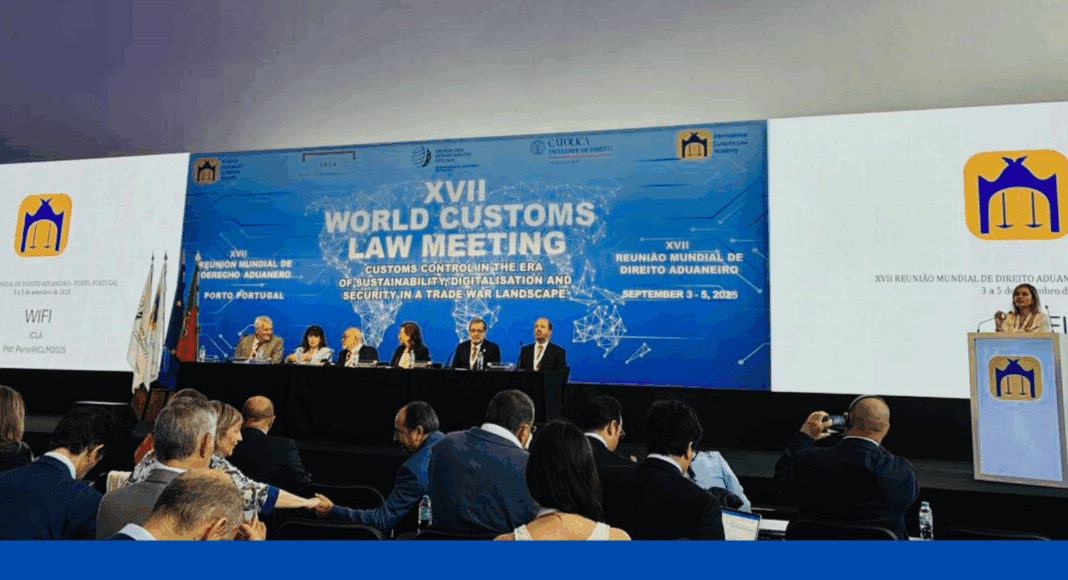

With an increasingly globalized and complex world, more than 300 delegates from 33 countries They met in Porto, which from September 3 It has become the epicenter of international debate. The 5th World Customs Law Meeting is being held there, organized by the International Academy of Customs Law (ICLA) under the program "Customs Control in the Era of Sustainability, Digitalization, and Security in a Trade War Context," which concludes today, Friday the XNUMXth.
Opening ceremony
The academic opening ceremony was held on 4 Thursday in the historic Porto Customs House and was attended by prominent representatives of the field. Manuel Fontaine, Director of the Faculty of Law of Porto, thanked the delegates for their presence, while José Rijo, partner of SPCA Law Society, highlighted the panels on green trade and Artificial Intelligence. For his part, Mário Alexandre Alves Jorge, President of the Order of Official Dispatchers of Portugal, He highlighted the current challenges of trade in the face of protectionist measures.
Sara Amella, from the International Academy of Customs Law, He highlighted the participation of delegates from 33 countries in a context of economic fragmentation and emphasized digitalization as an essential condition for operating and protecting the value chain.
Finally, Helena María José Alves Borges, Director General of the Portuguese Tax and Customs Authority, He emphasized the role of Artificial Intelligence in addressing new professional demands and the need for experts in new forms of marketing. He also highlighted the importance of controlling trade flows to protect society, prevent illicit trafficking, and foster training and trust, noting that the use of technology in customs has reached 40%, with the goal of consolidating a respected administration that serves as an example of good practices.
World News: Sustainability and Green Trade
(I.e.Conference: Public Sustainability Policies and Their Challenges in International Trade
Following the opening remarks, the agenda began with a keynote address by Aik Hoe Lim, Director of the Trade and Environment Division of the World Trade Organization (WTO), who emphasized that we are experiencing a period of change that impacts the role of global trade law, technological development, climate change, pollution, and resource loss. He emphasized that trade is not abstract; it connects people, and the environment is a key interest for sustainable growth. He emphasized that international forums must discuss environmental issues, and the expert recalled that "trade is not abstract; it connects people, and the environment is a key interest for sustainable growth." In this regard, he stressed that "international forums must discuss environmental issues, and the GATT, as one of the pillars of international economic cooperation, is part of this effort."
Something of note: Lim emphasized that sustainability and trade must seek a balance: “The environment is important, but the measures adopted must be balanced. Although there is no specific formal agreement, there are mechanisms to resolve any problems that may arise.”
The Director explained the work being done in the Trade and Environment Committee, highlighting the importance of discussion forums to address potential crises. "While we are not experts in all areas, we seek to understand the measures being implemented and what they consist of," he stated.
Among the basic principles for the application of trade-restrictive environmental measures, Lim highlighted:
- No discrimination (between partners and between imported and domestic products).
- Prohibition of quantitative restrictions.
- Avoid unnecessary barriers to trade.
- No protection above agreed limits.
- Transparency.
He also emphasized that "when implementing an environmental measure, it must be done consistently, consciously, holistically, fit for purpose, and flexibly."
In conclusion, Lim reflected on the transformation that the green transition represents: “Green trade is changing commerce. Environmental measures recognize this situation, but their effectiveness depends on how they are established and implemented. There must be objectivity and constant debate, ensuring that the green transition is smooth and sustainable.”
(I.e.Panel: The Impact of Environmental Standards on International Trade and the Role of the Private Sector in Cross-Border Environmental Compliance
Next, another interesting activity took place, presented by Florencia Sarmiento, Policy Advisor for the Economic Law and Policy Program at the International Institute for Sustainable Development (IISD)Sarmiento emphasized the importance of forests and warned that "the rate of deforestation shows that this activity generates a huge loss of resources." He noted that both the public and private sectors must take concrete measures, and presented data illustrating specific cases.
Regarding the EU Deforestation Regulation (EUDR), he explained that it is an action aimed at preventing uncontrolled deforestation. The regulation, mandatory since June 29, 2023, requires due diligence to comply with legal requirements starting December 30, 2025. "Products from the six core forest-risk sectors can only be exported to the EU market if they meet certain legality and due diligence requirements," he noted. Failure to comply with these regulations entails sanctions such as seizure, temporary marketing bans, and fines. He clarified that the regulation covers deforestation and forest degradation that occurred after December 31, 2020.
Regarding the role of the private sector, Sarmiento highlighted that “many companies have committed to eliminating deforestation from their supply chains” (WWF, 2018; CDP, 2023), although 43% of Forest 500 companies have no commitment and 63% lack evidence of implementation (Global Canopy, 2024). He noted that companies combine certification with other tools such as satellite monitoring, payments for ecosystem services, nature-based solutions, landscape approaches, and community partnerships. He concluded that “voluntary action alone is insufficient to achieve systemic change; greater commitment is required.”
Axel Marx, Deputy Director of the Center for Global Governance Studies at the University of Leuven, Belgium, emphasized the relevance of these issues given the pressure of an uncertain global agenda. Regarding the impact of environmental regulations on international trade, he indicated that "companies must comply with new sustainability obligations, both in their operations and throughout their cross-border supply chains." He explained that risk-based due diligence involves identifying and addressing actual or potential sustainability impacts to prevent or mitigate adverse effects. "Due diligence approaches oblige companies to govern sustainability in their own operations and across borders," he concluded, stressing that voluntary standards are useful but do not guarantee a safe harbor and incur costs.
Lars Karlsson, Global Head of Trade and Customs Consulting at Maersk, Stockholm, SwedenHe continued with a crucial topic for traceability and highlighted the importance of a "digital passport for goods," comparing it to a personal passport as an identification tool. This mechanism would provide information on climate change, merchandise accidents, trade compliance, supply chain visibility, customs data, and risks related to ESG and tariffs. "Changes in trade are irreversible; therefore, planning and digitalization are essential," he emphasized. He also noted that "Artificial Intelligence is vital for data management and validation, which today constitutes the new wealth."
Customs Issues: Customs Digital Transformation
(I.e.Conference: Artificial Intelligence and its applications in international trade and customs control.
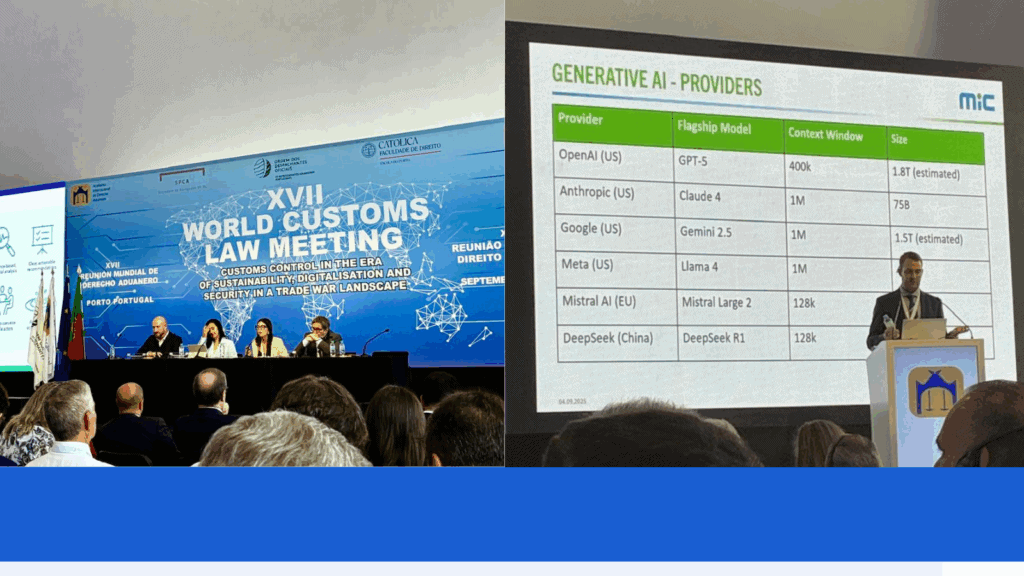
Thursday afternoon continued with the Artificial Intelligence sectionMaximilian Sandberger, Data Scientist at MIC, Austria, explained the channels of AI intervention through different data models, highlighting the importance of providing adequate information and updating it in response to changes. He underlined the role of prompts, the instructions given to the system to achieve specific results, and detailed the current benefits of AI: speed, efficiency, accuracy, and cost-effectiveness. He also noted limitations such as the need for quality data, pattern recognition, handling of complex information, and maintenance. He concluded that, in the coming years, AI will become faster and more effective, enhancing human efficiency without replacing it.
The agenda then focused on an interactive session on Artificial Intelligence, which became the main topic of the afternoon. Valeria Picard, Head of Commerce, International Chamber of Commerce (ICC), Paris, FranceHe compared the current impact of AI to the industrial revolution, highlighting its rapid evolution and diverse effects. He cited WTO data showing that 91% of companies report efficiency gains and improved decision-making, while 75% use AI in customs tasks such as classification and rules of origin. He emphasized its relevance to microenterprises and the need for regulatory frameworks and secure data that can cross borders without restrictions, unleashing the technology's full potential.
Then Natalia Mathá, Machine Learning Product Leader at MIC, Austria, demonstrated how AI is applied in tariff classification, explaining how the input data allows systems to automatically identify a product's tariff number. Although accuracy is not 100%, its use serves as a reliable guide, combining the efficiency of AI with human oversight.
Fernando Salazar, Surplus Tax Inspector at the State Tax Administration Agency of SpainAEAT highlighted the efficiency of AI in queries about classification, origin, and value, noting that data quality and the correct formulation of questions are essential.
Thus concluded the day's session. All speakers agreed that generative AI has enormous potential, but it must be implemented carefully, ensuring gradual learning that minimizes the margin of error in customs operations.
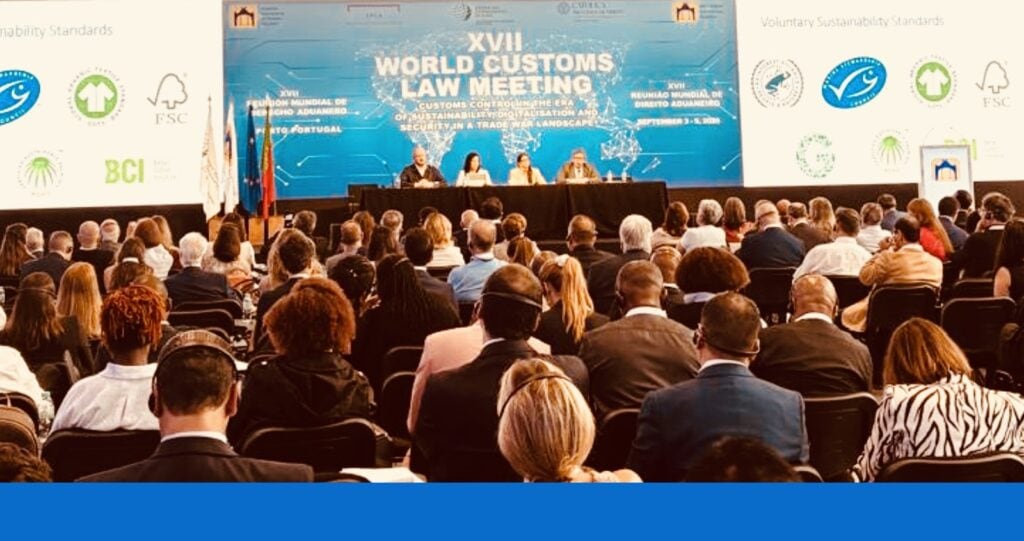
Today, Friday, the program will address customs law and security, standards harmonization, and professional training, with experts from Brazil, Spain, Portugal, Panama, Mexico, Germany, and Belgium.There will be conferences, panels, and roundtables, and, of course, we will share the most relevant concepts in customs law.

Aduana News foi o primeiro jornal aduaneiro da Argentina a lançar sua versão digital. Com mais de 20 anos de trajetória, suas publicações e iniciativas têm como objetivo oferecer o conhecimento mais relevante sobre temas aduaneiros, contribuindo para a promoção do comércio seguro e da facilitação do comércio na região.