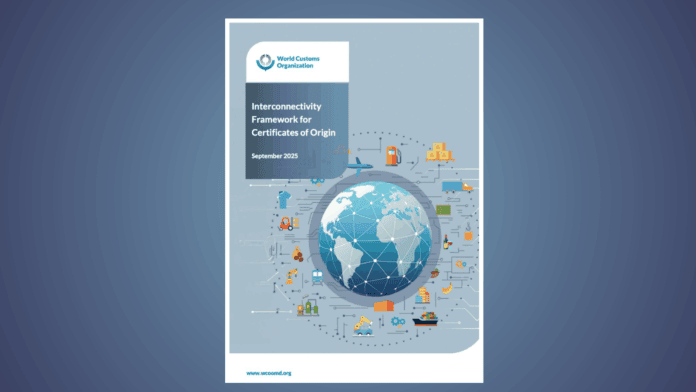
The World Customs Organization (WCO) presented today (22.10.2025) the first version of the Interconnectivity Framework for Certificates of Origin (COs), a 66-page document that establishes protocols, standards, and guidelines for the electronic exchange of origin information between exporting authorities and importing customs authorities. This initiative seeks to simplify, streamline, and standardize international trade processes, contributing to the digitalization and facilitation of global trade.
Interconnectivity Framework: objectives and scope
The document is organized in five main sections, supplemented by five annexes, and according to the WCO, "standards-based interoperability is essential for continued digitalization." The digitalization of origin-related procedures is key to ensuring "efficient, transparent, and secure trade" within the framework of Free Trade Agreements (FTAs).
The WCO also explains that the document addresses the "legal framework, business process model, data set and technical requirements» necessary to ensure the efficient exchange of CO information.
To this end, in September 2023, to examine how to address interoperability challenges, the WCO launched a Feasibility Study on an Interconnectivity Framework for Certificates of Origin. As part of this process, an Informal Working Group (IWG), composed of interested members of the Technical Committee on Rules of Origin (TCRO), was established to develop a standardized approach to enable the exchange of CO data within the framework of bilateral or multilateral FTAs and to guide the design of a technological solution to facilitate interconnectivity between parties.
Data exchange models
As previously indicated, the document includes five annexes that explain the data exchange models. One of them analyzes the data elements to be exchanged according to the Push Model, for which the WCO developed a Derived Information Package (DIP) for the COs. Two other annexes present additional models: one addresses the Semi-Automated Pull Model for CO, and the other explains Self-Declaration of Origin and how the Push Model works in this case.
According to the WCO, the Interconnectivity Framework was developed based on experience with preferential Certificates of Origin. However, "particularly with regard to business process models and technological specifications, the Framework could be used as a reference for both preferential and non-preferential Certificates of Origin«.
Course 2026
After presenting the Framework, the WCO reported that, as a next step, the Secretariat is developing an e-learning course to facilitate understanding of the various elements of the Framework. This course will be available in early 2026 on the platform. CLiKC! of the WCO. The Organization also indicated that any additional queries may be directed to the WCO Secretariat.
Recalling that the WCO's work focuses on the operational level, ensuring that goods move efficiently, safely, and predictably across borders, it is essential that the entities and individuals responsible for implementing information exchange between countries carefully review the materials published by the Organization.

Aduana News foi o primeiro jornal aduaneiro da Argentina a lançar sua versão digital. Com mais de 20 anos de trajetória, suas publicações e iniciativas têm como objetivo oferecer o conhecimento mais relevante sobre temas aduaneiros, contribuindo para a promoção do comércio seguro e da facilitação do comércio na região.