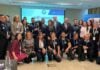
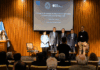
The XVI World Meeting on Customs Law has started this Thursday and will continue until tomorrow, September 29, in Germany, with the participation of experts in international trade and customs from almost 35 countries from the five continents. Its objective is to analyze the challenges of "Customs in times of global change«.
Participants attend the Humboldt University of Berlin, the oldest university in this German city and one of the best in the world. It has served as a model for other universities in Europe and Western countries.
La opening ceremony was headed by a panel comprising the Prof. Dr. Hanz Michael Wolffgang (Director of the Institute for Customs Law and International Trade at the University of Münster ICTL), Dr. Lothar Harings (President of the European Foreign Trade Forum EFA), Dr. Marc Brocardi, President of the Office for Development through Automation and Simplification of Foreign Trade ODASCE, France), Prof. Dr. Malte Peters (Vice Dean of the Faculty of Finance of the Federal University of Applied Sciences) and Dr. Andres Rohde Ponce (President of the International Academy of Customs Law (ICLA). The distinguished panel highlighted the globally resonant event, which is an opportunity to analyse the complex global situation and to anticipate possible developments.
After referring to the five panels of the World Meeting, the Prof. Andres Rohde Ponce welcomed numerous participants from all over the world and from various fields, such as legislators, judges, customs authorities, consultants of international organizations, representatives of global companies, members of leading law firms and professors, among others.

Panel 1: Current world events
Ferdinand of Matthew, The former Ambassador to the World Trade Organization and President of its General Council, referred to the current situation and prospects of world trade, highlighting growth projections for 2023/2024. In this regard, the specialist noted that India, China and Indonesia would be the countries with the highest percentage in favor of such expansion, while Argentina would have a negative value. He referred to the importance of the value chain, as a means that acts in favor of growth and highlighted the example of Vietnam as one of the countries that most applies this scheme. Another issue highlighted was the growth of services. He highlighted the presence of restrictions in the world, aligned with the trade war between China and the United States, who choose to apply policies subsidizing their trade, and on this, he considered that the WTO would not be effective. Finally, he considered that globalization is a phenomenon that will continue, although it is not known how it may appear in the future.

El Dr. Alejandro Gamboa-Alder, former Secretary of the Council for Trade in Goods of the World Trade Organization, prepared his presentation on “The status of the implementation of the Trade Facilitation Agreement.” In this regard, he considered that concrete actions must be taken to ensure the proper implementation of the agreement in each country. He warned that this problem is evidenced by the lack of follow-up for the application, the need to adapt internal procedures, the lack of coordination at the border, to provide clarity on who and what is going to be implemented; also, by the lack of coordination and political decision.

In turn, the Dr. Nans-Michael Wolffgang, Member of the Board of Directors of the International Academy of Customs Law ICLA, addressed “The impact of mega-free trade agreements on international trade and customs administrations”. On the subject he said that there are 600 treaties notified to the WTO, for which a situation of protectionism and less trade, which shows that globalization is in transformation, with uncertainty about where it is going.

Meanwhile, Dr. Bryce Blegen, Member of the Board of Directors of the International Academy of Customs Law ICLA, referred to the “restrictions on the export of strategic raw materials”. He noted that the lack of supply of goods is seen as a consequence of export restrictions, measures that are critical and come in different forms, describing them as a potential problem.

Panel 2: New national and regional legislation
La Dr. Maryuanne W. Kamau and Dr. Lain Sandford, International Trade and Customs consultants presented on the EU Carbon Border Adjustment Mechanism (CBAM). They observed the changes that are being introduced in terms of control based on the CBAM System in the European Union in order to combat carbon leakage. They also detailed its guidelines and implementation processes, with the possible consequences for trade. They considered going into more depth on the need for compatibility between the WTO and the CBAM and creating programs to address the climate issue.

In turn, the Dr. Matthias Petschke, Director of Customs at the General Directorate of TAXUD, discussed the proposal to establish the Customs Code of the Union and the Customs authority of the European Union and to repeal Regulation (EU) No. 952/2013 and explained the importance of the changes to the Customs Code for the European Union. He detailed the reasons that underlie the essence of the need for these modifications, among which he mentioned: the duty to act with balance in the face of crises, the importance of customs processes, and electronic progress. To do so, dialogues must be assumed with countries that make up the Union and its partners, and he also considered it important to know the perspective of the private sector. Electronic commerce, in addition, was a point that he considered relevant to implement these changes. These modifications must be structural, unifying customs reform with trade facilitation; in this way he transmitted the proposal for fragmented digitalization, creating a common border for the entry of products. He said that there should be a more sensitive and stronger customs union. He considered it necessary to create a harmonized control unit, with a central customs authority. He also reported changes that will soon be implemented, such as the digital passport, to strengthen the security of products, clarifying that it is not due to protectionism, but to protect citizens in their consumption.

El Dr. Kevin Shakespeare, Director of Strategic Projects and International Development at the UK Institute of Export and International Trade, discussed the reform of the European Union Customs Union from the perspective of the private sector, making contributions that converge in harmony in these changes that promote business considerations of the EU customs reform.

The doctor. Jose Rijo, Visiting Professor at the Portuguese Catholic University (Porto), carried out a rich analysis of the different interpretations of the National Courts on the criterion of substantial transformation, including cases from the USA, Portugal, Brazil and Argentina, among others.

The start of the World Meeting on Customs Law was certainly met with great anticipation, although many of its initial speakers were cautious.
The second day of the event will be available in the next post.

Aduana News foi o primeiro jornal aduaneiro da Argentina a lançar sua versão digital. Com mais de 20 anos de trajetória, suas publicações e iniciativas têm como objetivo oferecer o conhecimento mais relevante sobre temas aduaneiros, contribuindo para a promoção do comércio seguro e da facilitação do comércio na região.