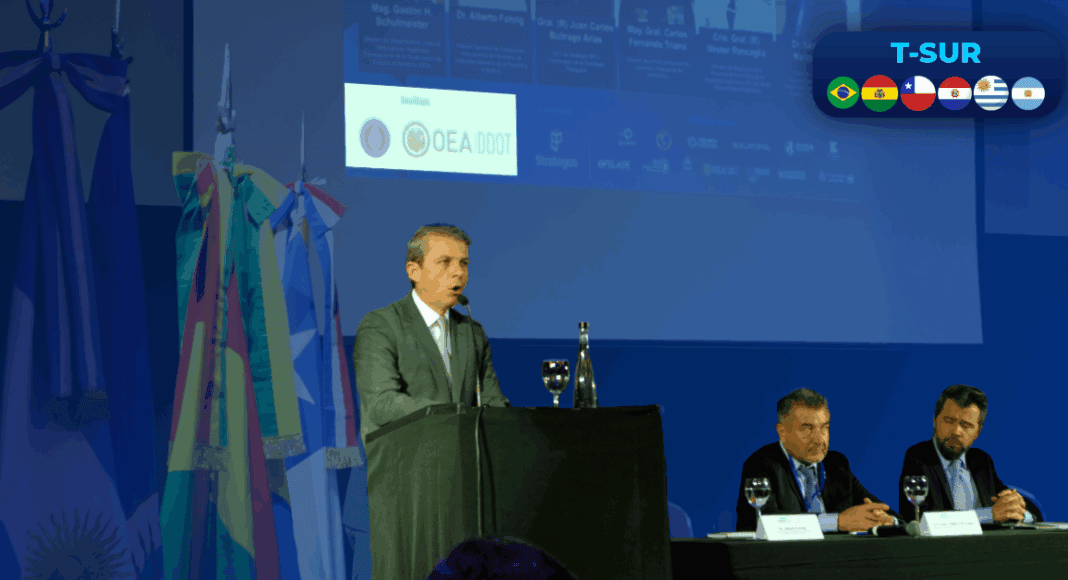

They call for strengthening trust, cooperation, and coordination to combat organized crime in the region. (*)
Argentina reaffirmed its regional leadership in the fight against organized crime by hosting the 5th Meeting of the Triangles-Southern Triangle Strategy, held in Buenos Aires, within the framework of his current presidency of the RANDOZ Mechanism - dependent on the Department against Transnational Organized Crime (TOC) of the OAS, headed by Master Gastón Schulmeister, with the support of the Ministry of Security, headed by Patricia Bullrich. The event brought together security authorities, customs officials, representatives of intergovernmental organizations, academia, and the private sector from Argentina, Bolivia, Brazil, Chile, and Paraguay, consolidating a crucial space for regional cooperation.
In that context, Juan Carlos Buitrago, a retired general from Colombia with over thirty years of experience in intelligence and security, was one of the most prominent voices at the meeting. A former National Police officer and founder of Strategos BIP, Buitrago is today a leading figure in Latin America in the analysis of transnational threats. In his remarks, he emphasized the urgency of strengthening trust, cooperation, and coordination between the public and private sectors to effectively confront organized crime and the illegal economy.
One of the cases discussed was that of the Triple Border, where Argentina, Brazil and Paraguay meetBounded by the Paraná and Iguazú Rivers, this area combines natural beauty with enormous security challenges. The Tancredo Neves Bridge, which connects Puerto Iguazú (Argentina) with Foz do Iguaçu (Brazil), is one of the main transit points in the region: according to official sources, more than 10 million people enter the country through it annually. Crimes such as smuggling, arms trafficking, drug trafficking, and human trafficking converge in this area, forming a transnational criminal network that demands a firm, coordinated, and sustained state response among the countries involved.
In that framework, Aduana News He spoke with General Buitrago to analyze the role of governance, institutional capacities, and operational cooperation, with special attention to the essential collaboration of the private sector in combating organized crime and the illegal economy, with a focus on the Triple Border.
🟦Governance and regional cooperation
Customs News: You spoke about a key issue: trust. I'm interested in addressing it from a structural perspective, linked to organized crime. I want to ask you about an emblematic case that you highlight here: the Triple Border, where security forces and customs converge. From the perspective of governance and regional cooperation, What capabilities and cooperation mechanisms do you consider priority for Argentina to lead an effective response? And from an operational perspective, what are the key elements for achieving effective coordination between the three countries?
General Buitrago: What was mentioned about the creation of binational and trinational counter-response cabinets, as proposed by the Brazilian delegate. These cabinets allow dialogue to go beyond the political or strategic, but to translate into operational results on the ground.
Second, the joint research groups are essential. They allow the exchange of information for operational and judicial purposes.
Furthermore, the integrated technology It's key. We must advance common mechanisms among the three countries. Many options have already been developed in Europe and the United States: from smart scanners to satellite information systems, which facilitate a real-time response by authorities.
Finally, I would like to highlight the proposal to create a Justice Training Center in the triple border, to strengthen the capacities of judicial operators to combat crimes linked to criminal economies.
🟦Surveillance and enforcement of the law
Aduana News: As for Regarding surveillance and law enforcement, what are the main obstacles to implementing integrated and effective control in this region, given the diversity of products circulating? And based on your experience, what specific practices could be shared to improve cooperation and intelligence?
General Buitrago: The main obstacle is corruption. Where there is smuggling, there is corruption.Mafias manage to co-opt authorities to facilitate the entry and sale of illegal goods.
Colombia has historically faced this challenge, and we know that the only way to combat it is with strong and transparent institutions. Often, there are insufficient resources, a lack of expertise, or even a lack of political will to prioritize this fight.
Furthermore, we must work to strengthen trust and credibility between countries, and between the public and private sectors. Without reciprocity and shared guarantees, regional cooperation cannot function.
🟦 Customs and border management
Aduana News Regarding customs management, what innovations and best practices would you recommend to curb multi-sector illicit trade along the Triple Border? What protocols should be prioritized by Argentina, which has taken a leading role in this meeting?
General Buitrago: First, I consider Urgent standardization of customs processes at the regional level, respecting the particularities of each country and, of course, its sovereignty.
I propose to create a Regional Standardization Center to identify common illicit trade chains. Customs in all three countries should work with a shared risk matrix capable of detecting penetration and contamination of legal chains by smuggling.
Secondly, we need exchange of customs information and intelligence in real time, not only for operational purposes, but also for conduct judicial investigations. Criminal structures take advantage of the normative differences between countries to exploit legal loopholes. We need systems of coordinated early warning, as Dr. Fábio Bechara rightly said, to act quickly and forcefully.
🟦Economic management and regulatory environment
Aduana NewsTo close on the topic of trust, and in relation to the regulatory environment and personnel risks in critical areas: How can the integrity and motivation of customs and police personnel be protected at the Triple Border?
General Buitrago: We must generate concrete economic incentives For staff working in high-risk areas: bonuses, bonuses, salary increases. Many customs officers or police officers are poorly paid and that is why they are more vulnerable to mafias, who manage multimillion-dollar sums.
In addition, it is essential to implement periodic reliability tests and asset controls. This allows for the detection of unjustified increases in assets or signs of illicit enrichment. They are essential tools for preventing corruption and severing ties with organized crime.
🟦Closing question
Customs News: To conclude, in this regional meetingl, where security authorities, prosecutors and representatives of the private sector come together, what would be a first concrete action and multi-sectoral to improve the response to illicit trade?
General Buitrago: I would say there are two priority lines:
1.Continuous training of the authorities to exchange good practices and standardize procedures.
2.Have a intelligence and data analysis platform, with qualified human resources, allowing for real-time decision-making and improving the effectiveness of the state response.
We thank General (R) Juan Carlos Buitrago for sharing his expert analysis and strategic vision at this pivotal meeting for the region.
*Report prepared by María Elsa Coronel.

Aduana News foi o primeiro jornal aduaneiro da Argentina a lançar sua versão digital. Com mais de 20 anos de trajetória, suas publicações e iniciativas têm como objetivo oferecer o conhecimento mais relevante sobre temas aduaneiros, contribuindo para a promoção do comércio seguro e da facilitação do comércio na região.