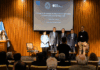
El Navigation Center hosted the successful culmination of the meetings entitled “Cycles on Customs Jurisprudence”, which took place on Tuesday (10.09.2024). The initiative brought together leading academics, lawyers from the public and private sectors, and representatives of various institutions to reflect on customs law.
The event was attended by members of the Argentine Association of Constitutional Justice (AAJC), the National Tax Court, the General Directorate of Customs, and representatives of private law firms.
During the closing ceremony, Alfonso Mingo Jozami, representative of the Navigation Center, an institution with 124 years of experience in foreign trade, emphasized: “Trade must flow, and therefore our role as an entity and as legal professionals is essential to ensure a country with legal security. This translates into more trade, greater economic activity, more employment and more production.” In this regard, Jozami stressed that dialogue between the public and private sectors is essential to strengthen legal security, a crucial pillar for economic development.
Matthew Mc Cormack, holder of Argentine Institute of Customs Studies, agreed on the importance of dialogue between sectors, stating: “It is vital to consider all perspectives, since a single vision limits solutions.” McCormack expressed the openness of the Institute under his charge for the participation of all interested parties and recalled that they meet on the first Monday of each month to discuss current customs issues. In addition, he welcomed the restoration of the Customs Advisory Council by the General Directorate of Customs, which recovers a valuable space for dialogue.

Mariano Luna, Representative of FALLS, addressed the crucial role of academia in collaboration between the public and private sectors. He stressed that, following the model of the Sábato Triangle, academia can facilitate a more open and honest dialogue. He announced that CAECE is carrying out a specialization in customs law, with the aim of training professionals who will promote the development of the sector.
Pablo Borgna, General Directorate of Customs, stressed the need to further the study of customs law, a discipline that is often complex. He emphasized that the evolution of customs law must be guided by the principles of constitutional justice, and highlighted the importance of the plurality of approaches to grant legitimacy to the system. He thanked doctors María Josefina Silva Risso, María del Pilar Amarante, Octavio Krause, and Erik M. Wagner for their valuable presentations, and acknowledged the teamwork of the judicial department, under the direction of Virginia Alapont.
Borgna also thanked the private institutions that organized the event—the Navigation Center, the Argentine Institute of Customs Studies, and the Argentine Association of Constitutional Law—and invited those who wish to join their initiatives. He extended his thanks to the National Tax Court for joining the proposal, reaffirming the importance of collaborative work.
The cycle, which was carried out in a hybrid format, consisted of 13 conferences spread over three days. These conferences were given by 20 leading representatives from various sectors and attracted a large audience, around 130 attendees in person.


The series of conferences thus addressed crucial and current issues in customs law, and is a testament to the collective effort to improve practices and policies in this area. Continued collaboration and openness to dialogue with stakeholders will remain essential to ensure a more transparent, fair and tailored customs environment to the needs of global trade.


Aduana News foi o primeiro jornal aduaneiro da Argentina a lançar sua versão digital. Com mais de 20 anos de trajetória, suas publicações e iniciativas têm como objetivo oferecer o conhecimento mais relevante sobre temas aduaneiros, contribuindo para a promoção do comércio seguro e da facilitação do comércio na região.