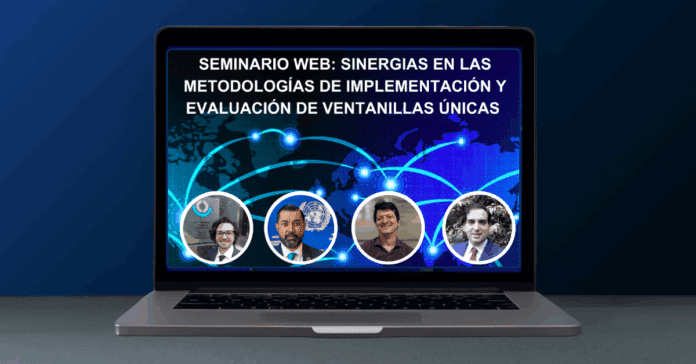
The Trade and Compliance Institute (TCI) continues its mission to promote the facilitation of international trade in Latin America and the Caribbean (LAC) with a technical panel focused on the integration of methodologies for the implementation and evaluation of Single Windows (SWs). Last Thursday, November 13, the event brought together experts from key international organizations and a practical case study of success in the region, highlighting the complementarity between strategic justification and performance measurement.
The Importance of a Holistic Life Cycle for the VU
Implementing a Single Window system is a complex project that requires not only technology, but also a solid strategic foundation and a mechanism for continuous evaluation. The technical panel sought to explore the synergies between two crucial methodological approaches that, while distinct, are intrinsically complementary for the complete lifecycle of a Single Window initiative.
The seminar highlighted that the success of a VU depends on the application of a Business Case robust, justifying the investment and ensuring political commitment, and of a Evaluation Methodology that ensures the platform meets international standards and trade facilitation objectives.
International Perspectives in Focus
The event featured the participation of high-level representatives from the World Customs Organization (WCO) and UN/CEFACT, who presented their reference methodologies:
| 🔹Organisation | 🔹Methodology | 🔹Main focus | 🔹Representative |
| OMA | Writing a Business Case for Single Window (BBCSW) | Strategic Justification and Basis for Implementation. | Juan Diego Chavarría Valverde |
| UN/CEFACT | Single Window Assessment Methodology (SWAM) and Case Study Repository | Maturity Assessment and Continuous Performance. | Joaquín González G. |
The WCO's Strategic Vision: The Business Case (BBCSW)
Within the framework of the digital transformation that international trade is experiencing, Juan Diego Chavarría The WCO highlighted the critical importance of properly managing the flow of information, making a powerful analogy:
“Data is limitless and is continuously produced, but it only becomes valuable when it is refined, analyzed, and organized. The OMA data model helps refine data to turn it into actionable information.”
Chavarría Valverde emphasized the importance of BBCSW as the strategic foundation for trade transformation. The BBCSW provides a structured framework to justify investment in a Single Window for Foreign Trade (VUCE), addressing economic, financial, operational, and risk management aspects.
"The idea today is to present to you how to build the business case... and discuss how the one-stop shop goes beyond a system or a technological tool, since we see the WTO as a one-stop shop environment."
Chavarría emphasized that the Business Case is not just about numbers, but integrates the strategic vision and financial responsibility, defining the scope, costs, benefits, risks and timeline of the project.
"The BBCSW addresses the 'why' and 'how' of implementing a Single Window for Foreign Trade (VUCE), laying the foundations for its long-term success, ensuring political commitment and resource allocation."
A key point in the WCO presentation was the need for a political mandate formal, resulting from the Strategic Business Case, that authorizes the VU, designates the leading organization and grants it the power to approve projects, change processes and rules, and define standards.
UN/CEFACT's Assessment and Continuous Learning: SWAM and Repository
For its part, Joaquín González G., Coordinator of the UN/CEFACT Single Window Domain, presented the SWAM and the Case Study Repository. SWAM, whose Whitepaper Published in August 2023, it offers a tool to assess the maturity level and performance of a Virtual Unit, identifying gaps and areas for improvement in the institutional, legal, technological and performance frameworks.
"The need for a standardized methodology like SWAM is crucial for continuous learning, helping to develop roadmaps for the future development of VUs."
The SWAM methodology, presented by Joaquín González during the seminar, offers a structured evaluation framework. According to its official documentation, it is structured around three main approaches: the Expert Analysis (based on the five key elements of Recommendation 33), the Key Factor-Based Assessment and Goal-Based Evaluation for Government and Trade.
The UN/CEFACT Case Study Repository complements the evaluation, providing practical examples and lessons learned from implementations in various countries, such as the case of Uruguay.
Joaquín González (UN/CEFACT) reinforced the importance of international recommendations and the SWAM methodology, developed to evaluate and strengthen one-stop shops:
“We have developed the SWAM methodology with most of the experts in the field. It is a tool intended to be used by government institutions, international institutions that finance trade facilitation projects, and the country itself.”
“We often develop public policies or implement processes within the government without involving the private sector. It is crucial that the private sector evaluates with hard data and demonstrates that there are areas of opportunity.”«.
The Practical Success Story: VUCE Uruguay
The most tangible experience of the seminar was provided by Juan Juncal, Technology Manager of the Single Window for Foreign Trade (VUCE) of Uruguay, who presented a case study demonstrating how the methodological principles of the WCO and UN/CEFACT can be successfully implemented in operational practice.
Uruguay's Single Window for Foreign Trade (VUCE), formally established in 2013, has successfully integrated over 83% of the identified processes and 91% of the agencies. Juncal explained that the implementation process began in 2011 with an initial investment of U.S. $ 2.5 millones, financed by the Inter-American Development Bank (IDB).
Juan Juncal shared Uruguay's practical experience, highlighting impact measurement and ongoing qualitative projects:
Juan Juncal shared Uruguay's practical experience, highlighting impact measurement and ongoing qualitative projects:
“Initially we had a very significant impact, but over time we stagnated. That's why we're taking a more qualitative approach to generate a significant leap in what we're offering our clients.”
“In some procedures, we've reached an automatic approval rate of 68%. This has allowed us to go from a process that took two days and required human intervention to one that takes only five seconds.”«.
The Uruguayan Single Window for Foreign Trade (VUCE) thus presents itself as a regional example of how single windows can evolve from basic transactional platforms to intelligent environments that generate measurable value for both the public sector and foreign trade operators.
(I.e.Quantified Benefits
The success of the VUCE translates into quantifiable benefits, according to the UN/CEFACT Case Study Repository:
| 🔹Sector | 🔹Cost savings (US$) | 🔹Savings in Man-Hours | 🔹Environmental Savings (Paper) |
| Private sector | 83 Millions | 5.3 Millions | 74 Million sheets |
| Public sector | 32 Millions | 1.7 Millions |
Furthermore, the VUCE has become a model of financial self-sufficiency, covering 100% of its annual budget of US$ 1.8 million starting in 2021, by charging a fee of US$ 5.68 per certificate issued.
Debate and Challenges for the Region
The debate moderated by Alejandro Rinaldi It deepened the interaction between methodologies and practical experience, focusing on issues critical to trade facilitation:
- Data Harmonization: The critical importance of data harmonization for the success and sustainability of virtual units, and how the WCO and UN/CEFACT methodologies address this aspect. The WCO, through its Data Model, plays a crucial role in "refining" raw data, standardizing and harmonizing it to turn it into actionable information.
- Methodological Integration: How BBCSW (Justification) and SWAM (Evaluation) can be more effectively integrated to create a holistic life cycle.
- Regional Challenges: The main challenges faced by developing countries when applying these methodologies and the strategies to overcome them, considering the experience of Uruguay.
- Regional Interoperability: How national Single Windows can support the development of Regional Single Windows and the harmonization of cross-border processes
Conclusion
The event also featured a "Bonus Track" with the participation of Milagros Desa-Delgado, from the World Bank, who commented on the report's prospects B-READY 2024, highlighting the relevance of assessing trade readiness in the global context.
The panel offered a valuable opportunity for participants to understand the importance of a integral approach in the management of Single Windows, from the initial justification to the continuous evaluation of performance. The combination of the WCO's strategic visions, the UN/CEFACT evaluation tools, and Uruguay's practical experience reinforces the need for Latin America and the Caribbean to adopt international standards to boost efficiency and trade facilitation.
Milagros Desa closed the presentations with a vision for the B-Ready project, which will include the evaluation of international trade in more than 160 economies:
“The B-Ready report is one of the World Bank’s flagship reports. Its aim is to assess the business environment in various economies at different stages of a company’s life cycle, and one of those topics is international trade.”
“We are evaluating 160 economies in three stages: 2024, 2025 and 2026. In 2024, 50 economies were evaluated, in 2025 there will be 60, and the rest in 2026. From 2027 onwards, we will do the complete evaluation.”
Eduardo Leite (TCI) closed the event, reinforcing the commitment to the continuation of the dialogue and the practical application of the shared knowledge:
“It is a great pleasure for me to be with you. I would very much like to have you all at our next webinar with the World Bank to continue discussing this very important matter.”
Upcoming webinar: "Boosting foreign trade in LAC: Perspectives from the B-READY 2024 Report"
The TCI invites the entire community to delve deeper into this crucial topic at its upcoming webinar, which represents the natural continuation of the methodological synergies analyzed at this event, where the World Bank team will present the findings of the B-READY 2024 report for Latin America and the Caribbean, offering a comprehensive vision that connects customs modernization with the improvement of the business environment in the region.
- Date: November 20 2025
- Language: Spanish
- Time:
-
-
09:00 h Mexico City and Central America (UTC-6)
-
10:00 h Colombia, Ecuador, Panama, Peru and the Caribbean (UTC-5)
-
11:00 h Bolivia, Venezuela and the Caribbean (UTC-4)
-
12:00 h Argentina, Brazil, Chile, Paraguay and Uruguay (UTC-3)
-
16:00 Central European Time (CET, UTC+1)
-
- TypeOnline
- Speakers:
◾Mary Isabel Delgado-Caceres (World Bank)
◾Melanie Martinz (World Bank)
◾Milagros Deza-Delgado (World Bank)
- Moderator:
◾Edna Ramirez-Robles (Trade and Compliance Institute)
- Open enrollment:
https://docs.google.com/forms/d/e/1FAIpQLSdf13o87XVlNTC6ogdnzsUaZ6CbVuFnXfz2ewDs7Fd1InV8gw/viewform
Highlighted
World Customs Organization (WCO). Writing a Business Case for Single Window.
United Nations Center for Trade Facilitation and Electronic Business (UN/CEFACT). White Paper on Single Window Assessment Methodology.
United Nations Center for Trade Facilitation and Electronic Business (UN/CEFACT). Single Window Case Study Repository – URUGUAY.
World Customs Organization (WCO). Case Study: URUGUAY VUCE – Performance Measurement.
World Bank Group (WBG). B-Ready.
Published notea By Customs News. Original content from the Trade and Compliance Institute (TCI)

Aduana News foi o primeiro jornal aduaneiro da Argentina a lançar sua versão digital. Com mais de 20 anos de trajetória, suas publicações e iniciativas têm como objetivo oferecer o conhecimento mais relevante sobre temas aduaneiros, contribuindo para a promoção do comércio seguro e da facilitação do comércio na região.