
News about the new regulations approved by MERCOSUR under Decision of the Common Market Council (CMC) No. 05/23 and No. 06/23.
For those of us who work in the field of international trade, it is a little easier to understand the scope of the new provisions and regulations that are approved and that directly affect both commercial and customs operations. For the rest of the population, it is a little more difficult to understand without a brief explanation of what the ROM is about and what benefits can be obtained from its application.
From my position as a negotiator for Argentina in this trade discipline of rules of origin, what I have observed over the years is that, although there are different stages in every negotiation and the technical issues in this particular case weigh much more than the purely political issues, in the end the conjunction of both is always necessary.
On this occasion, what was achieved was the completion of the updating and modernization work of the ROM at a technical level, plus the political will to translate this consensus into a new standard that replaces all previous ones in this area. Incidentally, from 2009 to the present, fourteen years have passed during which modifications were approved year after year, but the compatibility of all these regulations with all previous versions, plus this latest general review and update, remained.
With this instrument, the ROM, and by complying with its provisions, if a good is considered to be of MERCOSUR origin, it gains access to the commercial advantages of belonging to the bloc, that is, the payment of a 0% tariff.
The ROM is currently established in CMC Decision No. 01/09, which is the predecessor rule, together with its subsequent amendments, of the new ROM finally approved in the framework of the MERCOSUR Summit of Presidents on July 4. Although, in reality, there are two rules approved that day, since both CMC Decision No. 05/23 and CMC Decision No. 06/23 have implications for this reform and both must enter into force simultaneously for their effective application.
The update of the new ROM aims to move in the direction of the new state-of-the-art trade agreements, which have as their main objective the integration of global value chains, the facilitation of customs operations and the establishment of agile and simple procedures for commercial operators. In this line, this update brings to the bloc the novelty of these mechanisms and devices so that MERCOSUR can have these advantages and thus achieve improvements in market access conditions in intra-bloc trade.
In the normal course of the MERCOSUR negotiation processes for the latest preferential agreements with third countries, the majority of them result in the incorporation of these new concepts and standards.
The new ROM consists of seven chapters containing a total of fifty-six articles, plus ten appendices that form part of it. The first three chapters cover provisions relating to the criteria for the qualification of origin and the requirements for conferring origin. Chapters four and five refer to the certification modalities, the documentation required in the processes of certification of origin, as well as the procedures for verification and control of compliance with origin by the competent authority and the customs authority.
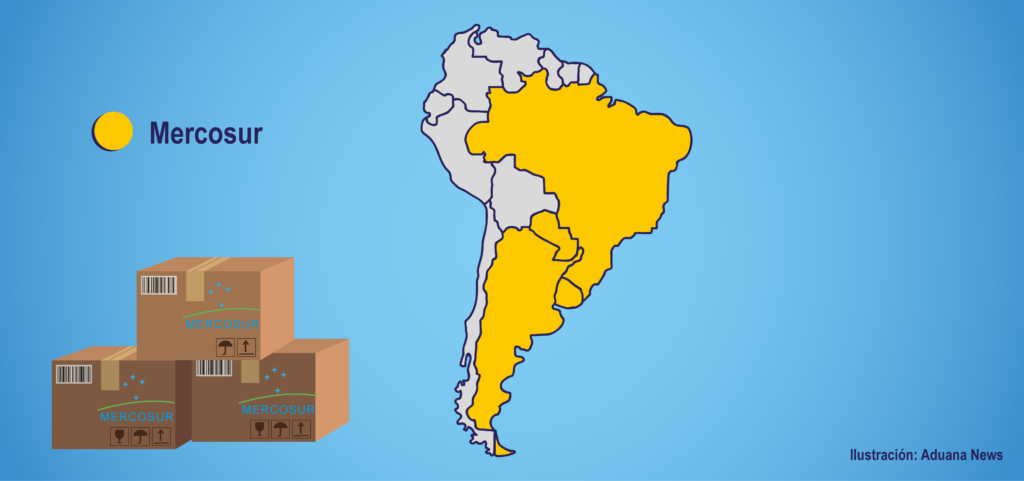
Amongst the Technical aspects that have undergone changes Compared to what is currently in force, the following stand out broadly:
- The inclusion of an indicative appendix for the correct reading of the ROM, its introductory notes and the unification of the origin requirements in a single list that covers the entire tariff universe and facilitates the identification of the requirement that, in terms of origin, a product must meet to be considered as originating in MERCOSUR.
- The modification, in those requirements that so require, of the maximum value of non-originating materials (VMNO) permitted in the production of a good by 5%, which represents 45% (today it is 40% for the entire bloc, without taking into account the differential treatments granted to countries with less relative development, as established in the corresponding Decision).
- The establishment of a more efficient and agile verification and control of origin procedure than the current one, which offers greater guarantees to operators and establishes clear provisions so that the implementing authority can develop the procedure and reach conclusions with greater regulatory basis.
As to First point, the difference with the current version is that definitions that did not exist before are incorporated to facilitate the interpretation of trade operators in operational matters, as well as the addition of introductory notes to the table of origin requirements, which tend to facilitate the reading of the specific requirements established, their correct interpretation and to avoid problems in the application of the ROM. The concept of "regional content value" (RCV) is replaced by "maximum value of non-originating materials." The differentiation between a general rule of origin applicable to all trade with an annex of exceptions with specific requirements dating back to other negotiation structures is eliminated, and it is replaced by a single annex containing the complete list of the Common Nomenclature of MERCOSUR (NCM) with its respective origin requirement to be met, all listed in the same place.
On second aspect, the international trend in trade was taken into account, as well as the agreements reached by MERCOSUR in recent years with the European Union, EFTA, Singapore, among others, and the need to improve the conditions within the bloc to equalize the percentages of value with said levels of international concessions. Of course, always taking into account the sensitivities and possibilities of the markets of the four Member States. We must not lose sight of the fact that in MERCOSUR everything agreed upon always results from a consensus and the effort in this sense is even greater, since the position and interests of four individuals must be aligned, prioritizing the benefit of the bloc as a single entity.
As to third topic, the objective has also been the complete revision of said chapter, which highlights the possibility of rectifying errors in the certificate of origin, prioritizing the material truth and favoring the situation of exporters in the origin verification processes in the event of an error in the declared origin qualification criteria. That is, the streamlining of the origin verification process, being able to request information directly from the Exporters/Producers of the merchandise and/or the Certifying Entities; the incorporation of the Declaration of Origin in a self-certification model in the future, beyond the fact that in Argentina it is not yet foreseen in the immediate future; the possibility of verifying, in addition to the origin of the good, the origin of the materials used in the production of said good; the suspension of deadlines in the investigation in response to requests for extensions in the procedure; the notification of the preliminary result of the origin verification in cases of denial of preferential treatment, so that the Exporter and/or the authority can make comments on the matter; the preservation of the origin of a product upon entry into a Free Trade Zone in accordance with Decree CMC No. 33/15; the return of the guarantees required by the customs authority within a period of one hundred and fifty days from the start of the verification of origin with respect to an import, even if it has not yet concluded; the extension of the validity period of the certificate of origin from the current one hundred and eighty days to a period of twelve months.
This, without prejudice to the fact that as a result of the in-depth reading of the full text of the ROM, various other questions arise, such as the mechanism for issuing derivative certificates, which will merit a separate chapter, and will also depend on which link in the chain performs the analysis of this normative text, and where one puts the focus of attention, clearly depending on the functions as a subject of international trade, whether from the operational or academic sphere, for the public or private, the productive specialization and also the interests and responsibilities of its function.
It is also important to remember, with regard to the universe of products applicable to the ROM, that an article was added that excludes automotive sector products from the scope of this new ROM. This simply reinforces the concept that MERCOSUR does not yet have a common automotive policy and that, therefore, trade in this sector is governed by the current bilateral Agreements (ACE 14 AR-BR, ACE 57 AR-UY and ACE 13 AR-PY).
Finally, with the prudence of not making this document too long and prioritizing on this occasion the explanation of minimum concepts of the ROM so that any reader can understand the magnitude and relevance of the topic (in general, its importance in international trade and in particular, in the development of the regional block), clearly many related aspects may require further development, which I allow myself to reserve for another opportunity.